

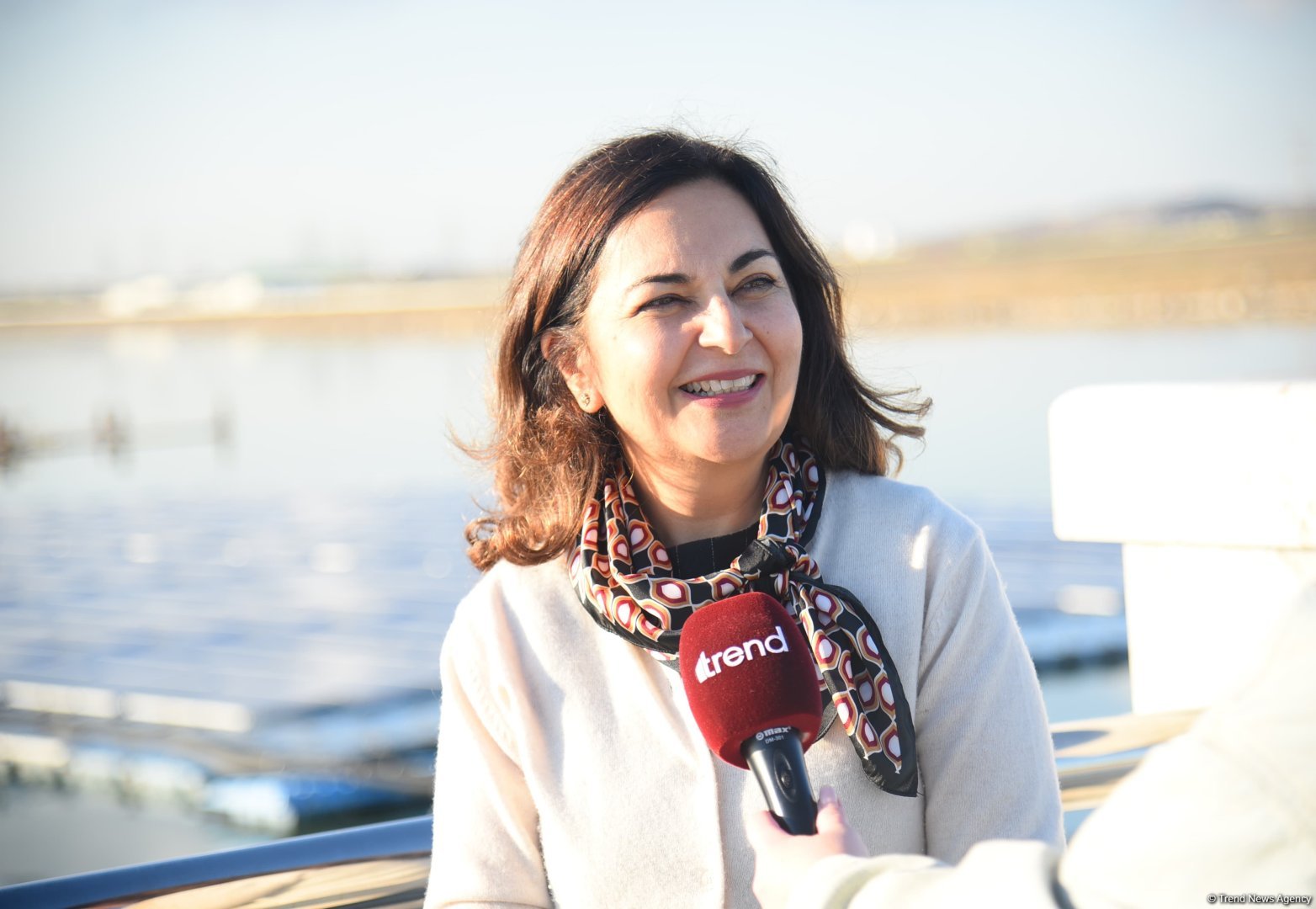



BAKU, Azerbaijan, November 4. The Government and people of Azerbaijan are to be commended for hosting COP29 this year, said ADB Country Director in Azerbaijan Sunniya Durrani-Jamal in an exclusive interview with Trend.
One of Azerbaijan's key initiatives is its commitment to add 1,870 MW of renewable energy to the grid for domestic consumption by 2027. ADB has already invested $1.7 billion in various successful energy projects in Azerbaijan, with plans to continue supporting the government’s shift from hydrocarbons to green energy through analytical studies, policy advice, and financing.
"Our strategy to support Azerbaijan’s green energy transition includes investment in solar and wind power, the development of green energy corridors, and the promotion of e-mobility, including electric vehicles and alternative fuels such as green hydrogen," Durrani-Jamal explained. Additionally, ADB is focused on assisting with the decarbonization of district heating systems.
A notable project is the co-financing of Masdar's 230MW Garadagh solar power plant near Alat, which is set to become the largest solar facility in the Caucasus. "The Garadagh Solar PV Plant is expected to provide electricity to 110,000 homes and reduce CO2 emissions by 200,000 tons per year," Durrani-Jamal noted. This project signifies a milestone in Azerbaijan’s renewable energy landscape, supported by long-term international financing from ADB, totaling $21.4 million.
Looking ahead, ADB is gearing up to seek board approval for two additional solar projects co-financed with the European Bank for Reconstruction and Development (EBRD) in November.
In July 2024, ADB, in collaboration with the Ministry of Energy and the Azerbaijan Renewable Energy Agency, inaugurated the innovative 100 kW Floating Solar Photovoltaic (FPV) Pilot Project on Boyukshor Lake, conveniently located near the Baku Olympic Stadium, the main venue for COP29. Durrani-Jamal expressed optimism about this initiative: "ADB is looking into alternative business models with private sector participation for managing the FPV facilities in the greater Baku area and other economic regions of Azerbaijan."
Additionally, ADB is keen to support wind energy investments in the country and plans to engage in discussions with both government officials and private sector investors regarding this potential.
On a regional level, Azerbaijan, Kazakhstan, and Uzbekistan signed a Memorandum of Understanding on May 2, 2024, for a Caspian Sea electricity transmission cable project. This initiative is part of the "green energy corridors" concept, designed to transmit renewable energy from the Caspian region via an undersea cable running across the Black Sea to Europe.
To further enhance the domestic utilization of green energy, ADB is offering its support to the Azerbaijani government in developing green e-mobility infrastructure through the procurement of electric buses. Durrani-Jamal emphasized, "We are also supporting the decarbonization of the district heating system," underscoring ADB's commitment to fostering a sustainable energy future in Azerbaijan.