


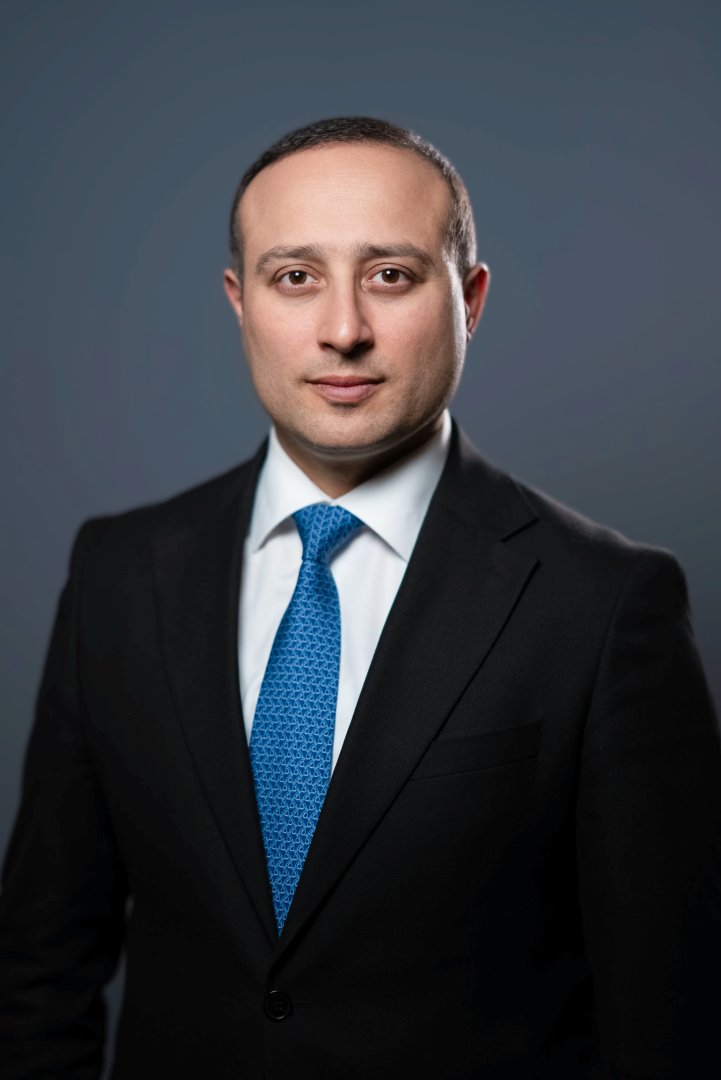

BAKU, Azerbaijan, March 5. The inclusion of new enterprises in the 'Support for the development of the digital economy' program, the establishment of Azerbaijan's first industrial cluster within the 'Transition to industrial clusters' initiative, and the expansion of this model are among the priority goals, the Executive Director of the Fourth Industrial Revolution Analysis and Coordination Center (C4IR), Fariz Jafarov, said in an interview with Trend.
He discussed the results achieved last year, the 'Support for the development of the digital economy' program, the development of human capital, C4IR's commitments in the implementation of the 'Strategy for the development of digital economy in Azerbaijan for 2026-2029', and outlined the future goals.
Jafarov pointed out that recent years have seen a significant turn in the tide towards a new chapter of the Fourth Industrial Revolution. According to him, the current global debate is no longer about whether technologies exist, but rather about how extensively they are implemented, how they are managed, and how they are converted into economic value.
"The application of artificial intelligence, big data analysis, data-driven decision-making, the new phase of automation, and green technologies have become essential tools of global economic competition.
In this global context, 2025 became an important transition year for Azerbaijan as well. During the year, the adoption of the 'Artificial intelligence strategy of Azerbaijan for 2025-2028' and the 'Strategy for the development of digital economy in Azerbaijan for 2026-2029' marked the country’s first effort to place its digital and technological transformation in a unified, measurable, and results-oriented framework.
For C4IR, 2025 accelerated the transition from conceptualization to implementation. Our main role is to build bridges between global trends and national priorities. Throughout the past year, we continued to formulate practical implementation mechanisms for the real sector and systematized the application of technology at the level of human capital and management," he said.
Jafarov emphasized that one of C4IR's key strategic results in 2025 was the start of the process of joining the Digital Economy Framework's 'Transition to industrial clusters' initiative.
"This initiative promotes the shift from an individual company approach to a cluster-based approach in industrial development. That is, state agencies, enterprises, suppliers, technology companies, startups, and universities work together within a coordinated industrial cluster framework. For instance, a unified digital platform, shared data exchange, joint IT and automation solutions, and coordinated staff training are implemented for all enterprises within an industrial park. As a result, the transition to Industry 4.0 in industrial parks and economic zones is accelerated, ensuring the systematic application of technologies and increasing digital productivity in the real sector.
As part of this initiative, the Sumgayit Industrial Park was designated as a pilot cluster, the NextGen industrial cluster concept was developed, and C4IR signed a memorandum of intent with the Ministry of Economy’s Economic Zones Development Agency (EZDA), SOCAR Carbamide, and SOCAR Polymer, marking the 40th cluster worldwide. These steps are crucial for the decarbonization of industrial clusters, the large-scale application of Industry 4.0 technologies through increased digital preparedness, and integration with international industrial standards. Azerbaijan will benefit from studying the cluster experiences of the world’s most advanced countries," he explained.
The executive director recalled that C4IR's activities are carried out in five main areas: the development and implementation of sectoral strategies, the stimulation of technology application, the development of human capital, international experience exchange, and awareness-raising and promotion.
"One key achievement in the development and implementation of sectoral strategies is the approval of the 'Strategy for the development of digital economy in Azerbaijan for 2026-2029' by the President of Azerbaijan Ilham Aliyev on December 10, 2025. This strategy covers three goals, nine priority areas, and 50 initiatives, focusing on systematic transformation in government, business, and society. This document strengthens the institutional framework for data-driven management and the digital transformation of the economy in government administration.
Another important area was the launch of the 'Support for the development of the digital economy' program. This program is based on the 'Twin transition' approach—technological and green transition—and focuses on the practical assessment and implementation of the technological readiness of industrial enterprises. In the pilot phase, three enterprises participated, and in the main phase, 15 enterprises are involved. The goal is to achieve 5-8% EBITDA (Earnings Before Interest, Taxes, Depreciation, and Amortization) growth and a 10-30% rise in efficiency by 2030.
At the same time, preparations have begun for the launch of the New Generation Technologies Center (Industry 4.0 Center), which will provide the 'earn and apply' model for the real sector.
The 'Azerbaijan Skills Accelerator' project was launched in April 2025. This initiative, in cooperation with the World Economic Forum, aims to systematically identify current and future skills requirements in the labor market and train specialized personnel to meet the real sector's needs. The co-chairs of the platform are the Minister of Economy Mikayil Jabbarov, the Minister of Science and Education Emin Amrullayev, SOCAR President Rovshan Najaf, and the CEO of PASHA Holding, Jalal Gasimov. C4IR coordinates the initiative, with nearly 100 local companies joining as members.
In essence, the Azerbaijan Skills Accelerator is a national platform based on a government-business-education partnership model that systematically measures skill gaps, launches fast-track training, and retraining mechanisms in priority areas. The goal is to accelerate the development of digital and technical skills, ensure social inclusivity, and strengthen the culture of lifelong learning.
Globally, under the World Economic Forum's initiative, about 50 national-level skills accelerators or similar platforms within the 'Reskilling Revolution' framework are operational in various countries. Azerbaijan is among the countries that have joined this initiative and developed its institutional model.
Another initiative for human capital development, the C4IR Academy (Fourth Industrial Revolution Academy), began in April 2025 and is actively continuing. The program aims to involve 70,000 citizens who will join over 18,000 courses on the 'Coursera' platform, focusing on improving knowledge in artificial intelligence, data analytics, business, and technological skills. Over 2,500 courses have been translated into Azerbaijani through artificial intelligence, increasing accessibility for a broader audience," he noted.
In his interview, Jafarov also discussed the 'Support for the development of the digital economy' program. He pointed out that the program focuses on practical results.
"In 2025, 15 local large, medium, and small industrial enterprises from the sectors of industry, construction, metallurgy, and retail joined the program. The technological readiness, digital potential, and sustainable development diagnostics have already been completed in these enterprises. Individual roadmaps for technological transformation have been prepared and presented in business plan format. The companies 'METAK', 'Azerfloat', and 'STP Global Cable', which joined the program in the pilot phase, have already started implementing their roadmaps. This means the program is not a paper-based assessment but a real transformation tool.
In 2026, new enterprises are planned to be included in the program. The participation is completely free of charge, and industrial enterprises can obtain detailed information about the program via the industry4.az website. Our goal is to ensure that as many local companies as possible join this transformation process systematically and benefit from the program," he said.
Jafarov also touched on the 'Azerbaijan Skills Accelerator' project, which was kicked off in partnership with the Ministry of Economy and the World Economic Forum. He pointed out that the growth of the digital economy, the rising tide of digitalization in local industries, and the use of cutting-edge technologies are essential for the sustainable and competitive advancement of the national economy.
"In this context, the World Economic Forum’s initiative to identify current and future labor market demands, eliminate existing skill gaps, and stimulate the involvement of the private sector in training and education led to the launch of the Skills Accelerator in Azerbaijan. This collaboration is crucial for strategically developing human capital in Azerbaijan and preparing for the future demands of the labor market.
The project will systematically identify existing and emerging skill gaps through detailed analyses, and targeted action plans will be developed to address these gaps. This approach ensures that the planned activities are not random but are shaped based on the needs of the real sector. The accelerator will enhance collaboration between the public and private sectors, promoting the development of flexible and practical skills that meet employers’ requirements. Digital skills, analytical thinking, technological literacy, and specific skills will be prioritized for preparing for future professions.
The project will enable a faster adaptation to the changing labor market through short-term specialization models, increasing employment opportunities for youth, and providing the existing workforce with opportunities to update their skills. Involving regions in the process will contribute to the more balanced and inclusive development of human capital. Ultimately, the 'Azerbaijan skills accelerator' will contribute to the creation of a modern, competitive, and sustainable skills ecosystem, laying a strong foundation for long-term economic development," he delineated.
In response to a question about the specific role of C4IR in the implementation of the 'Strategy for the development of the digital economy in Azerbaijan for 2026-2029', the executive director said that this document is the key framework for systematic and measurable acceleration of digital transformation in the national economy.
"The strategy identifies 50 initiatives in total, and from these, eight 'key initiatives' have been prioritized due to their high impact.
C4IR's role in the preparation and implementation of this strategy mainly involves ensuring coordination between the government, businesses, and international partners, creating pilot mechanisms for the real sector, and supporting the practical implementation of initiatives.
As a results-oriented document, the strategy outlines concrete indicators. The main targets include reaching 300 enterprises participating in digital transformation programs by 2029, creating 250 new startups, enabling 200 SMEs to access digital markets, and training 40,000 people in digital skills.
The strategy also outlines measurable economic outcomes, including a 5-8% EBITDA increase and a 10-30% rise in operational efficiency in enterprises that undergo digital transformation," he clarified.
At the conclusion, Jafarov revealed C4IR's key priorities, technological directions, and expected targets for 2026 and beyond.
"Since 2026, C4IR’s priorities will be directly linked to the implementation of the 'Strategy for the development of digital economy in Azerbaijan for 2026-2029' and will focus on the practical implementation of the key initiatives outlined in this strategy. These priorities will include the expansion of the application of Fourth Industrial Revolution technologies, such as artificial intelligence, data analytics, digital twins, and generative artificial intelligence, across various sectors of the national economy. There will also be a focus on the implementation of technological transformation programs for enterprises and the formation of data-driven decision-making mechanisms.
At the same time, the development of technological skills, the strengthening of the startup and innovation ecosystem, and the application of transformation models based on Key Performance Indicators (KPIs) for industrial clusters and economic sectors are also among the main objectives. This approach will reinforce C4IR's role as an executive platform that transfers international experience to the local economy, ensuring Azerbaijan's institutional and sustainable integration into the digital economy and the Fourth Industrial Revolution.
C4IR’s main priorities are to accelerate the country’s technological and industrial transformation, strengthen human capital, and turn technology into real economic value. In this period, artificial intelligence, Industry 4.0 technologies, data-driven management, and the development of the innovation ecosystem will be the main technological directions.
In particular, the inclusion of new enterprises in the 'Support for the development of the digital economy' program, the formation of Azerbaijan’s first industrial cluster within the 'Transition to industrial clusters' initiative, and the expansion of this model will be key targets. At the same time, continuing the 'C4IR Academy – National Program' for human capital development is of particular importance. Since the launch of the 'National Program' in April 2025, 60,000 people have joined over 250,000 courses on the 'Coursera' platform free of charge. They have successfully completed over 90,000 courses and obtained international certificates. Talks are underway with partners to extend the 'National Program' for another year, which will provide additional opportunities for tens of thousands of citizens to prepare for future professions," Jafarov concluded.
Stay up-to-date with more news on Trend News Agency's WhatsApp channel



