


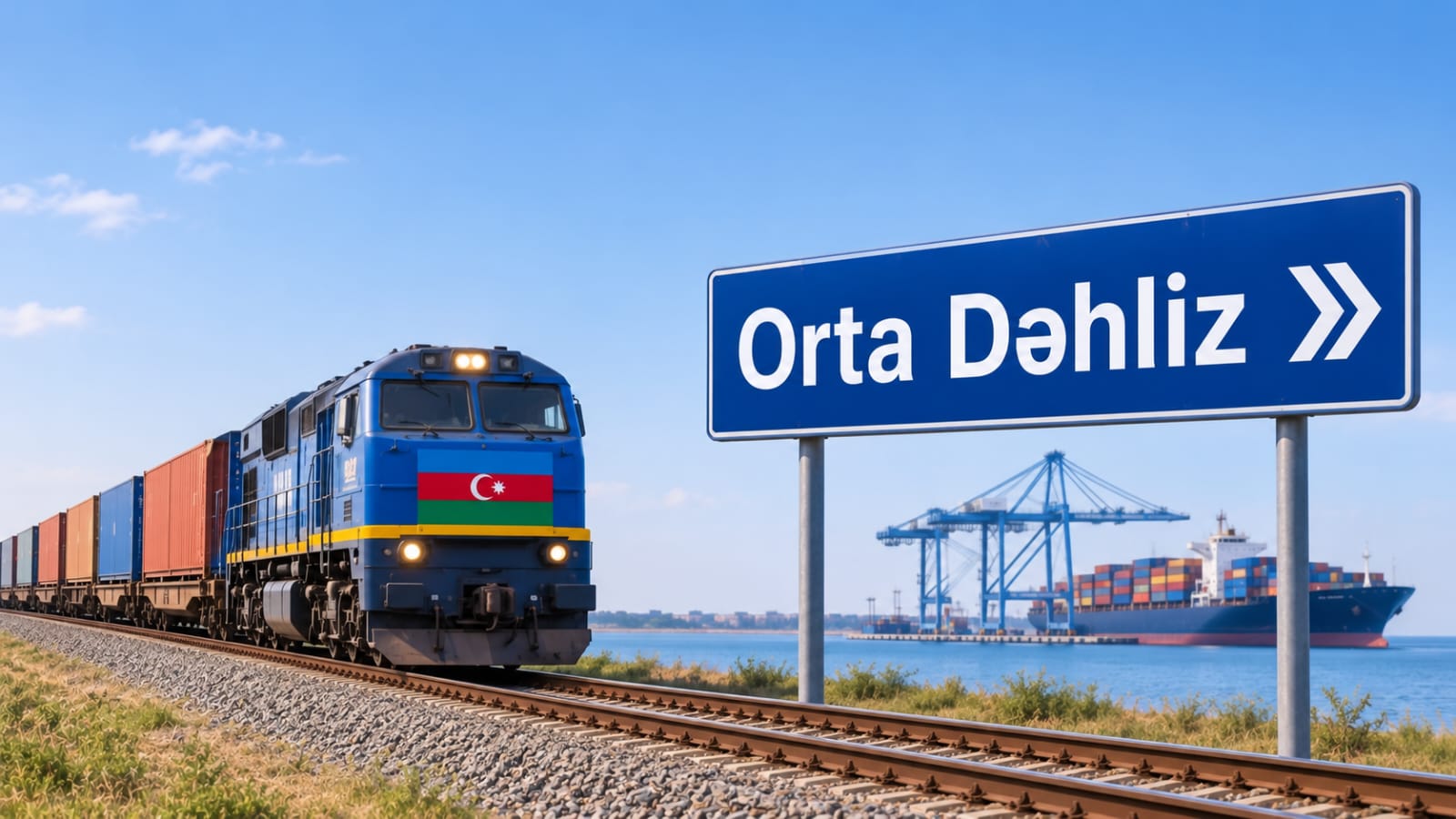

BAKU, Azerbaijan, November 17. Azerbaijan’s transportation and logistics strategy is entering a new phase. The increase in freight traffic along the Middle Corridor, the expansion of port and ferry infrastructure on the Caspian Sea, the development of the Zangezur Corridor, the commissioning of the Trans-Caspian fiber-optic cable, and preparations for the construction of the Rasht–Astara railway line — the main missing link in the North–South International Transport Corridor — are all integral parts of a unified process that is expanding the country’s role in regional connectivity.
The significance of these projects is not limited to an increase in the volume of goods transported. It is about creating a broader infrastructure system that facilitates the flow of goods, data, investments, and services between Asia and Europe. Within this system, Azerbaijan seeks to strengthen its position both as a transit country and as a regional hub providing port, rail, logistics, and digital communications services.
At the same time, the development of the Middle Corridor is of parallel importance to the completion of the Rasht–Astara line along the “North–South” axis. The complementarity of these two routes can expand Azerbaijan’s capacity to receive cargo flows from various directions and redirect them to regional and international markets.
Target of 30 million metric tons for Middle Corridor and Azerbaijan’s growing role as transit hub
The development of the Middle Corridor has become one of the main priorities on the regional economic agenda in recent years. Increased risks associated with traditional transport routes following the Russia-Ukraine war, conflicts in the Middle East, changes in international trade, and the need to diversify supply chains have heightened interest in the Trans-Caspian International Transport Route.
According to a statement by Mariam Kvrivishvili, Georgia’s Minister of Economy and Sustainable Development, Azerbaijan, Georgia, and Kazakhstan have approved a joint plan to increase freight traffic along the Middle Corridor to 30 million metric tons by 2029. This goal requires coordinated action by the three countries to increase the route’s capacity and improve operational efficiency.
Azerbaijan’s transit figures also indicate some progress in this direction. According to a statement by Rashad Hasanov, Deputy Minister of Digital Development and Transport, the volume of transit cargo through the country has roughly doubled over the past five years and is expected to approach 16 million metric tons by the end of 2026. In the medium term, the plan is to increase this figure to 30 million metric tons by 2030.
It is important to distinguish between two different figures here: the 30 million metric tons set by Azerbaijan, Georgia, and Kazakhstan for 2029 is a target for the total volume of cargo transportation along the Middle Corridor. The target of 30 million metric tons for 2030, announced by Azerbaijan, however, refers to the volume of transit shipments through the country’s territory.
On October 9, 2026, at a meeting of the CIS Council of Heads of State in a restricted format held in Turkmenbashi, President Ilham Aliyev emphasized that Azerbaijan is consistently strengthening its position as one of the region’s major transportation hubs and ensuring reliable transit along the “North–South” and “East–West” international corridors. “In the first half of 2026, transit cargo volumes through Azerbaijan increased by 10 percent to nearly 8 million tons. Our medium-term objective is to increase cargo volumes along each of the East-West and North-South corridors through Azerbaijan to 15 million tons,” the head of state said.
These figures indicate that Azerbaijan’s transit strategy is not limited to the Middle Corridor alone. The country seeks to expand its participation in a broader regional logistics network by attracting cargo flows in both the “East–West” and “North–South” directions.
Azerbaijan’s statistics on transport corridors for January–September 2026 also demonstrate the economic significance of these routes. During this period, 14.74 million metric tons of cargo were transported along the “East–West” corridor, including 7.5 million metric tons via the TRACECA route. Freight volumes via the “North–South” corridor totaled 6.87 million metric tons, via the “North–West” corridor - 3.89 million metric tons, and via the “South–West” corridor - 447,000 metric tons. Rail transport carried 12.08 million metric tons of cargo, maritime transport carried 5.37 million metric tons, and road transport carried 8.49 million metric tons. Transit cargo accounted for 47% of rail freight and 46.6% of road freight. These figures reflect, on the one hand, the significance of transit in Azerbaijan’s transportation system and, on the other, the importance of coordinating various modes of transport for the development of transport corridors.
New Transportation Links Across Caspian Sea: Port, Ferry, and Intermodal Logistics.
The effectiveness of the Middle Corridor depends not only on the condition of the railways and highways. The throughput capacity of ports on the Caspian Sea, the regularity of ferry services, the number of vessels, cargo handling times at ports, and coordination between rail and maritime transport are also key factors determining the route’s competitiveness. In this regard, the expansion of the Baku International Sea Trade Port and the deepening of cooperation with Kazakhstan in the field of maritime transport are of particular importance.
As part of the current expansion program for the Port of Baku, plans call for increasing its annual cargo handling capacity from 15 to 25 million metric tons. A multi-phase development plan is in place for container transportation. According to a statement by port advisor Khudayar Hasanli, container throughput is expected to reach 123,000 TEU by the end of 2026. The forecast for 2027 is 130,000–140,000 TEU. Current operational capacity allows for the handling of approximately 150,000 TEU. As a result of the work being carried out at the port, container handling capacity is expected to reach 260,000 TEU in the second half of 2027. At this stage, plans include dredging, the restoration and reconstruction of berths, the purchase of new equipment, the expansion of rail tracks and the container yard, as well as the creation of additional connecting tracks. At a later stage, plans call for increasing container throughput capacity to 500,000 TEU.
The documents signed between Azerbaijan and Kazakhstan on October 15, 2026, may provide additional impetus for the expansion of this infrastructure. With President Ilham Aliyev and President Kassym-Jomart Tokayev in attendance, AZCON Holding and Kazakhstan’s National Welfare Fund “Samruk-Kazyna” exchanged certificates confirming the acquisition of two dry cargo ships.
In addition, AZCON and Samruk-Kazyna have identified the main areas of strategic cooperation for the “Caspian Bridge” (“Super Ferry”) project, which involves organizing regular cargo shipments between the ports of Alat and Kuryk using high-capacity ferries. The main goal of the project is to improve the reliability of transportation across the Caspian Sea, reduce the time spent on port operations, create specialized terminals, and establish a unified transportation and logistics system.
At the same time, Azerbaijan Railways CJSC and Kazakhstan’s Temir Zholy JSC have signed a document outlining the basic terms for the creation of an intermodal freight terminal at the Baku International Sea Trade Port. The project is intended to strengthen the integration of port and rail operations, as well as create conditions for attracting container and other cargo flows. A joint venture is also planned to support the terminal’s operations. The investment model and financing terms will be finalized based on the project’s technical and economic indicators.
These initiatives complement one another: the new vessels and ferry system expand the possibilities for transit across the Caspian Sea, while the intermodal terminal facilitates the more efficient transfer of cargo arriving at the port to the rail network. Thus, the goal is not only to increase the port’s physical capacity but also to ensure faster and more predictable cargo movement on both shores of the Caspian Sea.
Digital Phase of Middle Corridor: Trans-Caspian Cable
A new phase in Azerbaijan’s transit strategy began on October 15, 2026, with the presidents of Azerbaijan and Kazakhstan participating in the official opening of the Trans-Caspian fiber-optic cable line. The project, implemented as part of the “Digital Silk Road” initiative, involves laying a fiber-optic cable approximately 380 kilometers long along the bottom of the Caspian Sea between Sumgayit and Aktau. The line has a capacity of over 400 terabits per second. With the launch of this project, the first direct undersea digital connection between Azerbaijan and Kazakhstan was established. Cable laying was completed in August 2026, and the opening ceremony took place in October.
President Kassym-Jomart Tokayev described the significance of
the project as follows:
“This is undoubtedly a very important project that will attract
international attention. But most importantly, it represents a new
type of corridor. It is truly not just a transport corridor, but an
innovation that meets the needs of the modern era, the era of
digitalization, and a completely new form of cooperation.”
President Ilham Aliyev, in turn, stated:
“Yes. It is also another step in strengthening cooperation between
Central Asia and Azerbaijan. Everyone is well aware that in
November last year, Azerbaijan was admitted as a full member of the
Consultative Meetings, and already this year, I recently
participated as a full member of the community. This is yet another
contribution to strengthening our cooperation, because this cable
will be utilized by both the countries of Central Asia and the
South Caucasus, as well as across a broader geography. So today we
have launched a global project.”
Tokayev briefly described the essence of the project as
follows:
“Yes, this is the Middle Corridor in digital format.”
This statement clearly demonstrates the project’s significance in terms of regional connectivity. While the Middle Corridor has thus far been viewed primarily as a transport route for containers, raw materials, and industrial goods, the new cable line expands its capabilities in the field of digital communications.
The new route will enable data to be transmitted from China and Central Asia through Kazakhstan, Azerbaijan, and Georgia, and then on to Europe via the Black Sea or Türkiye. This could diversify data exchange routes, enhance the resilience of digital communications, and strengthen the region’s role in the international digital infrastructure.
The economic significance of the project extends beyond telecommunications services. The high-speed connection creates additional opportunities for the development of data centers in the fields of artificial intelligence, cloud services, and computing infrastructure. This could strengthen the positions of Azerbaijan and Kazakhstan not only as markets for digital services but also as infrastructure providers serving international data flows.
The Zangezur Corridor: A New Link for the Middle Corridor
Another key priority of Azerbaijan’s regional transportation strategy is the development of the Zangezur Corridor. The completion of the Horadiz–Aghband highway, the continuation of construction on the railway line, and the modernization of the railway infrastructure in Nakhchivan are concrete steps in this direction.
The Horadiz–Jabrayil–Zangilan–Aghband highway is an integral part of the Hajigabul–Horadiz–Aghband highway and the Zangezur Corridor. The total length of the project is 149.9 kilometers, and the length of the main section of the highway is 123.6 kilometers. The road is built to technical category 1B standards and has four to six lanes. The project includes three tunnels, 28 bridges, eight interchanges, underpasses, and culverts. Although the completion of the highway is an important milestone, it is also crucial to complete the rail link and infrastructure toward Nakhchivan to fully realize the corridor’s transportation and logistics capabilities.
On November 6, 2026, the United States, Azerbaijan, and Armenia announced the creation of trilateral technical planning groups to accelerate the implementation of TRIPP. In the initial phase, two groups are planned—one for transportation and one for electricity transmission. The task of these groups is to resolve technical issues, move the project to the next stages of implementation, and integrate it into regional infrastructure networks.
According to estimates by the Ministry of Digital Development and Transport, the development of the Zangezur Corridor could create additional freight transport capacity of up to 15 million metric tons per year. The creation of a second western exit to Türkiye via Nakhchivan will not only diversify Azerbaijan’s international routes but may also expand the alternative connectivity options of the Middle Corridor. At the same time, it is important to note that TRIPP is currently in the technical planning phase. To realize the project’s full transportation potential, the implementation of agreed-upon technical mechanisms, the development of infrastructure, and the process of integration into regional networks must be completed.
Rasht–Astara Line: Missing Link in the “North–South” Corridor
Alongside the development of the Middle Corridor, the Rasht–Astara railway line is a key project capable of strengthening Azerbaijan’s position in the “North–South” International Transport Corridor. The goal of the North–South Corridor, established under an intergovernmental agreement signed on September 12, 2000, between Russia, Iran, and India, is to reduce transit times for cargo transported from India to Russia, Northern Europe, and Western Europe. The goal is to reduce transit times, which can take more than six weeks on existing routes, to approximately three weeks via this corridor.
The corridor’s significance for Azerbaijan stems from its direct connection to Iran’s railway network. On March 6, 2019, the 175-kilometer Qazvin–Rasht railway was put into operation. However, the fact that the Rasht–Astara section within Iran remains incomplete hinders the establishment of uninterrupted rail service along the western route of the “North–South” corridor.
The proposed 162-kilometer Rasht–Astara line is intended to bridge this gap. The project calls for the construction of nine stations. Under an agreement signed between Russia and Iran on May 17, 2023, Russia is set to participate in financing the project. In previous agreements, the project’s cost was estimated at 1.6 billion euro, and construction was scheduled to be completed within 48 months.
At the same time, Iran and Russia have finalized a budget of 1.36 billion euro for the construction of the Rasht–Astara railway line. The project will create conditions for expanding the transit and logistics capabilities of the Azerbaijani city of Astara and increasing freight volumes.
According to a statement made by Gilan Province Governor Hadi Haghshenas to Trend, of the 162 kilometers of land through which the line will run, property rights for approximately 120 kilometers have already been purchased from citizens, and the acquisition process is ongoing for the remaining 42 kilometers. He also reported that work to reinforce the railroad track had been carried out on a 60-kilometer section.
Subsequent statements regarding the project indicate that the preparatory process is moving forward. On November 4, 2026, the Iranian side announced that land parcels along the entire route, including the remaining 37-kilometer section of the line, had been transferred to the Russian side to ensure access for engineering and survey work. On November 8, it was reported that Iran’s Supreme National Security Council had approved the agreement on the construction of the Rasht–Astara railway. According to a statement by Russian Railways management on October 15, construction is expected to begin in 2027, with the line to be completed within three years. Thus, while the transfer of land plots and the approval of the agreement are important milestones for advancing the project, the start and completion of construction still lie ahead.
The commissioning of the Rasht–Astara line will connect Iran’s rail network, via Azerbaijan, to destinations in the Caucasus, Russia, and Northern Europe. For Azerbaijan, this means more than just an increase in transit cargo volumes. It could also expand the country’s opportunities to participate in logistics services, cargo transshipment, and rail and port operations along the “North–South” route.
The interconnection between the Middle Corridor and the “North–South” Corridor is of particular importance here. The former is aimed at facilitating freight transportation between China, Central Asia, and Europe, while the latter connects India and the Persian Gulf region, on the one hand, with Russia and Europe, on the other. The logistics capabilities of both routes, which intersect within Azerbaijan, can make the country’s transit system more flexible.
Expansion of Logistics Network
Azerbaijan’s transportation strategy is not limited to maritime and rail connections. The construction of an airport in the Alat Free Economic Zone also aims to expand the country’s multimodal logistics capabilities.
The main construction work on the airport, which began in April 2024, is expected to be completed by the end of 2026, and the facility is scheduled to begin operations in late March or early April 2027. In the initial phase, the annual cargo handling capacity is planned to be 500,000 metric tons. In the subsequent phase, the goal is to increase this figure to at least 2 million metric tons.
The airport’s location within the Alat Free Economic Zone, near the Port of Baku, could enhance its role in the logistics system. This creates additional opportunities for coordinating maritime, rail, road, and air transport within a single integrated space.
The construction of four container ships at the Baku Shipyard for AD Ports and Kazakhstan Railways also signals the expansion of the manufacturing component within Azerbaijan’s transportation infrastructure. This demonstrates the country’s potential not only in providing transit services but also in participating in the production of the technical equipment necessary for these services.
The project to build the Northern Railway Line in Istanbul (Türkiye) is also important in the context of broader regional rail connectivity between Europe and Asia. An agreement has been signed with the Islamic Development Bank to finance the project with 660 million euro, which includes the construction of approximately 127 kilometers of electrified track and modern signaling systems. The total cost of the project is estimated at approximately $8.1 billion, with international financial institutions providing 83% of the funding. Upon completion, the railway line’s annual freight capacity is expected to increase from 3 million metric tons to 50 million metric tons. Although this project is not located directly within Azerbaijan, it is part of a broader regional effort to develop railway infrastructure westward along the Central Corridor.
Message from international financial institutions: infrastructure alone is not enough
The stance of international financial institutions toward the development of the Middle Corridor is also crucial for the route’s prospects. Representatives of the International Monetary Fund (IMF) and the European Bank for Reconstruction and Development (EBRD) emphasize the importance of institutional and operational reforms, alongside physical infrastructure, for unlocking the corridor’s potential.
Roberto Cardarelli, Assistant Director in the Middle East and Central Asia Department (MCD) at the International Monetary Fund (IMF), said that over the past four to five years, the volume of cargo transported along the Middle Corridor has more than tripled. In his view, for the corridor to become a more significant route alongside the Northern and Southern routes, it is important to develop infrastructure such as roads, railways, and pipelines.
However, Cardarelli emphasized that physical infrastructure alone is not enough.
“To reduce trade costs, it is necessary to harmonize customs and border procedures, simplify the process of preparing the documentation required to transport goods from one country to another, and leverage the opportunities offered by digitalization and new technologies,” he noted.
This position highlights one of the main challenges facing the Middle Corridor. Delays at borders, customs, and ports when moving cargo from one country to another directly affect the overall delivery times and costs along the route. Increasing the capacity of a railway line or port does not automatically solve these problems. This requires harmonizing procedures between countries, accelerating data exchange, and establishing unified operational mechanisms.
The coordination efforts between the railways of Azerbaijan and Georgia serve as a practical example in this regard. At meetings held by a delegation led by Rovshan Rustamov, Chairman of Azerbaijan Railways CJSC, at the stations of Boyuk-Kasik, Gardabani, and Tbilisi, issues were discussed regarding the acceleration of border clearance procedures, the coordination of technical inspections, the elimination of duplicate operations, and real-time data exchange.
According to Azerbaijan Railways, the new operational approaches implemented on the Boyuk-Kasik–Tbilisi–Boyuk-Kasik route have cut the time it takes for freight trains to cross the border in half. This result demonstrates that to improve the efficiency of the logistics system, it is important not only to build new infrastructure but also to make more effective use of existing infrastructure.
Nataly Mouravidze, Head of the EBRD’s Baku Office, also highlighted three key priorities for the development of the Middle Corridor: eliminating major “bottlenecks” at ports, on railways, and at intermodal facilities; strengthening digitalization and coordination; and developing economic activity beyond the transportation sector.
According to her, business representatives evaluate not individual sections of the route, but its reliability, predictability, and costs along its entire length. Mouravidze emphasized that the success of the Middle Corridor should not be measured solely by the number of containers transported.
“Success should not be measured solely by the number of containers transported along the corridor or out of the region. The volume of investment attracted by the corridor, the number of jobs created, and business activity must also be taken into account,” she said.
This approach brings to the forefront the issue of transforming the Middle Corridor from a transit route into an economic corridor. The mere passage of cargo through the country’s territory does not, in and of itself, generate maximum economic benefit. To achieve this, it is necessary to develop warehousing and logistics services, cargo handling and packaging capabilities, industrial production, and export-oriented enterprises.
The “EU Business Climate Report Azerbaijan 2025/26,” funded by the European Union, also cites Azerbaijan’s geographic location, investments in transportation infrastructure, and the development of the Middle Corridor as factors that enhance the country’s significance as a regional transit hub. At the same time, the report identifies operational coordination, logistics costs, and existing “bottlenecks” in the corridor’s operations as major challenges for businesses. Consequently, the main task for Azerbaijan in the next phase is not only to increase the volume of transit cargo but also to derive greater economic benefits from these flows within the country.
Regional Partnership and International Interest
The development of the Middle Corridor is not limited to cooperation between Azerbaijan, Kazakhstan, and Georgia. Central Asian nations, Türkiye, the European Union, the US, and international financial institutions are also showing interest in the region’s transport and digital connectivity potential.
President of Kazakhstan Kassym-Jomart Tokayev noted the growing demand for the Trans-Caspian International Transport Route, adding that the modernization of infrastructure will expand the region's economic opportunities. According to World Bank estimates, if the planned infrastructure projects are implemented, the volume of cargo transported across the Caspian Sea could increase fourfold by 2040.
Tokayev has also proposed discussing the integration of the Middle Corridor with TRIPP at the expert level. This suggests that various routes, while serving as alternatives to one another, could in certain instances become complementary components of a unified regional logistics network. Chargé d'Affaires at the US Embassy in Azerbaijan, Amy Carlon, said at the CAMCA Regional Forum that the Trans-Caspian route has the potential to significantly transform trade relations across Eurasia. According to her, the US has supported the Trans-Caspian Enterprise Fund with $201 million. Carlon described the route not merely as an infrastructure project, but as a bridge between economies and people.
Azerbaijan’s Minister of Foreign Affairs, Jeyhun Bayramov, also emphasized, at an event held on the sidelines of the UN General Assembly, that transport and logistics connectivity can accelerate economic growth, strengthen the resilience of supply chains, and create investment opportunities. He noted that the TRIPP initiative, in addition to establishing unimpeded multimodal connectivity between Azerbaijan and Nakhchivan, also holds potential for regional energy ties and the diversification of energy sources.
The expansion of Azerbaijan’s economic relations with Central Asia is also a significant part of this process. According to a statement by Minister of Economy Mikayil Jabbarov at the CAMCA Regional Forum, a 2023 World Bank assessment indicates the potential for trade volume along the Middle Corridor to triple and transit times to be halved by 2030. He noted that Central Asia has become Azerbaijan’s fastest-growing trading partner region over the past five years.
According to Jabbarov, regional cooperation should not be limited solely to transport. Joint production, investment funds, and energy and digital connectivity between Azerbaijan and the countries of Central Asia could also become key pillars of economic integration.
Support for the development of the Middle Corridor is also explicitly addressed in the Joint Declaration on Strategic Partnership signed with the UK. The document notes that both sides recognize the importance of regional and international connectivity and will support transport, logistics, and infrastructure projects that facilitate cross-border trade and investment. This demonstrates that Azerbaijan’s Middle Corridor strategy has been incorporated into the economic agenda shared with its European partners. China’s Ambassador to Azerbaijan, Lu Mei, also said that there is significant potential for expanding cooperation between the two countries in the fields of transport, energy, trade, and investment. For China, the Middle Corridor serves as a gateway to European markets via Central Asia and the South Caucasus. Consequently, the development of transport and logistics cooperation between Beijing and Baku is crucial for the long-term prospects of this route.
Economic Test of Middle Corridor: From Transit to Value-Added
Director of the Middle East and Central Asia Department at the International Monetary Fund (IMF), Jihad Azour, noted that potential investments in the Middle Corridor offer countries in the region the prospect of deeper integration into the global economy. According to him, economic growth in many Central Asian and Caucasian nations has accelerated in recent years, driven by shifts in the direction of investment and trade flows. At the same time, Azour emphasized that for infrastructure investments to yield tangible economic results, it is essential to improve the institutional environment, enhance the role of the private sector, reform state-owned enterprises, and reduce the state’s footprint in the economy.
This stance highlights one of the key economic issues regarding the future development of the Middle Corridor: while transport links create new opportunities for the countries in the region, capitalizing on these opportunities requires a competitive business environment, high-quality human capital, and efficient public governance.
For Azerbaijan, this is particularly significant in terms of developing the non-oil sector and diversifying exports. Beyond transit revenues, the creation of new economic activities, such as logistics services, warehousing, processing, manufacturing, digital services, and high-tech sectors, can enhance the benefits the country derives from the corridor.
The fiber-optic cable, shipbuilding, and air cargo transport projects are not isolated initiatives. Together, they form a system of infrastructure and services essential for transforming transport flows into economic value.
New Regional Logistics Model for Azerbaijan
The projects that Azerbaijan has implemented or is planning indicate a shift in the country’s role within the regional transport system. While the primary focus in the earlier phase was on attracting transit cargo flows by leveraging the country’s geographical location and existing transport infrastructure, the current strategy encompasses a broader scope.
The 30-million-ton regional target for the Middle Corridor, the expansion of the Port of Baku, the establishment of the Alat–Kuryk ferry system, the intermodal terminal project, the Trans-Caspian fiber-optic cable, the development of the Zangezur Corridor, and preparations for the construction of the Rasht–Astara railway line all serve to enhance Azerbaijan’s connectivity along the East–West and North–South axes.
However, the economic impact of these projects will not be determined solely by their completion. Key indicators will include the speed and cost-efficiency of cargo transport, the extent to which border and customs procedures are simplified, the coordination of port and railway operations, the involvement of the private sector, and the value added within the country by transit flows.
As emphasized by representatives from the IMF and the EBRD, the success of the Middle Corridor depends not only on the expansion of physical infrastructure but also on digitalization, institutional reforms, and the deepening of regional cooperation.
Thus, the primary task facing Azerbaijan is to transform its geographical position into a broader economic advantage. To achieve this, the country must evolve beyond serving merely as a transit territory for cargo; it must develop into a regional hub that integrates international trade, logistics, digital communications, processing, and manufacturing. The parallel development of the Middle Corridor and the Rasht–Astara line, alongside digital and multimodal connectivity, provides a key opportunity to realize this objective.


