


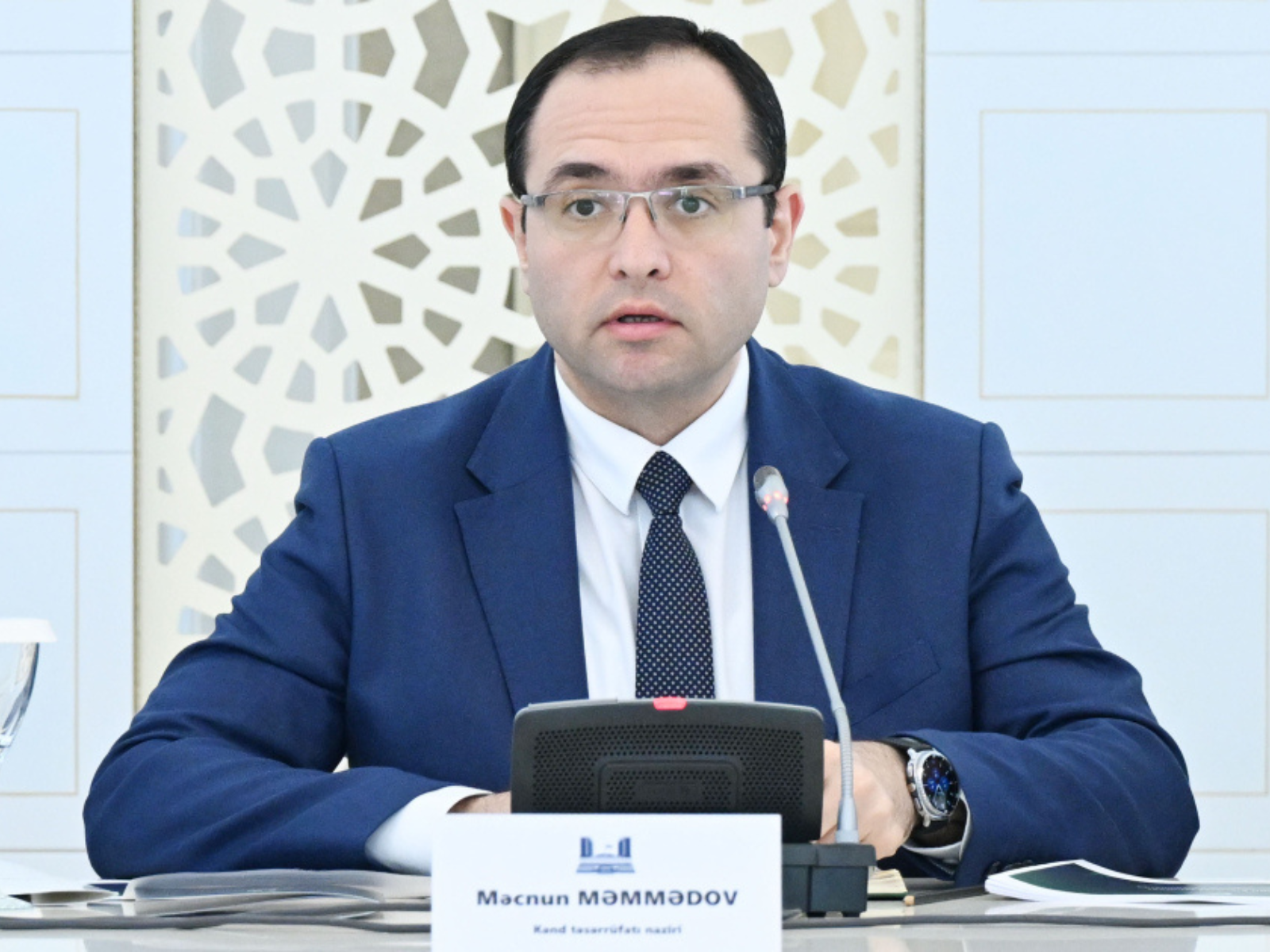

BAKU, Azerbaijan, June 11. Product subsidies are aimed at offsetting expendures in Azerbaijan, the Minister of Agriculture Majnun Mammadov said during a public hearing held at the Parliament's Agrarian Policy Committee about the tasks arising from the "State Program for the Development of Agricultural Production and Processing, Fisheries, and Aquaculture for 2026–2030", Trend's correspondent reports from the event.
“Unfortunately, some farmers do not fully implement agrotechnical maintenance measures, preferring to fertilize without conducting soil analysis, and modern irrigation technologies are not applied at the proper level. However, our main goal here is to achieve high productivity by using modern irrigation systems in specialized regions,” he noted.
According to him, today, about 50% of grain crops in Azerbaijan are located in rainfed areas and in the context of climate change, it’s impossible to achieve a significant increase in productivity solely through rainfed agriculture.
“Of course, the introduction of new varieties, the creation of drought-resistant varieties and the expansion of scientific research can yield certain results. However, the current amount of precipitation in the country is not enough to achieve high productivity in all areas. Therefore, water supply is a key condition. We can achieve high productivity only in areas where water is provided and modern irrigation technologies are applied.
Let me give a simple example. Last year, the average productivity of farms that joined the food wheat program and applied modern irrigation systems was 5.8 tons. This indicator is much higher than the average productivity in the country. If 22,000 hectares of land were covered under that program last year, this figure has already reached 29,000 hectares. We believe that this indicator will increase further in the coming years,” the minister explained.
According to Mammadov, reducing crop losses and post-harvest losses is also very important. One of the main reasons we encourage the creation of cold storage facilities, and especially grain silos, is precisely to improve crop storage conditions and minimize losses.
“Today, in various regions of the country, we observe that grain, wheat, barley and corn are still stored in warehouses by pouring, sometimes even without being packed in bags. Under such conditions, the product is subject to losses of 10, 20, and in some cases up to 30 % during storage from one season to another due to humidity, moisture and other factors. To solve this problem, it is important to create modern grain silos.
That is why the state program envisages increasing the number of cold storages and grain silos. This will also serve to expand logistics capabilities.
Logistics and sales issues were touched upon. It was noted that this direction wasn’t directly and widely reflected in the state program. However, in fact, the program indirectly serves the development of these areas. Cold storages and grain silos help solve logistics problems, and crop subsidies expand sales opportunities.
For example, some farmers are dissatisfied with the price difference between table fruit on the market and fruit delivered to the processing industry. However, it should be noted that industrial products can never be sold at the same price as table products. High-quality, sorted and table-grade fruit is sold at a higher price. Products that don’t pass the sorting stage must be sent for processing,” he clarified.
Mammadov pointed out that due to the relatively low price of industrial products, some farmers aren’t interested in harvesting and delivering them to processing plants.
“For this reason, the crop subsidies we apply for apples and pomegranates are aimed at compensating the farmer for both harvesting and transportation costs. Thus, the farmer also receives additional income after delivering the product to the processing enterprise.
Crop subsidies, on the one hand, create additional sales opportunities for farmers, and on the other hand, strengthen the raw material supply of processing enterprises.
According to our calculations regarding cold storage facilities, Azerbaijan needs approximately 900,000 tons - 1 million tons of cold storage capacity. Currently, approximately 400,000 tons of this have been created in previous years due to state support. According to the State Program, it is planned to create an additional 100,000 tons of storage capacity by 2030. It is expected that at a later stage, there will be a need to further increase investments in this direction.
The same situation applies to grain silos. Currently, the country needs approximately 2.5 million tons of grain storage capacity.
In general, world experience shows that countries are making serious investments in expanding storage infrastructure. For example, Türkiye has increased its grain storage capacity from 9 million tons to 12 million tons in the last five years and plans to increase this figure to 20 million tons by 2030,” he also said.
Speaking about the issue of export subsidies, the minister noted that a phased approach is envisaged in this direction.
“First of all, it’s planned to bring products into line with international certificates and promote certification. Unfortunately, currently our local products are mainly dependent on one or two markets. In order to reduce this dependence and enter new markets, products must meet international standards.
After completion of this stage, additional export promotion mechanisms can also be considered.
We believe that product subsidies will also play a certain stabilizing role in preventing price fluctuations. The introduction of milk subsidies this year will also serve to form price stability between farmers and processing enterprises.
However, fully administrative price regulation is not in line with the principles of a market economy. Currently, the closest mechanism to price regulation in Azerbaijan is applied in the cotton sector, and here the state uses certain incentive tools to support farmers.
In addition, various mechanisms existing in international practice to mitigate price fluctuations are currently being studied.
Proposals were also made regarding giving preference to local products in state procurement and the supply system. As the Ministry of Agriculture, we support this approach. We believe that this step will have a positive impact on the development of local production and the expansion of market opportunities for farmers.
Finally, the issue of the development of higher education institutions and personnel training was also touched upon. At the same time, it is planned to expand dual diploma programs. In this direction, cooperation is being expanded between the University of Oklahoma, Turkish universities and Azerbaijani higher education institutions. This will make a significant contribution to personnel training in the agricultural sector in accordance with international standards.
Serious work is being carried out by the Ministry of Science and Education across the country to expand vocational education institutions, which will also yield positive results. The Agrarian College under the Agrarian University operating under the Ministry of Agriculture has already started its activities, and we believe that this structure will play an important role in personnel training in the agricultural sector.
At the same time, there are programs implemented within the framework of cooperation between ADA University and the University of Bologna.
Educational programs in agricultural specialties have already been launched within the framework of the Azerbaijan-Italy University.
In general, the need for personnel in the agricultural sector is expected to increase. There is a serious need for specialists specializing in animal husbandry in particular. Unfortunately, some of the existing specialists belong to the older age group and the number of middle-aged personnel is relatively small.
Although there has been an increase in interest in agricultural education in recent years, continuous educational work should be carried out to increase the attractiveness of this field, correctly explain its potential and convey its prospects to society.
I believe that you also pay attention to this issue during meetings with the population in the regions. One of the questions that I often ask farmers and during citizen receptions is: "Are your children interested in agricultural education?"
If a farmer's child is not interested in agricultural education, this is a serious signal for me. In this regard, with your support, we should be more active in increasing interest in agricultural education in the regions, directing young people to this field, and strengthening awareness-raising activities,” the minister concluded.



