


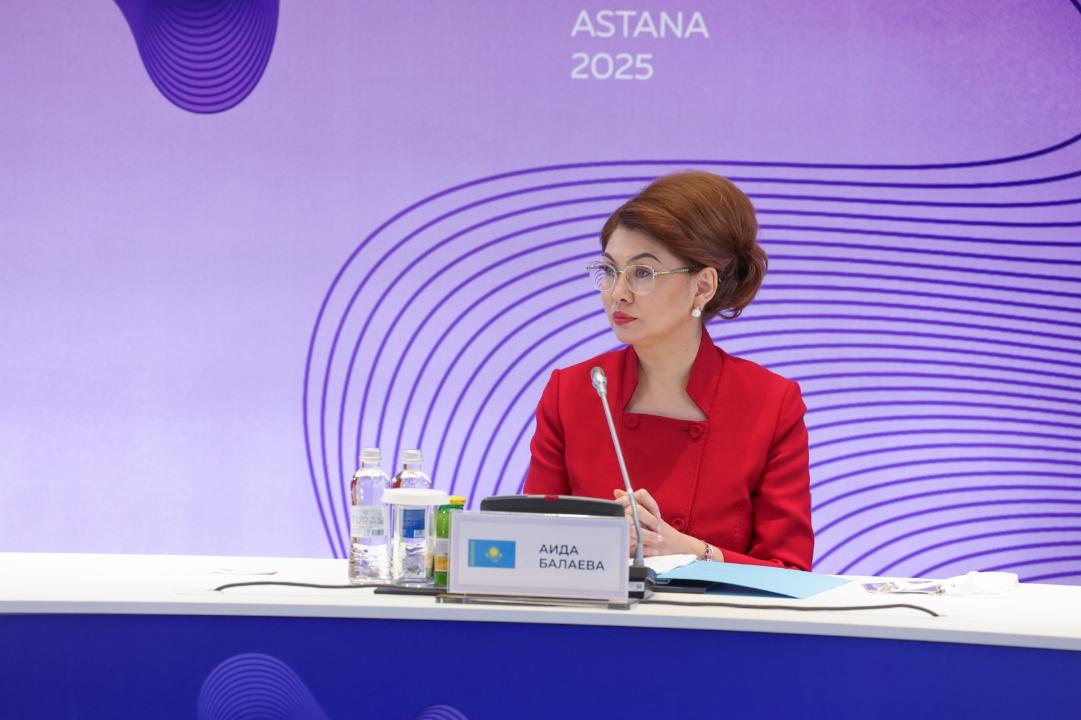

ASTANA, Kazakhstan, April 16. Kazakhstan’s Minister of Culture and Information, Aida Balayeva, outlined key priorities in the field of information security during her address at the Central Asian Media Forum in Astana, Trend reports.
“The Ministry of Culture and Information is continuously working to establish effective cooperation with the administrations of online platforms. Thanks to these efforts, representatives of services such as TikTok, Facebook, Instagram, VKontakte, Odnoklassniki, Mail.ru, and others are now officially recognized in Kazakhstan. It is important to emphasize that Kazakhstan has made significant progress in combating illegal content (cyberbullying, fraud, extremism, pornography), as well as disinformation. The most notable progress has been made in protecting minors in the digital space,” Balayeva stated during the forum.
The minister recalled that in 2018, Kazakhstan passed the law “On the Protection of Children from Information Harmful to Their Health and Development,” which laid out legal mechanisms for restricting access to harmful content. The law continues to evolve.
“This law became a crucial starting point for ensuring children’s information security in the digital space. Thanks to the measures adopted, definitions such as ‘information security of children,’ ‘protection of children from harmful content,’ and ‘children’s access to information’ have emerged. A list of prohibited content for children has been established, and age restrictions for media products have been introduced,” she noted.
Balayeva also touched upon the issue of fake news and disinformation, stating that it is a challenge faced by all countries in the region.
“Given recent trends in mass media development, one of the common issues across Central Asian countries is the spread of false information, disinformation, and provocative messages on social media and messaging platforms,” Balayeva added.
The 2nd Central Asian Media Forum has officially opened in Kazakhstan’s capital.
Politicians, journalists, media executives, international organization representatives, and prominent experts from a variety of countries, including Kazakhstan, Uzbekistan, Tajikistan, Turkmenistan, the United Kingdom, China, Qatar, and Russia, are among the more than 700 participants at the event.
The goals of the event are to tackle global issues like climate change and geopolitical instability, to debate the effects of digital transformation on the information space in Central Asia, and to strengthen cooperation between media outlets in the region and their worldwide partners.
The forum will continue on April 17, with workshops scheduled for national and Central Asian media outlets, as well as university students. Among the speakers are prominent experts from the UK, the U.S., and Russia.



