


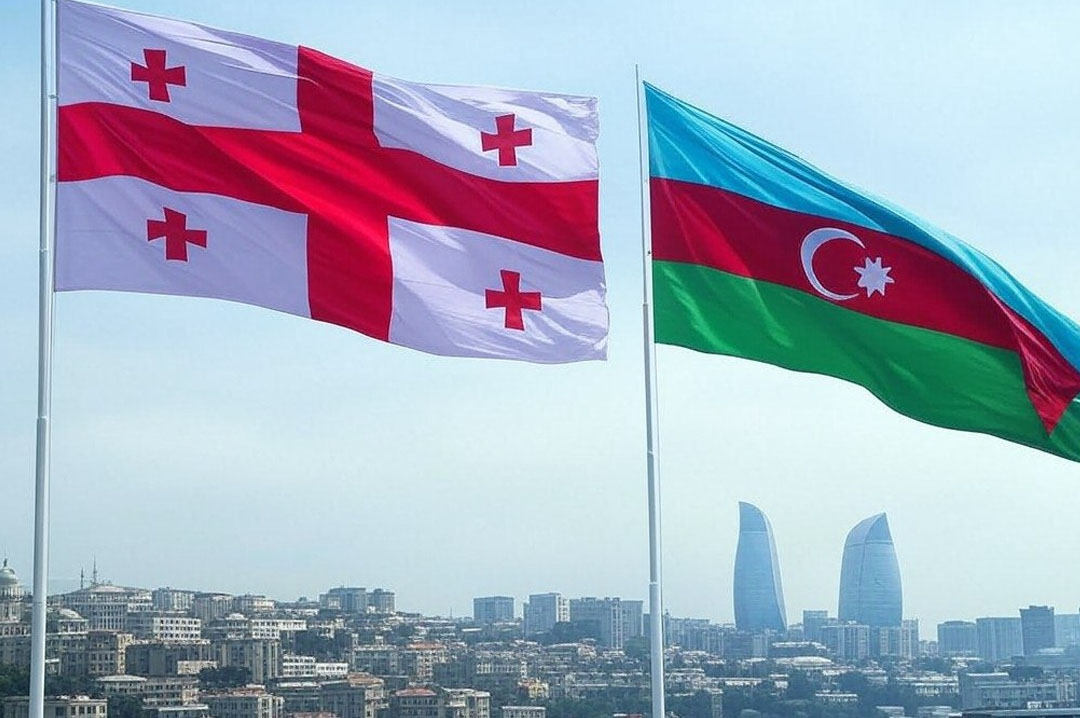

BAKU, Azerbaijan, April 3. At the beginning of 2026, the economic partnership between Azerbaijan and Georgia is demonstrating steady upward momentum, turning bilateral relations into a key driving force of regional integration in the South Caucasus.
In February 2026, Foreign Minister Jeyhun Bayramov hosted delegations of parliamentarians from Türkiye and Georgia, where issues of partnership and regional security were at the center of discussions. The meeting addressed allied relations with Ankara and strategic partnership with Tbilisi, as well as the overall security situation in the region. The sides emphasized the importance of interparliamentary cooperation - the 10th trilateral meeting of the foreign affairs committees of the parliaments of Azerbaijan, Türkiye, and Georgia gave additional impetus to this process. Such trilateral formats, including meetings of foreign and defense ministers, consistently help strengthen peace, stability, and prosperity in the South Caucasus.
This political foundation directly supports economic cooperation, which continues to show solid growth. In January 2026, trade turnover between Azerbaijan and Georgia reached $77.9 million, up 6.6% year-on-year. Exports from Azerbaijan increased by 7.3% to $69.3 million, while non-oil exports rose by 19.4% to $31.6 million, allowing Georgia to rank third among importers of Azerbaijani non-oil products with a share of 11.78%. By the end of 2025, bilateral trade reached $1.4 billion, marking a 3.8% increase. The positive trend continued into early 2026: in January–February, trade turnover grew by 18.9% to $176.6 million, according to Azerbaijani data. Azerbaijan remains Georgia’s fifth-largest trading partner, accounting for 5.3% of its trade.
Against this backdrop, Economy Ministers Mikayil Jabbarov and Mariam Kvrivishvili reaffirmed their commitment to further strengthening ties at the Georgia–Azerbaijan–Türkiye business forum in February 2026. Jabbarov highlighted the importance of deepening economic integration between our countries and further enhancing the efficiency of our partnership, particularly through the development of the Middle Corridor, digital infrastructure, and expanded export opportunities. This route is already actively functioning as a real alternative to traditional pathways, linking Asia with Europe through Azerbaijan and Georgia and creating additional opportunities for both countries.
The development of transport and energy infrastructure has become one of the main pillars of the partnership. In 2025, Azerbaijan invested $143.9 million in Georgia’s economy, accounting for 8.5% of total foreign direct investment. The total volume of Azerbaijani investments exceeded $3.1 billion, and the number of companies with Azerbaijani capital reached 1,660. Georgian investments in Azerbaijan grew 2.6 times to $91.3 million. In the energy sector, Azerbaijan supplied 2.3 billion cubic meters of natural gas to Georgia in 2025, valued at $250.3 million. Meanwhile, the Baku–Tbilisi–Ceyhan oil pipeline and the South Caucasus gas pipeline continue to operate reliably. Georgia plans to complete key road sections of the Middle Corridor as early as 2026, while the sides are actively discussing customs simplification and joint border checkpoints.
The presidents of both countries have repeatedly emphasized how deeply rooted Azerbaijan–Georgia ties are. An important political signal was the first official visit of Georgian President Mikheil Kavelashvili after his election - he chose Azerbaijan as his first destination. On April 16, 2025, the two presidents made press statements in Baku.
“The oil and gas projects, the oil and gas pipelines, and the transport and communication initiatives jointly implemented by Azerbaijan and Georgia are truly of great significance. These projects have not only reshaped the transportation and energy map of the South Caucasus but also that of the entire Eurasian region.
If we are talking about the energy security of Europe today, it is impossible to imagine it without Azerbaijan and Georgia. Currently, Azerbaijan exports natural gas to 12 countries, including Georgia, and these exports are carried out through Georgia. Our achievements in the field of transport and communications - the newly built railways and ports - have created great synergy in both Azerbaijan and Georgia. In fact, they have become an integral part of the Middle Corridor,” said President Ilham Aliyev.
President Mikheil Kavelashvili, in turn, added: “I am absolutely convinced that our high-level strategic and good-neighborly relations that have stood the test of time will be further strengthened and elevated to a new level through the pursuit of the national interests of Georgia and Azerbaijan. Close cooperation between our countries in all areas is of particular importance for the effective resolution of the tasks facing the region and the world at large.
We are implementing a number of common and mutually beneficial projects, and this makes our region even more attractive to the world. Ensuring lasting peace and stability is important for the South Caucasus region to become even more competitive, reliable and sustainable.”
Much of the momentum in bilateral ties is attributed to the long-standing policy of President Ilham Aliyev, who has prioritized relations with Georgia, backed infrastructure development, and promoted regional stability. Analysts say this approach has helped transform the partnership into a key driver of economic and political cooperation in the South Caucasus.
From increased trade and investment to major infrastructure initiatives, the Azerbaijan–Georgia partnership is already delivering measurable results. Both countries view the relationship as mutually beneficial, strengthening bilateral ties while contributing to broader regional stability and reinforcing confidence in future growth.



