


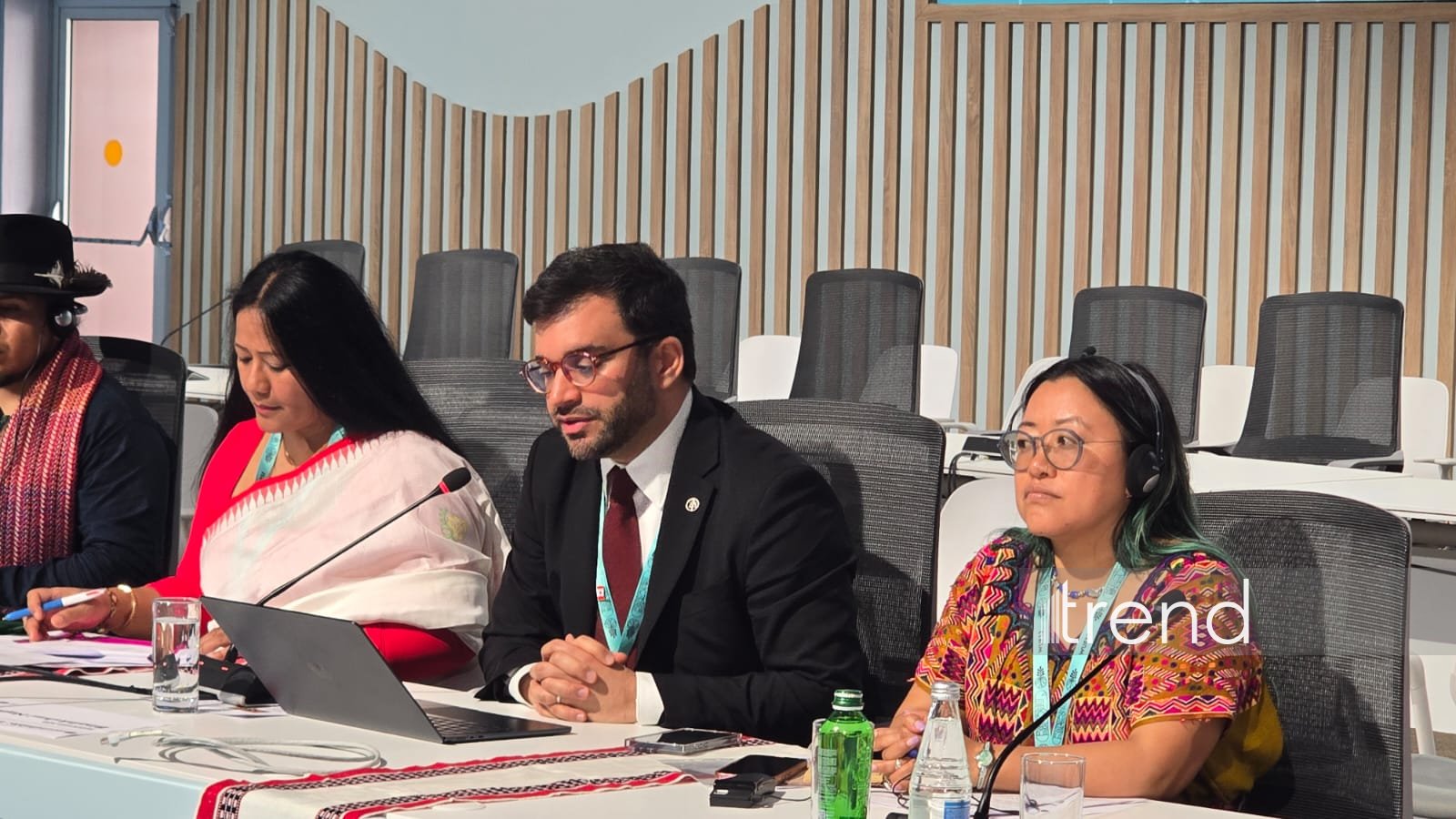

BAKU, Azerbaijan, May 22. The fundamental right to adequate housing for indigenous populations cannot be evaluated in isolation from their distinct ancestral lands, unique cultural heritages, and traditional knowledge bases, Omar Siddique, Head of the UN-Habitat Office in Canada, said, Trend reports.
The official made the remark during a high-level roundtable discussion on "Indigenous Peoples," held within the framework of the 13th session of the World Urban Forum (WUF13) in Baku.
According to him, systemic violations of indigenous housing rights represent far more than individual human rights structural breaches, operating simultaneously as a severe blow to collective communal rights, time-honored traditions, distinct lifestyles, and grassroots community values.
"The core bottlenecks that indigenous peoples face regarding access to adequate housing are deeply rooted in historical injustices, colonial legacies, and the systematic dispossession of their sovereign lands and territories," Siddique emphasized.
The UN-Habitat representative noted that the socio-economic fallout of these systemic deficiencies remains visible across multiple geographic regions worldwide.
"Alarmingly high rates of homelessness among indigenous populations, forced evictions, unlawful land grabs, and poorly managed resettlement cycles serve as the most glaring indicators of this crisis. Displacements triggered by climate anomalies, localized conflicts, industrial development initiatives, or the outright refusal to legally recognize indigenous land tenure separate these communities from the environments that sustain their cultural identity," he stated.
According to Siddique, mitigating these deep-rooted challenges demands a comprehensive, rights-based approach that positions indigenous populations directly at the center of the institutional decision-making pipeline.
"In strict alignment with the United Nations Declaration on the Rights of Indigenous Peoples, adequate housing frameworks must undergo co-design and preparation with the direct, active participation of indigenous communities. Structural housing solutions must map precisely to the unique spatial needs, cultural expectations, and daily lived experiences of these populations," he pointed out.
He added that securing universal housing rights requires an unyielding, inclusive planning paradigm engineered to guarantee that no individual and no territory undergoes institutional neglect.
Siddique concurrently noted that the active attendance of numerous indigenous leaders spanning Latin America, Africa, and Asia at the Baku roundtable establishes a critical global platform to cross-examine data, draft policy recommendations, and share localized best practices.
The UN-Habitat official announced that the strategic outcomes of these roundtable debates will directly enrich the drafting of the Baku Call to Action at WUF13, alongside shaping the mid-term review processes of the New Urban Agenda.
"The preservation of indigenous housing rights stands as a core pillars of UN-Habitat's global operations. This priority will maintain sharp institutional focus, anchoring our workflows from the Baku Call to Action through to the comprehensive review of the New Urban Agenda and all subsequent international urban initiatives," Siddique concluded.
Meanwhile, today Baku is hosting the final day of WUF13.
On the first day of the forum, a ministerial meeting on the New Urban Agenda, a ministerial roundtable, women’s and civil society assemblies, business sessions, and discussions on urban well-being took place. The forum also featured a flag-raising ceremony for the UN and Azerbaijan.
The second day of the forum was marked by the first-ever Leaders’ Summit. On this day, high-level discussions were held on the global housing crisis, urbanization policy, and urban sustainability. Also as part of WUF13, the Mexico City pavilion was inaugurated, presented as a key platform for expanding cooperation with the Latin American region and preparing for WUF14.
The third day of WUF13 was also marked by an extensive program of events. Discussions on this day covered topics such as the global housing crisis, the creation of safe and inclusive cities, climate resilience, artificial intelligence and urban governance, “green” urbanization, social equality, and sustainable transportation.
One of the highlights of the third day was the signing of a sister-city agreement between the Azerbaijani city of Shusha and the Turkish city of Trabzon.
The fourth day of WUF13 featured an extensive program of events dedicated to the themes of urbanization, climate change, inclusive urban development, housing policy, and sustainable management.
On the fifth day of the forum, discussions continued on the global housing crisis, the creation of safe and inclusive cities, climate resilience, the use of artificial intelligence in urban management, “green” urbanization, and social equality.
One of the key events of the Cities Forum of the United Nations Special Program for the Economies of Central Asia (SPECA), held on the fourth day, was the announcement of Almaty’s official accession to the “Declaration of Intent on the Establishment of the SPECA Forum on Smart Cities Resilient to Climate Change.”
Also, for the first time in WUF history, the “WUF13 NGO Forum: Global Partnership and Decision-Making” was held at the initiative of Azerbaijan.
The WUF13 Forum, dedicated to the theme “Housing the world: Safe and resilient cities and communities", brought together governments, international organizations, experts, and civil society representatives to strengthen global cooperation in the field of sustainable urban development. More than 40,000 people from 182 countries registered to participate in the forum.



