


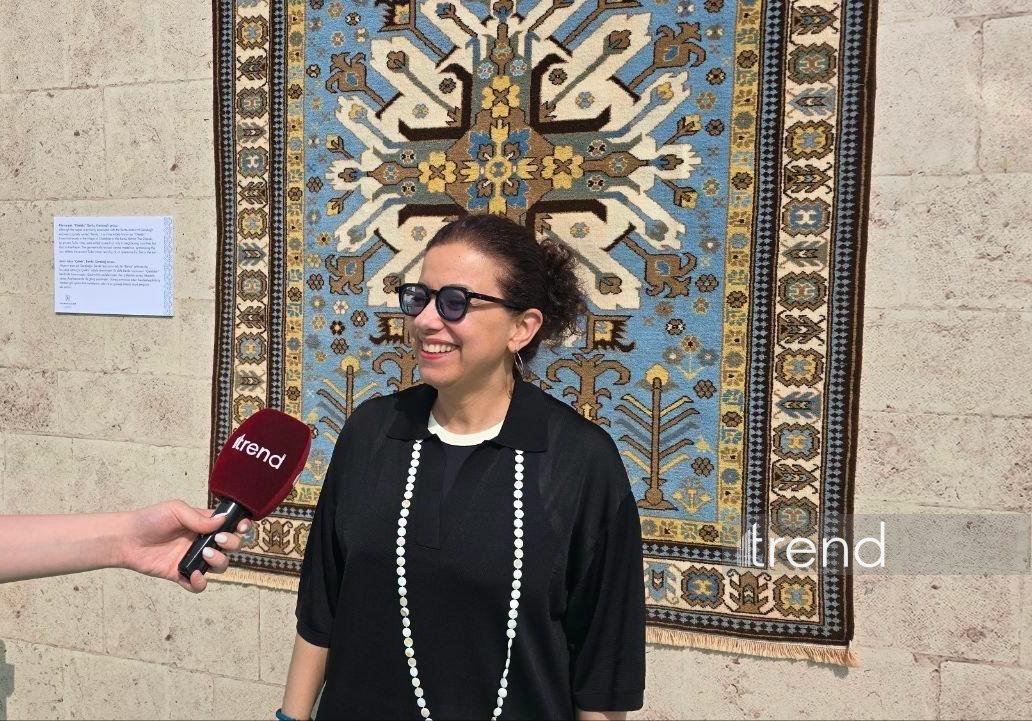

BAKU, Azerbaijan, May 21. Azerbaijan is already leading on many initiatives in South-South cooperation, Director of the United Nations Office for South-South Cooperation Dima Al-Khatib said in an exclusive interview with Trend on the sidelines of the 13th session of the World Urban Forum (WUF13) in Baku.
"Azerbaijan has a fantastic model of public service delivery which is called ASAN. It is now also being shared with many countries in the Global South. I think some 30 countries between Africa and Asia are collaborating with ASAN to try to take the success of this model into other countries. This is one example. The second example is the launch of the Global South NGO Platform, which also consists of some 100 NGOs amplifying the voice of the civil society, also to advance the urban agenda. There are many other initiatives where Azerbaijan can definitely play a critical role in supporting the urban agenda and South-South cooperation," she said.
Dima Al-Khatib pointed out that the focus of the WUF13 is on housing, which is an important topic for the Global South.
"For us, it is important that all of the messages that come out of the WUF13 are also relayed to the countries of the South in terms of actions. The different challenges that come with the urban agenda, whether it's climate change, inequalities, challenges related to gender equality, engagement of the youth, can be accelerated and advanced via South-South cooperation, because countries that share common cultural heritage, geography, challenges, can learn from each other much faster. It saves a lot of time and creates solidarity among the countries," she said.
She noted that cities are not only sources of problems and suffering from challenges, they are also sources of solutions.
"Many cities have already come up with solutions that can be shared with other countries, whether in the area of health, agriculture, waste management or even water management. All of these challenges that every city can face also present themselves as sources of solutions. Through the South-South and Triangular cooperation, these solutions can travel from one place to another. Of course, it has to be tailored to the country context, but these are definitely an important mechanism for addressing issues through South-South cooperation.
As you know, by 2050, it is estimated that 70% of the world population will live in cities, in urbanizing environments. And 90% of those 70% are in the countries of the South. There will be lots of pressures on cities. This is why it's very important that the urban agenda is addressed from all levels, policy level, financial instruments level, solutions level. On all of those levels, South-South and Triangular cooperation can be a key mechanism," Dima Al-Khatib explained.
She went on to add that the Global South, which is 80% of the countries of the globe, sometimes share commonalities, whether it's the socio-economic context, environmental challenges, or social challenges.
"It makes it easier for them to learn from each other on how to address them. They could do it jointly, but also some of those who have succeeded in addressing some of those challenges can share those experiences. Some of the challenges in the global South transcend the geographic boundaries. When you talk about climate change, it affects the countries regardless of the geography. This is why it requires that countries work together to address them. So South-South cooperation is extremely important and central to any development for the countries of the South in order to accelerate the sustainable development goals and make sure that there is sharing of solutions, experiences, capacity-building opportunities," she said.
Dima Al-Khatib noted that a lot of the countries of the global South suffer also from the debt distress.
"They are looking for financial instruments that will help alleviate the financial distress. Some of them have succeeded to do that, so they can learn also from each other. But of course, to do that, there is a need also for support from the different development partners, whether it's development banks, private sector, multilateral system, the UN system, which brings a lot of expertise, such as UN Habitat with the urban agenda, United Nations Office for Disaster Risk Reduction for the disasters, World Health Organization on the health front, and so on.
Moreover, nowadays, everybody uses smart technologies, smartphones, digital platforms, and this is the fastest way for people to access knowledge, to learn from each other. We do maintain, as an office for South-South and Triangular Cooperation, a digital knowledge platform called South-South Galaxy, which has now more than a thousand best practices. Any country, entity, civil society can access that platform and learn from those best practices. Now we are also improving this digital platform to include capacity building instruments, opportunities where countries can have dialogue among each other, and real-time news, as well as information about potential financial mechanisms," she concluded.



