


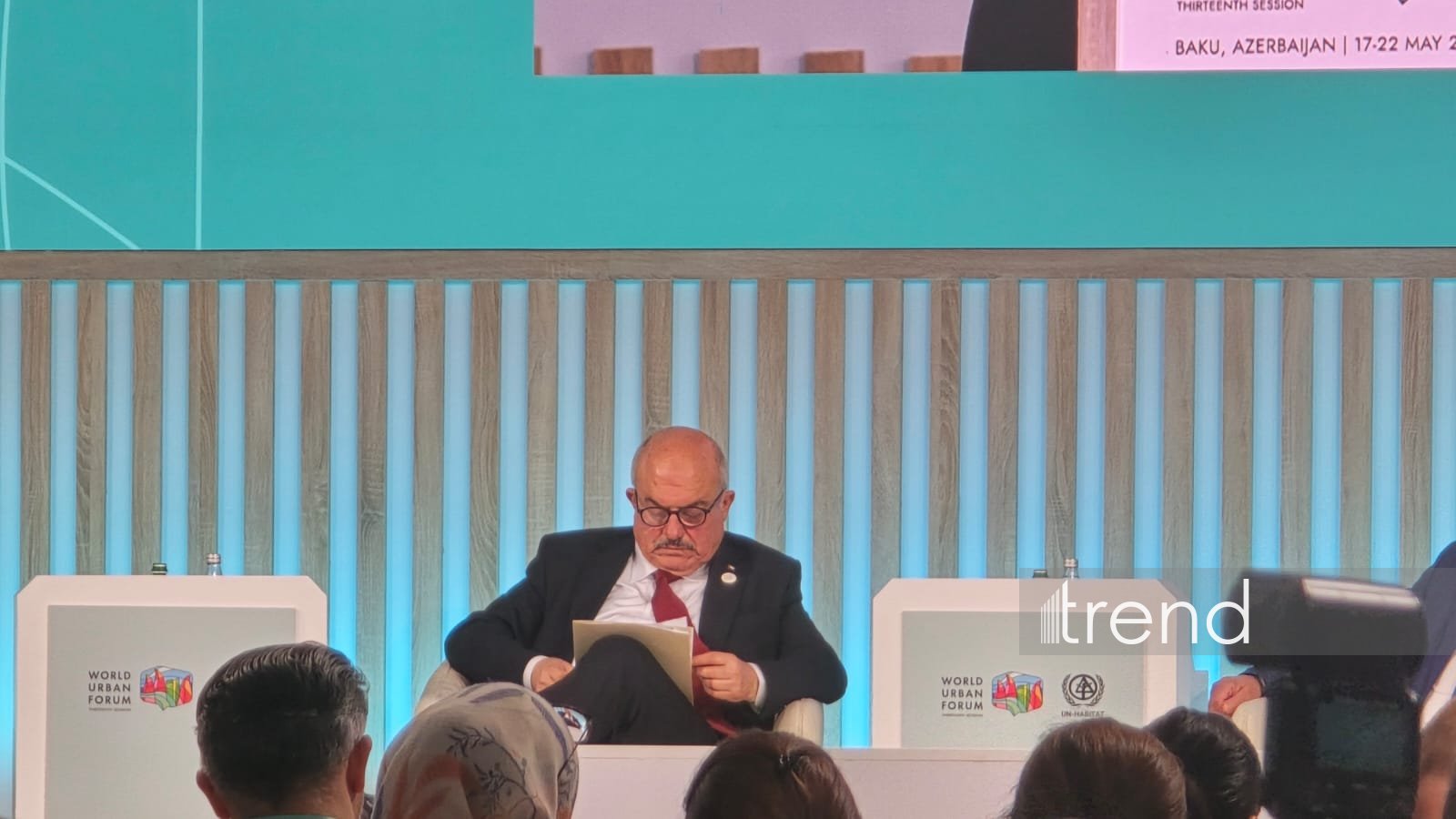
BAKU, Azerbaijan, May 21. Resolving the housing deficit within Palestine, particularly across the Gaza Strip, extends far beyond physical residential reconstruction to serve as a baseline vehicle for restoring human dignity, stability, and societal well-being, said Sami Hijjawi, Minister of Local Government of the Palestinian Authority, Trend reports.
The government official made the remarks during a session titled "Housing at the Centre of Crisis Recovery and Reconstruction" held within the framework of the 13th session of the World Urban Forum (WUF13) in Baku.
According to the minister, large-scale destruction across the Gaza Strip has left approximately 372,000 housing units damaged. Within this aggregate figure, roughly 60,000 units sustained partial damage and remain structurally viable for rehabilitation, while the vast majority have undergone total collapse or severe structural destruction.
He emphasized that the conflict has displaced approximately 2 million people—representing the overwhelming majority of Gaza's total population. Concurrently, across the West Bank, particularly within the Jenin and Tulkarm encampments, more than 10,000 residential units have sustained damage, forcing tens of thousands of citizens to flee their homes.
Hijjawi reported that the destruction has targeted more than just the residential housing stock, inflicting severe damage upon core water distribution networks, sewage systems, educational facilities, and healthcare infrastructure lines.
"True structural recovery cannot achieve viability solely by addressing immediate emergency humanitarian needs; it remains fundamentally dependent upon the parallel provision of safe, secure, and dignified long-term housing," he stressed.
According to the minister, the ultimate success of the rehabilitation trajectory hinges upon the mobilization of unified international political will, sustainable long-term financing pipelines, unhindered access to raw construction materials, streamlined international coordination, and the active integration of local communities directly into the decision-making cycle.
He noted that the proposed Palestinian recovery strategy operates on a structured five-year framework plan. The initial phase prioritizes the deployment of rapid transitional shelter solutions alongside the targeted repair of partially damaged properties. Building upon this baseline, the subsequent strategic phase targets the construction of at least 200,000 entirely new housing units.
Hijjawi added that the comprehensive reconstruction blueprint looking ahead must transcend simple residential real estate blocks, incorporating the parallel rebuilding of schools, medical centers, water utilities, and electrical grids to cultivate resilient, self-sustaining municipal ecosystems.
"For our governance structures, post-conflict reconstruction operates far beyond a standard technical engineering workflow. It represents an overarching humanitarian and moral responsibility geared toward restoring civic hope and forging a path toward an equitable, lasting peace," the minister concluded.
Today marks the fifth day of WUF13 in Baku.
The first day included a ministerial meeting dedicated to the New Urban Agenda, a ministerial roundtable, assemblies for women and civil society, business sessions, and discussions on urban prosperity. An official ceremony marking the raising of the UN and Azerbaijani flags also took place.
The second day stood out for the inaugural Leaders' Summit, featuring high-level discussions on the global housing crisis, urbanization policy, and urban resilience. Concurrently, the opening of the Mexico City pavilion took place, serving as a significant platform for expanding cooperation with the Latin American region and preparing for WUF14.
The third day of WUF13 featured a comprehensive program of events covering the global housing crisis, the formation of safe and inclusive cities, climate resilience, artificial intelligence and urban governance, green urbanization, social equity, and sustainable transport.
One of the highlights of the third day was the signing of a sister-city memorandum between the Azerbaijani city of Shusha and the Turkish city of Trabzon.
The fourth day of WUF13 featured a broad program of events dedicated to urbanization, climate change, inclusive urban development, housing policy, and sustainable governance.
One of the important events of the UN Special Programme for the Economies of Central Asia (SPECA) Cities Forum, held on the fourth day, was the announcement of Almaty’s official accession to the “Declaration of Intent on the Establishment of the SPECA Smart Climate-Resilient Cities Forum.”
Also, for the first time in WUF history and at Azerbaijan’s initiative, the “WUF13 NGO Forum: Global Partnership and Decision-Making” was held.
WUF13, which has attracted more than 40,000 registered participants from 182 countries, will continue until May 22. Held under the theme “Housing the world: Safe and resilient cities and communities,” the forum brings together governments, international organizations, experts, and representatives of civil society to strengthen global cooperation in the field of sustainable urban development.



