


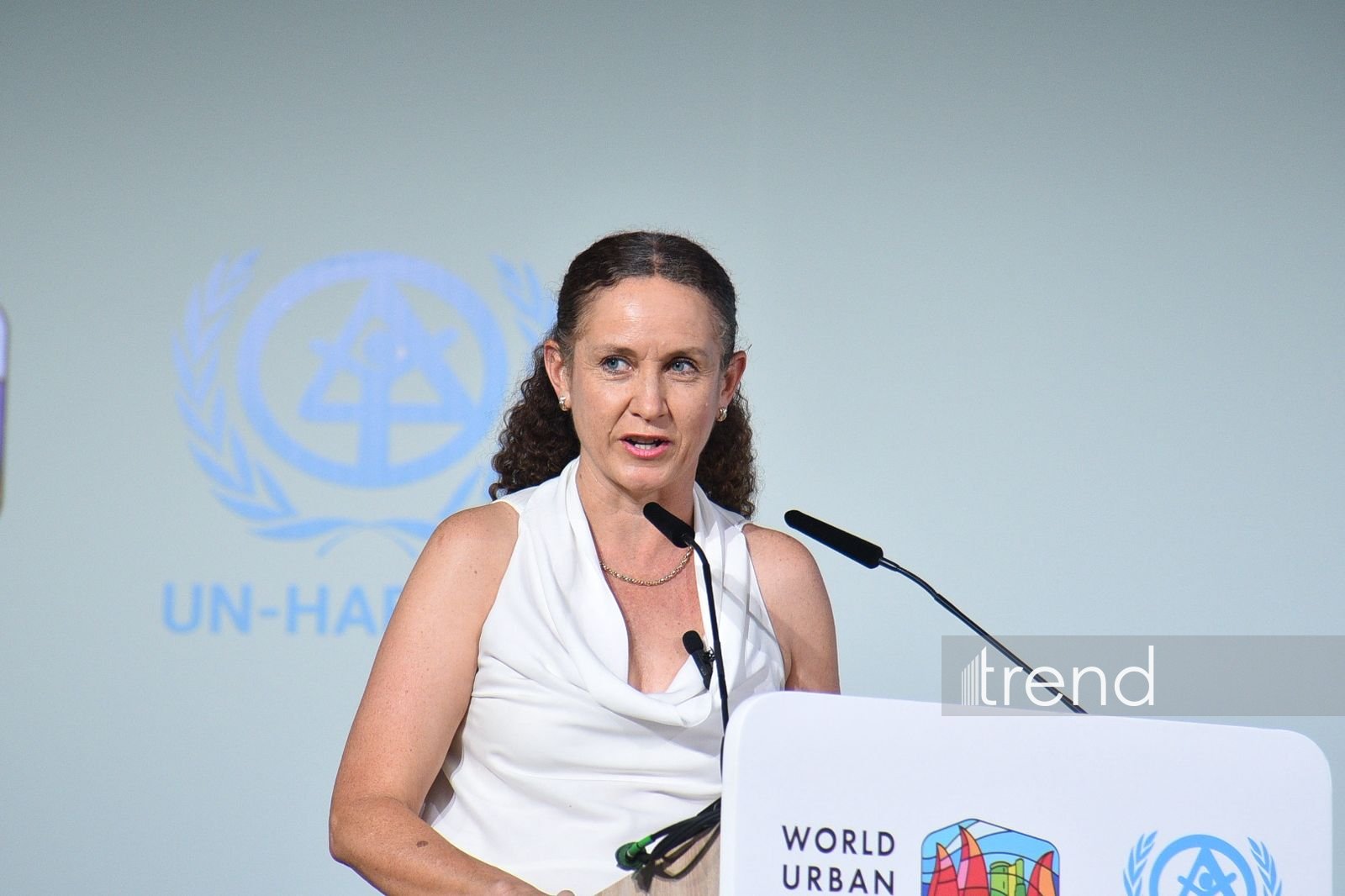

BAKU, Azerbaijan, May 20. The annual cost of health damage caused by PM2.5 emissions reaches $8 trillion, Executive Director of the Clean Air Fund's Breathe Cities Initiative, Cecilia Vaca Jones, said at an event "Breathing Life into the New Urban Agenda: Integrating Air Quality and Green Infrastructure for Resilient Cities" within the framework of the 13th session of the World Urban Forum (WUF13) in Baku, Trend reports.
She noted that low-income communities suffer more from air pollution. The main reason for this is that they live near major highways, industrial zones, waste incineration sites, or in poor living conditions.
"If we look at the air quality map of a city, we can also see the most vulnerable and at-risk areas. It is in those places that measures should be taken, because those are the people who suffer the most from air pollution," she pointed out.
Jones emphasized that, according to the World Bank, the annual economic cost of health damage caused by PM2.5 emissions alone is about $8 trillion, which is equivalent to about 6% of global GDP.
"It's not just about health costs. Air pollution causes lost productivity, increased hospital admissions, school dropouts, and additional burdens on families. Prevention is often cheaper than treatment," she explained.
According to her, if cities could reduce people's exposure to polluted air, it would both reduce the pressure on health systems and improve the quality of life.
"Every asthma attack prevented, every hospital admission, and every child who breathes better means savings for families, cities, and health systems," the executive director noted.
She added that clean air is not against economic development and can be achieved in parallel with sustainable development.
"Some people think that environmental measures weaken economic growth. However, there is ample evidence that more sustainable cities develop faster. Dirty air is not an inevitable consequence of development," stressed Jones.
According to the executive director, the key issue is to make air quality visible, measurable, and a key issue on the political agenda.
"Cities need to ask themselves: Is air quality a priority? Today's thriving cities show that clean air is an integral part of better development," she noted.
Jones highlighted that collecting data on air quality helps to make an invisible problem visible.
"Data allows us to identify sources of air pollution, the most affected areas, and vulnerable groups. This helps policymakers make better decisions, but data alone isn't enough. People need to trust and understand this data," she added.
She further noted that community engagement and citizen participation also play a role. This approach allows people to change their behavior and actively participate in improving air quality.
During her speech, Jones also touched on successful experiences implemented in various cities. She gave an example of the "SUMA" initiative implemented in the Colombian capital of Bogota.
"This program is implemented in the most vulnerable neighborhoods. Within the framework of the project, urban planning, green infrastructure, housing conditions, and the development of public spaces are implemented in an interconnected manner, and air quality is measured before, during and after interventions," she said.
According to her, such an approach improves not only air quality, but also the overall quality of life of people.
"If there are more trees, green infrastructure, quality housing, and public spaces in a neighborhood, this has a positive impact on both air quality and people's quality of life," Jones underscored.
Today marks the fourth day of WUF13 in Baku.
The first day included a ministerial meeting dedicated to the New Urban Agenda, a ministerial roundtable, assemblies for women and civil society, business sessions, and discussions on urban prosperity. An official ceremony marking the raising of the UN and Azerbaijani flags also took place.
The second day stood out for the inaugural Leaders' Summit, featuring high-level discussions on the global housing crisis, urbanization policy, and urban resilience. Concurrently, the opening of the Mexico City pavilion took place, serving as a significant platform for expanding cooperation with the Latin American region and preparing for WUF14.
The third day of WUF13 featured a comprehensive program of events covering the global housing crisis, the formation of safe and inclusive cities, climate resilience, artificial intelligence and urban governance, green urbanization, social equity, and sustainable transport.
WUF13, which has attracted more than 40,000 registered participants from 182 countries, will continue until May 22. Held under the theme “Housing the world: Safe and resilient cities and communities,” the forum brings together governments, international organizations, experts, and representatives of civil society to strengthen global cooperation in the field of sustainable urban development.



