


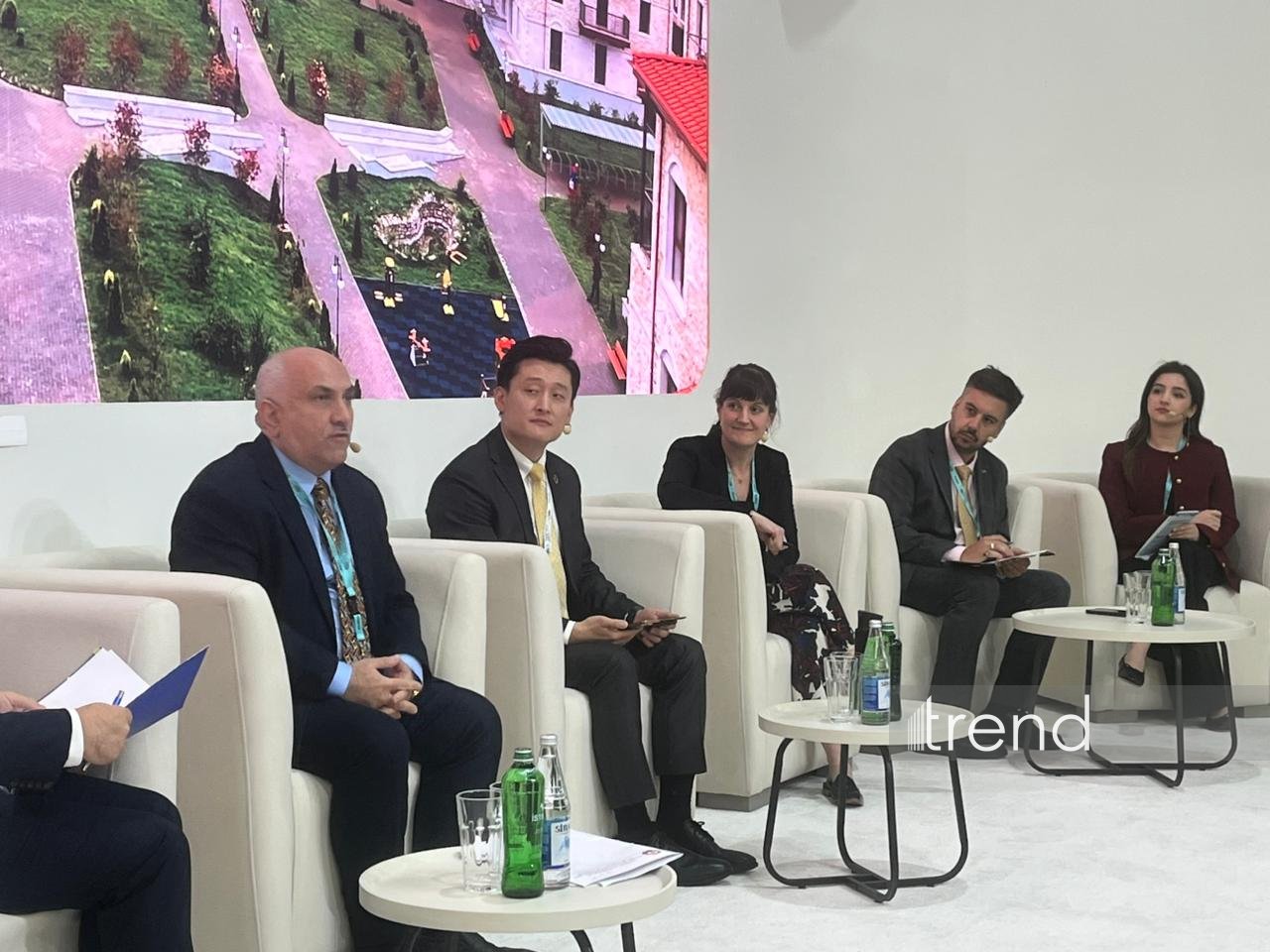

BAKU, Azerbaijan, May 20. Karabakh is one of the most heavily mined areas in the world, Fuad Huseynov, Deputy Chairman of the State Committee for Refugees and Internally Displaced Persons of the Republic of Azerbaijan, said, Trend reports.
Speaking at the panel discussion titled “Migration and Cities: A Framework for Safe, Innovative and Sustainable Governance,” conducted as part of WUF13, Huseynov emphasized that during the Armenian occupation, Karabakh and Eastern Zangezur were extensively contaminated with landmines, rendering these regions some of the most hazardous mine-affected areas globally.
He also noted that during the occupation, Armenia completely destroyed settlements on Azerbaijani territory.
“Today, international experts consider these areas to be among the most heavily mined regions in the world. Armenia refuses to provide accurate and complete mine maps, which leads to the continuation of mine terrorism against the civilian population. Since 2020, more than 420 people have been killed or seriously injured as a result of mine explosions,” he said.
The deputy chairman of the committee noted that, despite this, Azerbaijan continues rapid reconstruction work in the liberated territories.
“Today, settlements are being built in Karabakh and Eastern Zangezur based on the concepts of smart villages, smart cities, green energy, and modern urbanization. In a short period of time, master plans have been approved for 91 settlements, including 11 cities, across 12 districts. This is one of the rare and unique cases in the architectural and urban planning experience of the Middle East,” he emphasized.
He added that currently, more than 85,000 people have returned to 43 settlements in Karabakh and Eastern Zangazur, including 9 cities, 3 towns, and 31 villages.
Today, the fourth day of the WUF13 conference is taking place in Baku.
The first day included a ministerial meeting dedicated to the New Urban Agenda, a ministerial roundtable, assemblies for women and civil society, business sessions, and discussions on urban prosperity. An official ceremony marking the raising of the UN and Azerbaijani flags also took place.
The second day stood out for the inaugural Leaders' Summit, featuring high-level discussions on the global housing crisis, urbanization policy, and urban resilience. Concurrently, the opening of the Mexico City pavilion took place, serving as a significant platform for expanding cooperation with the Latin American region and preparing for WUF14.
The third day of WUF13 featured a comprehensive program of events covering the global housing crisis, the formation of safe and inclusive cities, climate resilience, artificial intelligence and urban governance, green urbanization, social equity, and sustainable transport.
WUF13, which has attracted more than 40,000 registered participants from 182 countries, will continue until May 22. Held under the theme “Housing the world: Safe and resilient cities and communities,” the forum brings together governments, international organizations, experts, and representatives of civil society to strengthen global cooperation in the field of sustainable urban development.



