


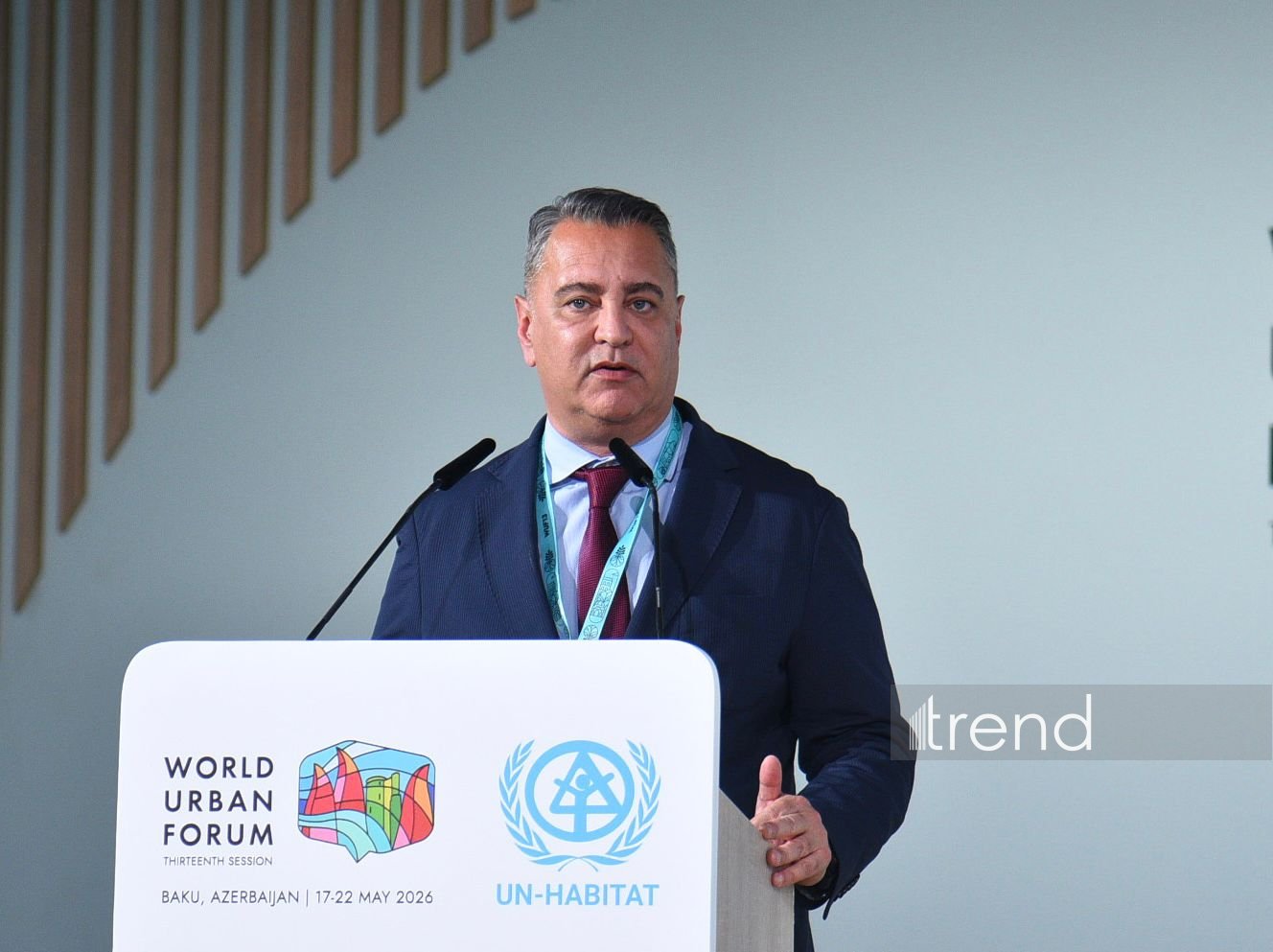

BAKU, Azerbaijan, May 20. Young people play a key role in shaping the future of cities, promoting clean air and sustainable development, Alexandre Hedjazi, an associate professor at the University of Geneva, said, Trend reports.
He made the remark during his presentation titled “Breathing Life into the New Urban Agenda: Integrating Air Quality and Green Infrastructure for Resilient Cities” as a part of the 13th World Urban Forum held in Baku.
Alexandre Hedjazi noted that the younger generation, which has inherited these cities, stands to lose the most but also gain the most if the right steps are taken. According to him, inaction is not an option, and young people play a key role in shaping decisions in this area.
“The lives of young people in cities are not merely a secondary
issue, but a key structural element of urban planning. Young people
are also the driving force behind the shift toward cleaner air and
sustainable cities.
The primary responsibility before us today is for everyone to call
on their governments to create more breathable cities and to
include clean air on the permanent agenda of future World Urban
Forums,” he said.
The associate professor noted that at this stage, it is necessary to translate ideas into concrete actions, and in this process, air quality must be placed at the center of urban policy.
He added that experts are proposing science-based approaches to issues such as air pollution, sustainable urban development, ecological systems, and health equity.
Hedjazi noted that, although Baku is known as the “city of winds,” climate change is causing shifts in wind direction and air currents, creating additional challenges for urban planning.
Today, the fourth day of the WUF13 conference is taking place in Baku.
The first day included a ministerial meeting dedicated to the New Urban Agenda, a ministerial roundtable, assemblies for women and civil society, business sessions, and discussions on urban prosperity. An official ceremony marking the raising of the UN and Azerbaijani flags also took place.
The second day stood out for the inaugural Leaders' Summit, featuring high-level discussions on the global housing crisis, urbanization policy, and urban resilience. Concurrently, the opening of the Mexico City pavilion took place, serving as a significant platform for expanding cooperation with the Latin American region and preparing for WUF14.
The third day of WUF13 featured a comprehensive program of events covering the global housing crisis, the formation of safe and inclusive cities, climate resilience, artificial intelligence and urban governance, green urbanization, social equity, and sustainable transport.
WUF13, which has attracted more than 40,000 registered participants from 182 countries, will continue until May 22. Held under the theme “Housing the world: Safe and resilient cities and communities,” the forum brings together governments, international organizations, experts, and representatives of civil society to strengthen global cooperation in the field of sustainable urban development.



