


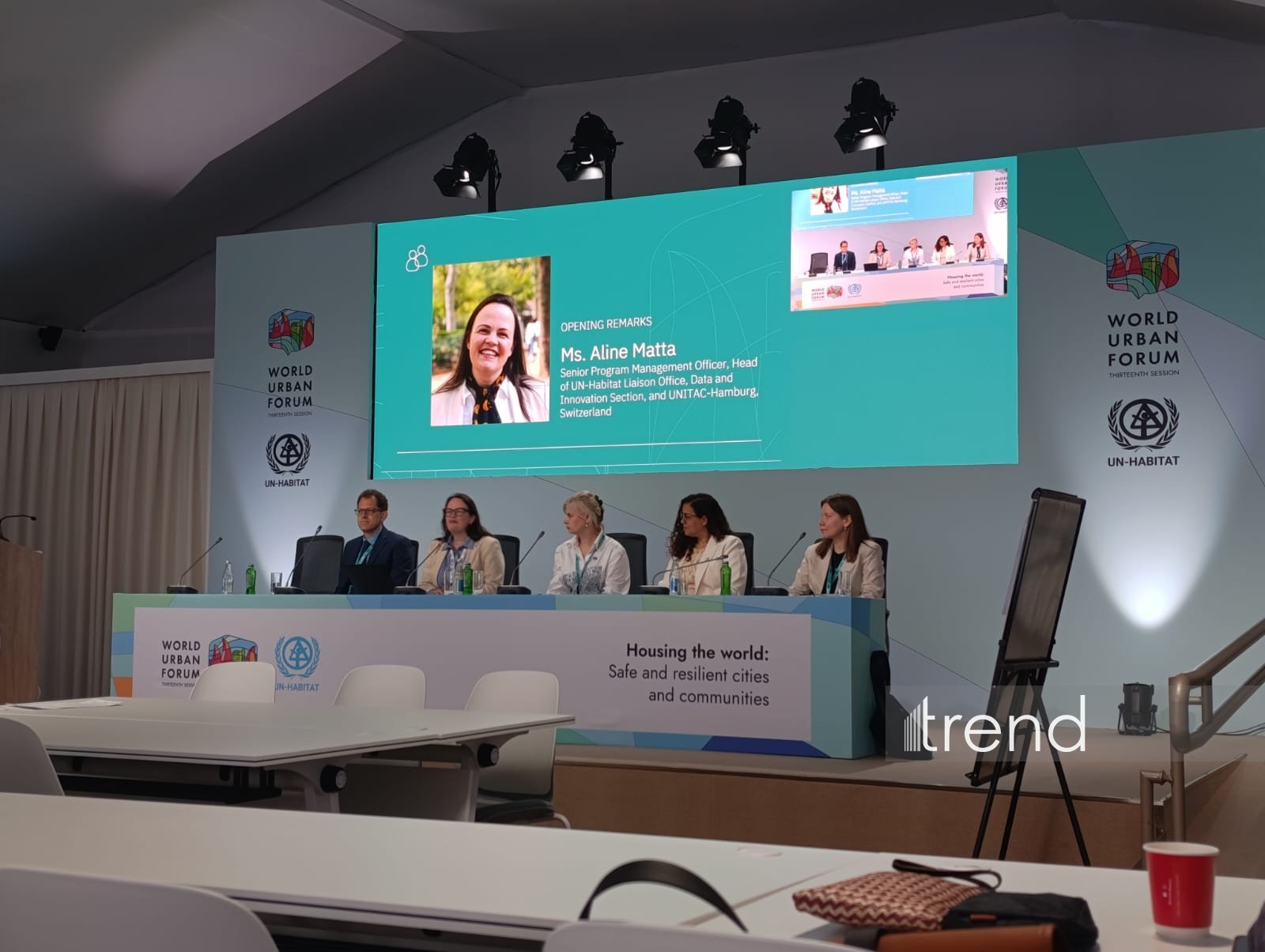

BAKU, Azerbaijan, May 20. Many municipalities around the world continue to face major difficulties in responding to growing urban challenges, a United Nations official said Wednesday during the 13th session of the World Urban Forum (WUF13) in Baku, Trend reports.
Alina Matta made the remarks during a training session titled “Policies, Documents, and Material Resources: Building Capacity for Crisis Preparedness and Response.”
“Today’s session addresses a question that is becoming increasingly urgent for cities and local governments worldwide: what does a municipality need to remain functional, responsive, and resilient in the face of overlapping crises?” Matta said.
She noted that local governments are often the first institutions to respond to emergencies, including climate disasters, infrastructure failures, conflict-driven displacement, and severe economic shocks.
“However, through the work of UN-Habitat and UNITAC, we continue to see that many municipalities face significant challenges in addressing urban crises,” she said.
Matta stressed that strengthening local institutional capacity is essential for building resilient, inclusive, and sustainable cities.
“Preparedness is not only about reacting to emergencies after they occur,” she said. “It is also about developing systems, partnerships, and knowledge that allow cities to anticipate risks, maintain essential services, and protect vulnerable populations.”
In the mean time, today marks the fourth day of WUF13 in Baku.
The first day included a ministerial meeting dedicated to the New Urban Agenda, a ministerial roundtable, assemblies for women and civil society, business sessions, and discussions on urban prosperity. An official ceremony marking the raising of the UN and Azerbaijani flags also took place.
The second day stood out for the inaugural Leaders' Summit, featuring high-level discussions on the global housing crisis, urbanization policy, and urban resilience. Concurrently, the opening of the Mexico City pavilion took place, serving as a significant platform for expanding cooperation with the Latin American region and preparing for WUF14.
The third day of WUF13 featured a comprehensive program of events covering the global housing crisis, the formation of safe and inclusive cities, climate resilience, artificial intelligence and urban governance, green urbanization, social equity, and sustainable transport.
WUF13, which has attracted more than 40,000 registered participants from 182 countries, will continue until May 22. Held under the theme “Housing the world: Safe and resilient cities and communities,” the forum brings together governments, international organizations, experts, and representatives of civil society to strengthen global cooperation in the field of sustainable urban development.



