


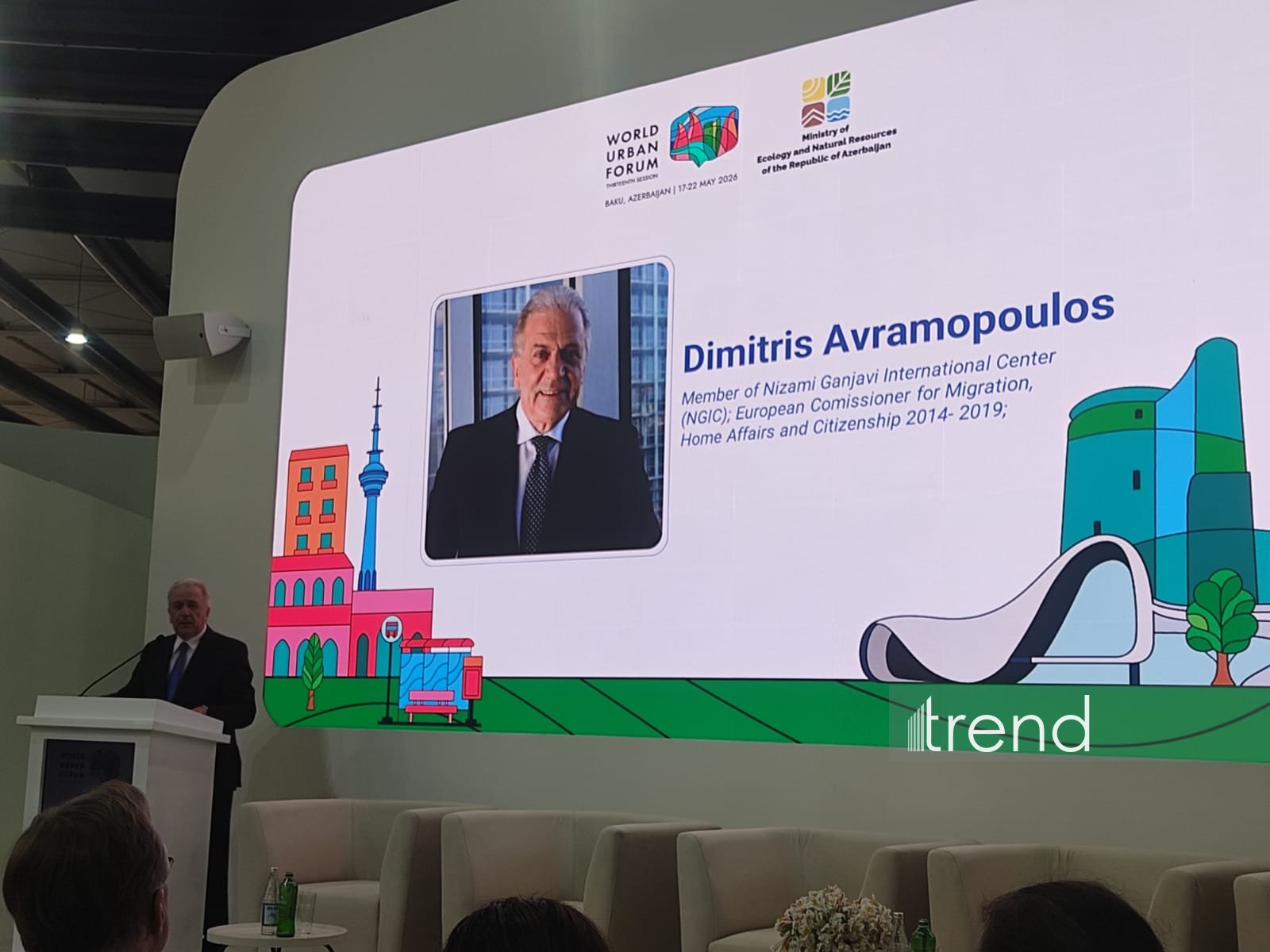

BAKU, Azerbaijan, May 19. To combat natural disasters, it is necessary to strengthen long-term international cooperation, European Commissioner for Migration, Home Affairs, and Citizenship from 2014 through 2019, Dimitris Avramopoulos said, Trend reports.
He made the remark at an event titled “Early Warning Systems and Climate-Resilient Cities” held as part of WUF13.
He added that resilience is built through advanced forecasting and planning. An early warning system involves not only technology but also management,
According to him, technology alone is not enough; political will and people-centered governance are also important:
“Half of the world’s population lives in cities, and this share continues to grow. As people increasingly concentrate in cities, cities are becoming the epicenters of global challenges. Serious problems are emerging, such as energy and technological constraints, as well as social inequality.
Fires, floods, heat waves, and building fires are no longer a distant abstraction but a reality of urban life. Climate change must be viewed not only as an environmental problem but also as a complex issue with social and economic consequences. These changes affect agriculture and livestock farming, as well as the service sector, and disrupt the social balance. The most vulnerable groups—people in insecure housing, children, the elderly, and internally displaced persons—bear the brunt of disasters.
Issues of early warning systems and climate resilience should be considered together. For urban policy, it is crucial to promote resilience, strengthen infrastructure, and maintain a balance between the city and nature. Key priorities include “green corridors,” sustainable water systems, and reducing carbon emissions. Policy must be based on scientific data, and long-term international cooperation must be strengthened. No country can tackle these challenges alone,” he added.
Resilience is built through advanced forecasting and planning. An early warning system involves not only technology but also management,
Meanwhile, the third day of the 13th session of the World Urban Forum (WUF13) is underway in Baku.
On the first day, a ministerial meeting dedicated to the New Urban Agenda, a roundtable of ministers, assemblies of women and civil society, business sessions, and discussions on urban well-being were held. A ceremony for raising the flags of the United Nations and Azerbaijan also took place within the framework of the forum.
The second day of the forum drew attention with the first-ever Leaders Summit. High-level discussions on the global housing crisis, urbanization policy, and urban resilience were held that day. At the same time, the Mexico City pavilion was inaugurated within the framework of WUF13. The pavilion was presented as an important platform for expanding cooperation with the Latin American region and preparing for WUF14.
WUF13, which has attracted more than 40,000 registered participants from 182 countries, will continue until May 22. Held under the theme “Housing the world: Safe and resilient cities and communities,” the forum brings together governments, international organizations, experts, and representatives of civil society to strengthen global cooperation in the field of sustainable urban development.



