


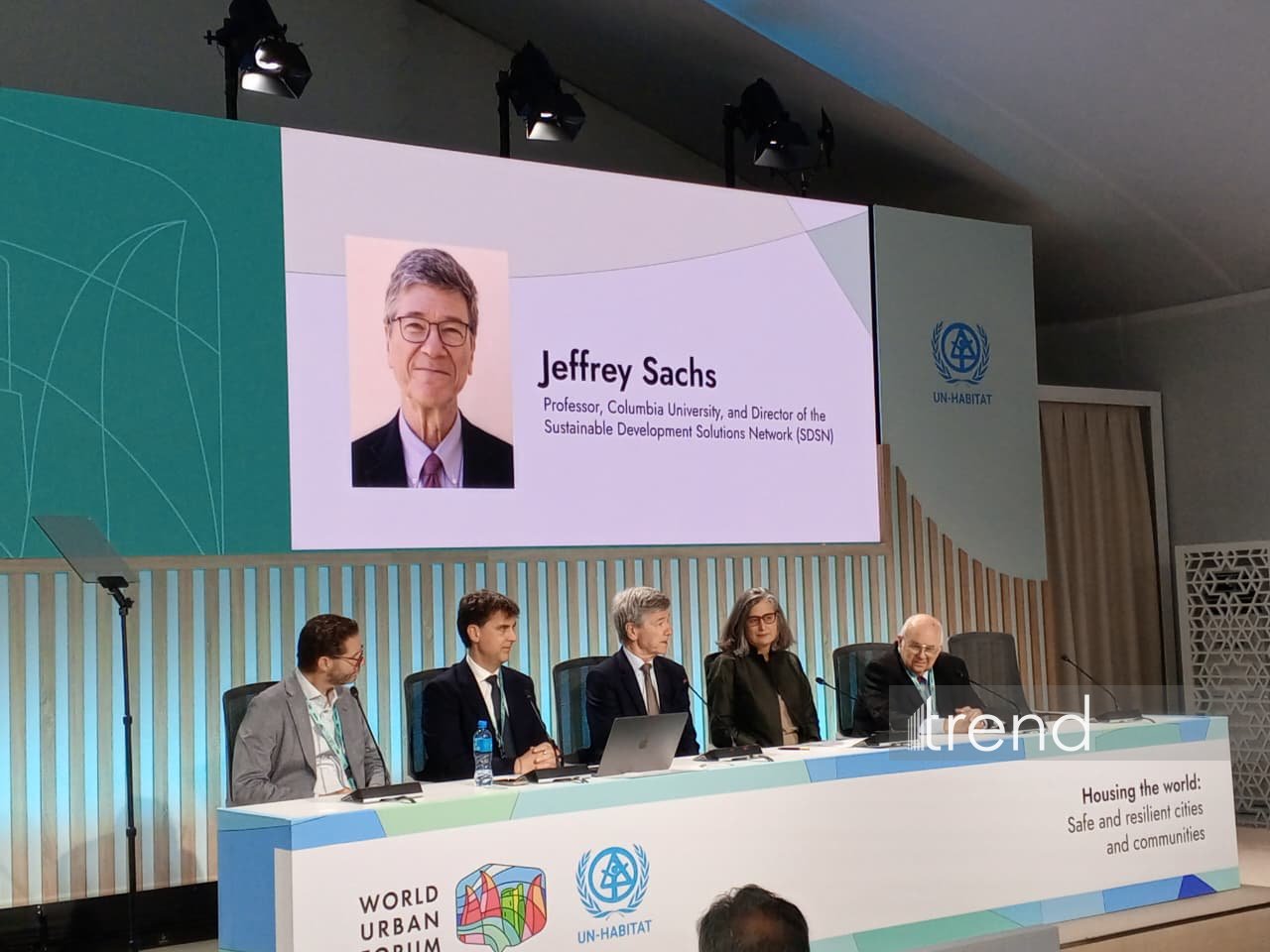
BAKU, Azerbaijan, May 19. The success of cities directly determines the future of the entire world, Jeffrey Sachs, Director of the UN Sustainable Development Solutions Network, stated during a press conference within the framework of the 13th session of the World Urban Forum (WUF13) in Baku, Trend reports.
"The success of cities means the success of the world. The success of the world depends on the success of cities," he noted.
Sachs emphasized that by 2050, the global urbanization rate will reach 70%, with approximately 2 billion additional people moving to cities over the next 25 years.
According to him, the most intense growth in urban population is expected in Sub-Saharan Africa and South Asia, creating additional challenges for infrastructure, employment, and the social sphere.
He noted that the cities of the future must become "green, digital, safe, and productive" spaces where people can live, work, and raise families.
Sachs also stressed that modern cities face common global challenges — climate change, technological transformations, including the development of artificial intelligence, as well as shifts in mobility and the electrification of transport.
At the same time, along with shared problems, there are distinct regional differences, including income levels, access to finance, economic structures, as well as specific challenges in healthcare, education, and employment, he added.
The third day of the 13th session of the World Urban Forum (WUF13) is underway in Baku.
On the first day, a ministerial meeting dedicated to the New Urban Agenda, a roundtable of ministers, assemblies of women and civil society, business sessions, and discussions on urban well-being were held. A ceremony for raising the flags of the United Nations and Azerbaijan also took place within the framework of the forum.
The second day of the forum drew attention with the first-ever Leaders Summit. High-level discussions on the global housing crisis, urbanization policy, and urban resilience were held that day. At the same time, the Mexico City pavilion was inaugurated within the framework of WUF13. The pavilion was presented as an important platform for expanding cooperation with the Latin American region and preparing for WUF14.
WUF13, which has attracted more than 40,000 registered participants from 182 countries, will continue until May 22. Held under the theme “Housing the world: Safe and resilient cities and communities,” the forum brings together governments, international organizations, experts, and representatives of civil society to strengthen global cooperation in the field of sustainable urban development.



