


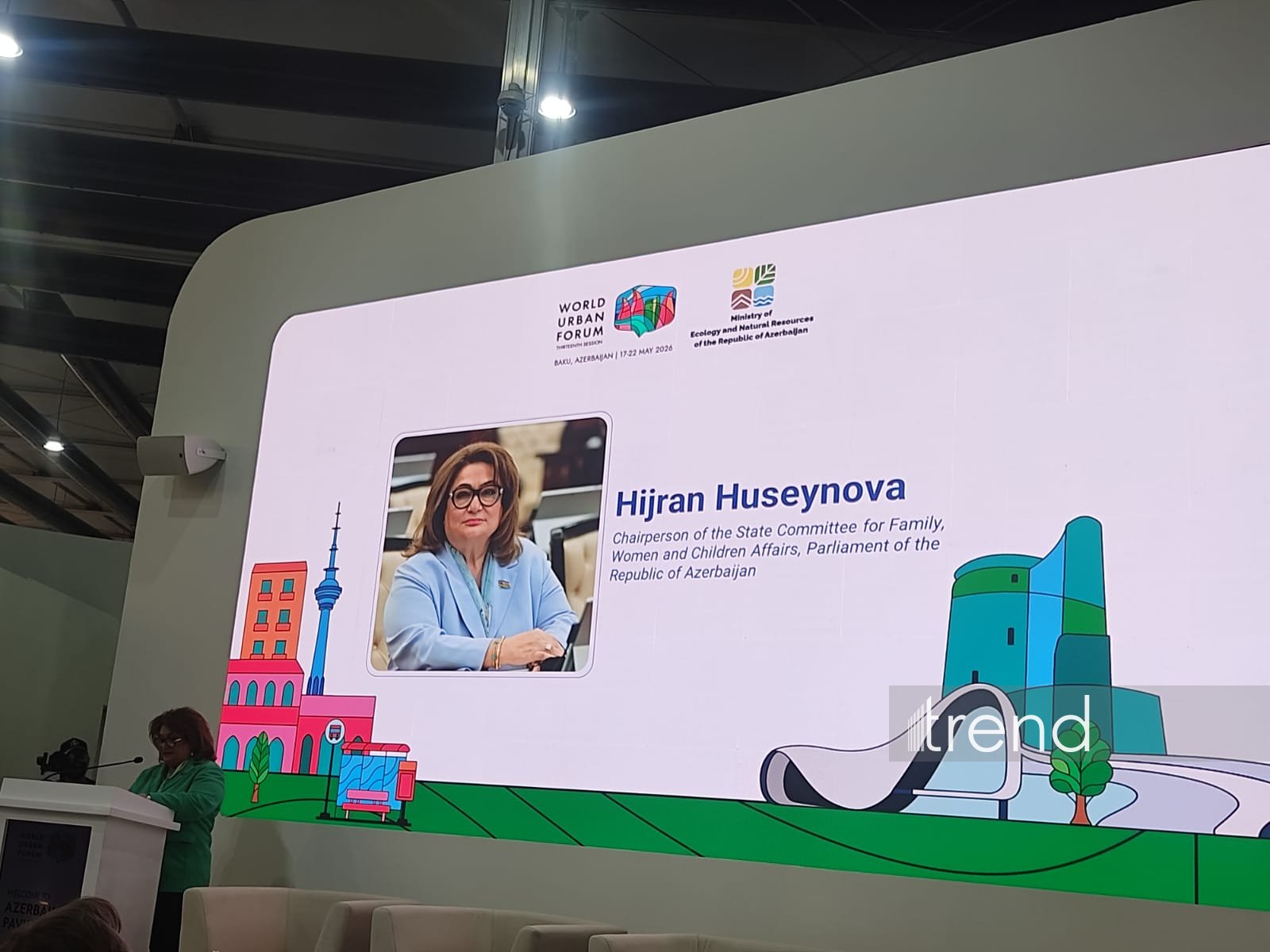
BAKU, Azerbaijan, May 19. Human-centered early warning systems are essential for building climate-resilient cities and protecting vulnerable populations, Hicran Huseynova, chair of the Azerbaijani parliament’s Committee on Family, Women and Children Affairs, said during an event held within the framework of the World Urban Forum (WUF13) in Baku, Trend reports.
Speaking at a panel titled “Early Warning Systems and Climate-Resilient Cities,” Huseynova said the Karabakh region suffered severe environmental damage during the years of occupation.
“During the occupation, Karabakh was subjected to ecocide. More than 60,000 hectares of forest area in cities and settlements were destroyed, causing serious damage to the region’s ecosystem,” she said.
According to Huseynova, Azerbaijan now has a unique opportunity to build “smart cities” in the liberated territories.
She said awareness initiatives implemented in the country are aimed at strengthening the legal and social dimensions of sustainable development, while emphasizing that social inclusivity should remain a key priority.
“Early warning systems and climate-resilient city concepts combine scientific forecasting, advanced technologies and social inclusion,” Huseynova said. “This approach is vital for reducing economic losses and protecting vulnerable populations.”
She added that expanding early warning systems is also important for increasing women’s participation and ensuring child protection.
Huseynova stressed the importance of accurate forecasting, risk assessment and the implementation of reliable warning systems in the face of growing climate threats.
“Heatwaves, floods and droughts are affecting the entire world. Timely warnings are critically important,” she said.
According to Huseynova, smart city technologies can allow authorities to take preventive measures hours before disasters occur.
“It is essential to establish human-centered warning systems,” she said. “Warnings should be communicated in simple language while taking into account the specific needs of vulnerable groups.”
She also called for stronger environmental awareness, the development of ecological culture and greater emphasis on inclusive urban planning projects.
Huseynova noted that monitoring data show family-level awareness also plays an important role in identifying disaster risks.
“Creating safe urban environments for children and preparing them for climate-related risks remains one of the biggest challenges ahead,” she added.
WUF13 is being held in Baku from May 17 to 22 under cooperation between the United Nations Human Settlements Programme (UN-Habitat) and the Azerbaijani government.
Held under the theme “Housing for All: Safe and Sustainable Cities and Human Settlements,” the forum brings together governments, experts, communities and international partners to discuss sustainable urban development and housing challenges.
In the mean time, the third day of the 13th session of the World Urban Forum (WUF13) is underway in Baku.
On the first day, a ministerial meeting dedicated to the New Urban Agenda, a roundtable of ministers, assemblies of women and civil society, business sessions, and discussions on urban well-being were held. A ceremony for raising the flags of the United Nations and Azerbaijan also took place within the framework of the forum.
The second day of the forum drew attention with the first-ever Leaders Summit. High-level discussions on the global housing crisis, urbanization policy, and urban resilience were held that day. At the same time, the Mexico City pavilion was inaugurated within the framework of WUF13. The pavilion was presented as an important platform for expanding cooperation with the Latin American region and preparing for WUF14.
WUF13, which has attracted more than 40,000 registered participants from 182 countries, will continue until May 22. Held under the theme “Housing the world: Safe and resilient cities and communities,” the forum brings together governments, international organizations, experts, and representatives of civil society to strengthen global cooperation in the field of sustainable urban development.



