


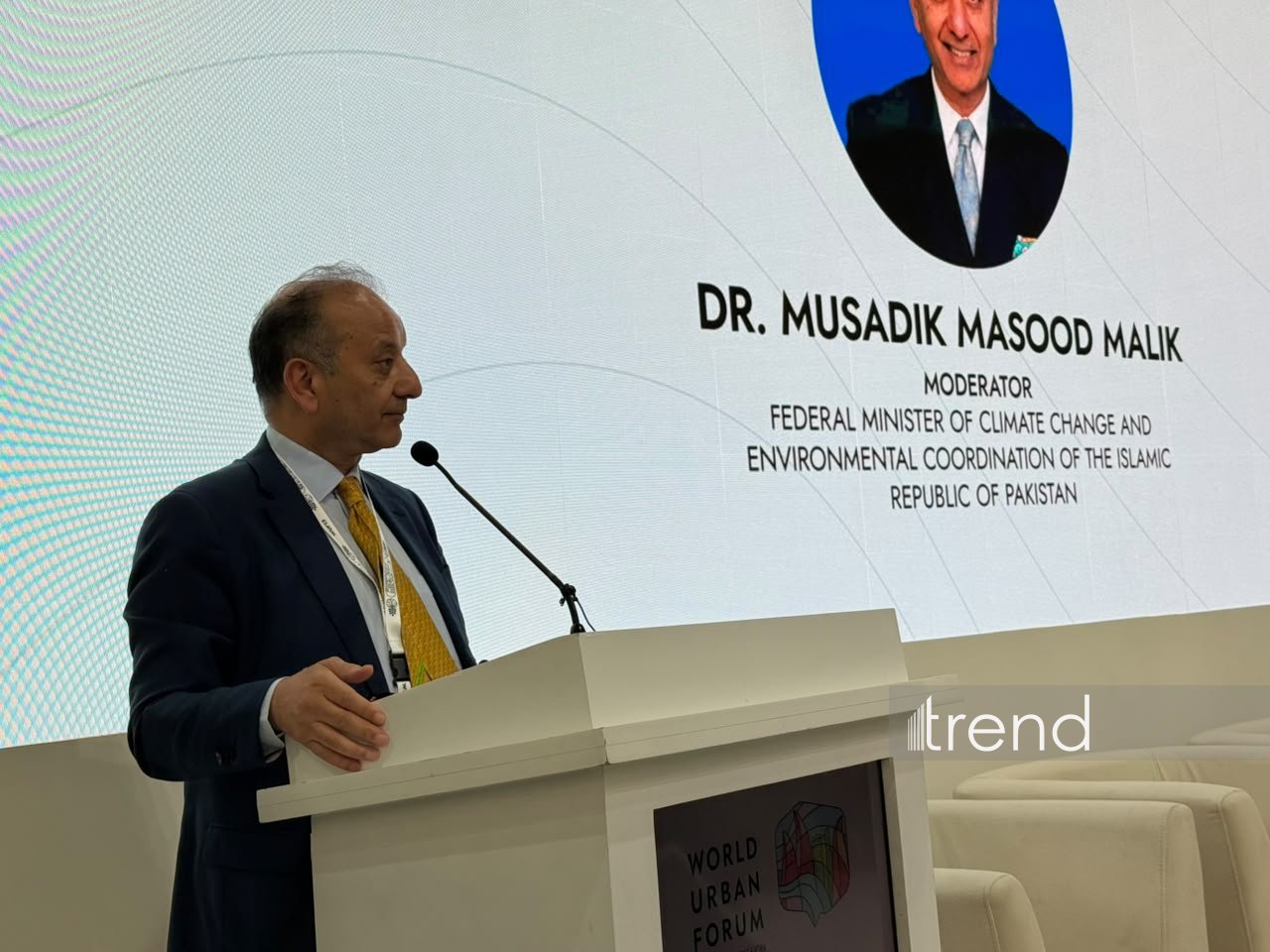

BAKU, Azerbaijan, May 19. The world is currently experiencing revolutions in nanotechnology, biotechnology, artificial intelligence, and global connectivity, yet the driving force behind all of these remains the electrification revolution, Musadik Masood Malik, Federal Minister for Climate Change and Environmental Coordination of the Islamic Republic of Pakistan, said, Trend reports.
The minister made the remarks during the event titled "High-Level Energy and Urban Dialogue of D-8 Countries" held within the framework of the 13th session of the World Urban Forum (WUF13) in Baku.
"Energy stands at the very center of production, economic growth, mobility, and people's daily lives," he noted.
The Pakistani official pointed out that the D-8 countries possess immense advantages in terms of renewable energy.
"These nations hold rich natural resources such as solar, wind, and hydropower. If integrated correctly, this potential can create a sustainable energy supply. We lack the necessity to talk about sending a rover to Mars; rather, the focus centers on a farmer or a factory worker living a normal life. People must have a house with a roof, electricity, a school, a small clinic, and a safe living environment," Malik stated.
The minister also drew attention to the global housing crisis during his speech.
"Currently, approximately 3 billion people in the world lack safe housing conditions, and more than 300 million people face actual homelessness," he flagged.
Touching upon the severe heatwaves hitting his country, the Pakistani minister noted that in 2024, temperatures reached 48 degrees Celsius in one of the country's largest cities, resulting in the loss of hundreds of lives within a single week.
"People living in impoverished neighborhoods suffer the most from energy shortages and power outages. Blackouts effectively return people to the Stone Age. When there is no energy, life stops. Over the past 10 to 15 years, climate disasters have claimed thousands of lives, injured tens of thousands, and displaced millions of people. This core question must remain at the forefront when designing urbanization and energy policies," the minister concluded.
The third day of the 13th session of the World Urban Forum (WUF13) is underway in Baku.
On the first day, a ministerial meeting dedicated to the New Urban Agenda, a roundtable of ministers, assemblies of women and civil society, business sessions, and discussions on urban well-being were held. A ceremony for raising the flags of the United Nations and Azerbaijan also took place within the framework of the forum.
The second day of the forum drew attention with the first-ever Leaders Summit. High-level discussions on the global housing crisis, urbanization policy, and urban resilience were held that day. At the same time, the Mexico City pavilion was inaugurated within the framework of WUF13. The pavilion was presented as an important platform for expanding cooperation with the Latin American region and preparing for WUF14.
WUF13, which has attracted more than 40,000 registered participants from 182 countries, will continue until May 22. Held under the theme “Housing the world: Safe and resilient cities and communities,” the forum brings together governments, international organizations, experts, and representatives of civil society to strengthen global cooperation in the field of sustainable urban development.



