


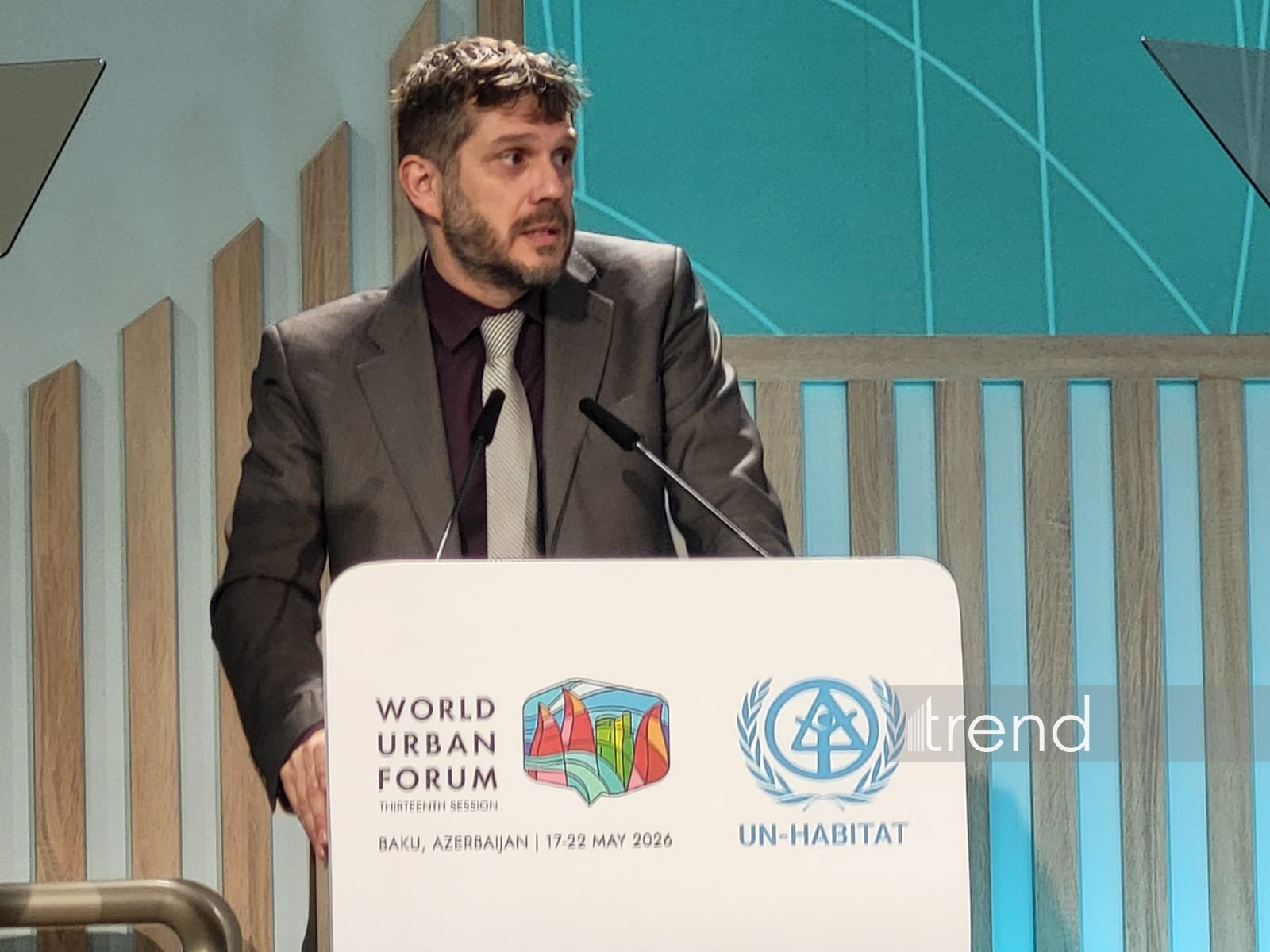

BAKU, Azerbaijan, May 19. Housing policy that ignores the metropolitan dimension leads to the construction of homes without a full-fledged urban environment or quality of life, said Jordi Vaquer, Secretary General of the Metropolis association, Trend reports.
He made the remark during a panel discussion titled "Launching the Barcelona Metropolitan Declaration: Bold Commitments to Addressing the Housing Crisis at a Metropolitan Scale" held within the framework of the 13th session of the World Urban Forum (WUF13) in Baku.
"Today, it is practically impossible to find a large city that is not simultaneously a metropolitan reality," he said.
According to Vaquer, modern megacities function as complex systems linked not only by flows of people but also by ecological, energy, and food processes.
"A metropolis connects to surrounding territories through air quality, ecological corridors, energy sources, food security, and other factors that previously fell outside the scope of the urban system," he noted.
He emphasized that governance systems ignoring these interconnections will fail to effectively protect the interests of residents. Vaquer also stated that existing metropolitan governance structures often remain underrecognized and underfunded, despite their vital role.
"The metropolitan level rarely holds constitutional backing and often lacks a presence where key decisions get made and large financial resources are allocated," he said, adding that such structures nonetheless possess a key advantage—flexibility and the capacity for collaboration between municipalities.
"Metropolitan institutions remain inherently inclusive, consultative, and open. They adapt better to dynamically changing urban realities," Vaquer stressed, pointing out that many forms of inter-city cooperation initially emerge informally, sometimes starting as WhatsApp groups of mayors looking for solutions before evolving into full-fledged governance institutions.
Speaking on housing policy, Vaquer emphasized that building housing without considering the broader urban environment does not solve the quality-of-life issue.
"You can build 100,000 housing units, but if they lack connections to jobs, education, public life, green zones, and transport, that is not creating a city—it is simply building houses," he stated, concluding that the metropolitan dimension serves as a necessary condition for forming a comfortable and sustainable urban environment.
The third day of the 13th session of the World Urban Forum (WUF13) is underway in Baku.
On the first day, a ministerial meeting dedicated to the New Urban Agenda, a roundtable of ministers, assemblies of women and civil society, business sessions, and discussions on urban well-being were held. A ceremony for raising the flags of the United Nations and Azerbaijan also took place within the framework of the forum.
The second day of the forum drew attention with the first-ever Leaders Summit. High-level discussions on the global housing crisis, urbanization policy, and urban resilience were held that day. At the same time, the Mexico City pavilion was inaugurated within the framework of WUF13. The pavilion was presented as an important platform for expanding cooperation with the Latin American region and preparing for WUF14.
WUF13, which has attracted more than 40,000 registered participants from 182 countries, will continue until May 22. Held under the theme “Housing the world: Safe and resilient cities and communities,” the forum brings together governments, international organizations, experts, and representatives of civil society to strengthen global cooperation in the field of sustainable urban development.



