


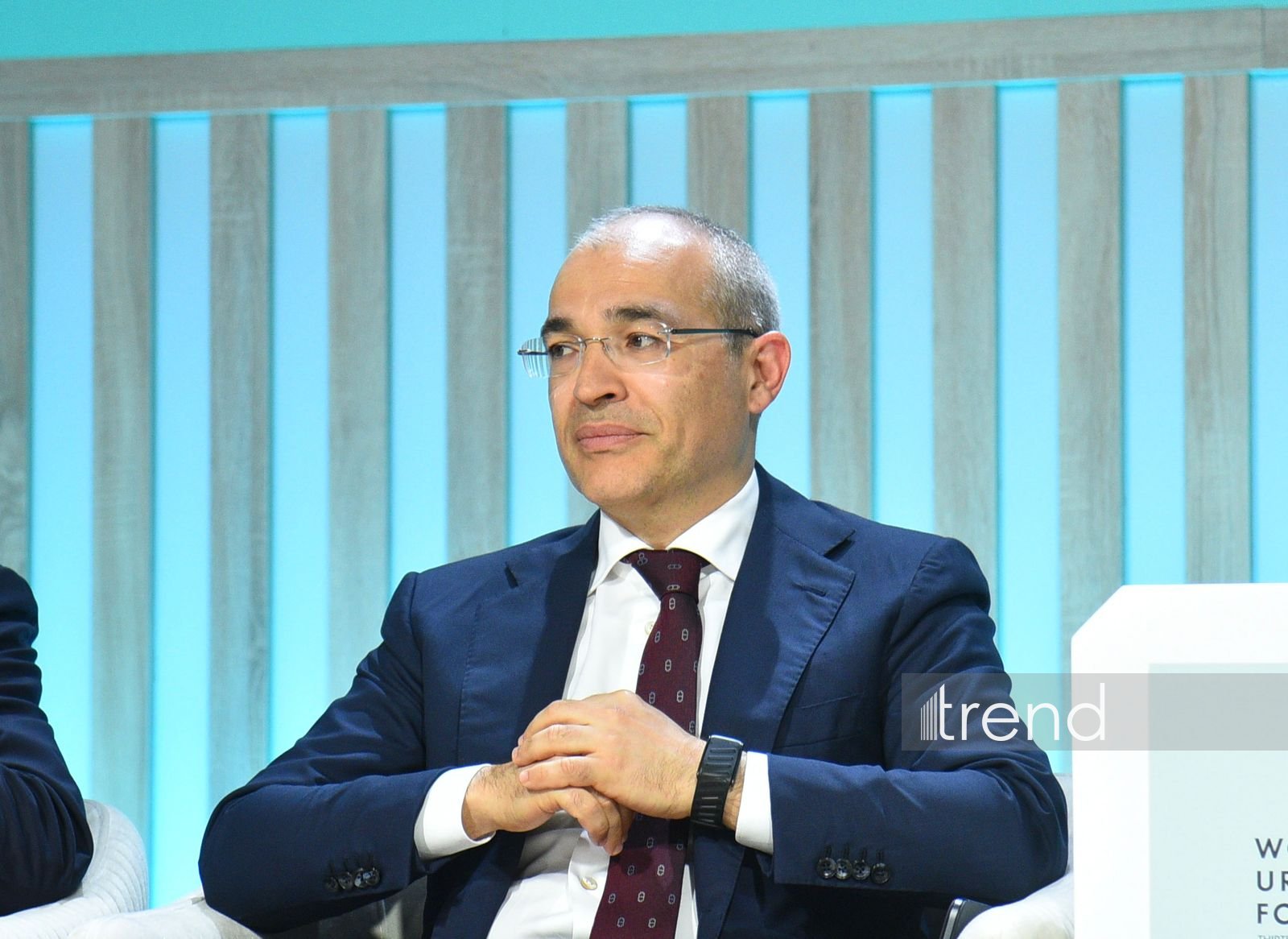

BAKU, Azerbaijan, May 19. The top priority in recovery and reconstruction efforts in the liberated territories is ensuring a sustainable return, Azerbaijan's Minister of Economy Mikayil Jabbarov said, Trend reports.
He made the remark at the event “Cities at the Center of Connectivity: Urban Reconstruction and Regional Cooperation, held as part of WUF13.
The minister noted that one of the key issues in the economic planning of the Great Return was correctly determining the sequence of job creation and economic activity.
According to him, the goal was to ensure the fastest possible return of people who had lived far from their native lands for many decades:
“To this end, an individual approach was applied in each city in the liberated territories, and state policy was aimed at developing sectors of activity in accordance with the economic potential of these territories. One of the main challenges was the parallel and prompt execution of work. To this end, broad legislative measures were implemented to stimulate economic activity, including tax incentives, preferential loans, and the creation of industrial parks.”
According to Jabbarov, connectivity is at the heart of all these processes.
He noted that preparing three airports, roads, bridges, and
digital infrastructure ahead of people’s return has been one of the
key factors accelerating and improving the quality of the Great
Return process.
The minister added that Azerbaijan’s investments in connectivity
extend not only to the country’s domestic territory but also to
access to international markets.
“The concept of a university town that has taken shape around the Garabagh University in Khankendi represents a model—the first of its kind in the history of modern Azerbaijan—based on building economic activity on an academic foundation. In cities such as Ganja, Nakhchivan, and Sheki, an approach is also being applied that focuses on developing regions where traditional knowledge and human capital are strong,” the minister added.
Meanwhile, the third day of the 13th session of the World Urban Forum (WUF13) is underway in Baku.
On the first day, a ministerial meeting dedicated to the New Urban Agenda, a roundtable of ministers, assemblies of women and civil society, business sessions, and discussions on urban well-being were held. A ceremony for raising the flags of the United Nations and Azerbaijan also took place within the framework of the forum.
The second day of the forum drew attention with the first-ever Leaders Summit. High-level discussions on the global housing crisis, urbanization policy, and urban resilience were held that day. At the same time, the Mexico City pavilion was inaugurated within the framework of WUF13. The pavilion was presented as an important platform for expanding cooperation with the Latin American region and preparing for WUF14.
WUF13, which has attracted more than 40,000 registered participants from 182 countries, will continue until May 22. Held under the theme “Housing the world: Safe and resilient cities and communities,” the forum brings together governments, international organizations, experts, and representatives of civil society to strengthen global cooperation in the field of sustainable urban development.



