


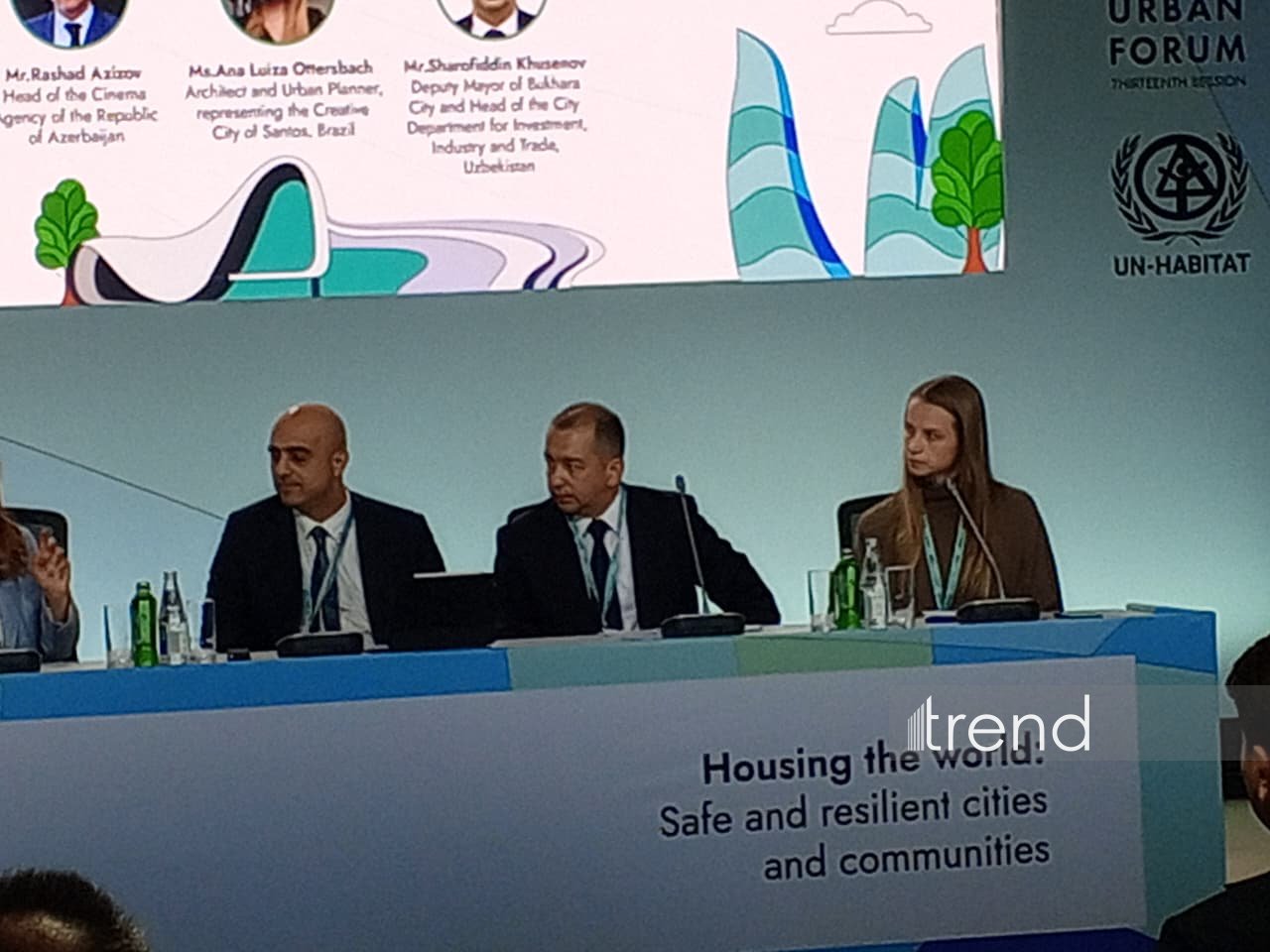
BAKU, Azerbaijan, May 19. The Uzbek city of Bukhara is strengthening its position as one of Central Asia’s leading cultural and tourist hubs, leveraging its heritage and creative industries as drivers of sustainable urban development, the deputy Mayor of Bukhara and Head of the City Department of Investment, Industry, and Trade, Sharofiddin Khusenov, said, Trend reports.
He made the statement at the panel session “UNESCO Creative Cities and Sustainable Urban Development” as part of WUF13 in Baku.
Sharofiddin Khusenov expressed gratitude to the forum organizers for providing a platform for dialogue between cities and international partners, emphasizing the importance of inclusive and sustainable urban development.
“It is a great honor for me to speak at such a high-level event as the World Urban Forum in Baku. On behalf of the Bukhara City Administration, I would like to express my sincere gratitude to the organizers for this important platform, which brings together world leaders and cities committed to sustainable, inclusive, and resilient development,” he stated.
Presenting his city, Sharofiddin Khusenov noted that Bukhara is one of the oldest cities in Central Asia, with a history spanning more than 2,500 years, and an important hub on the Great Silk Road, which historically connected the East and West and fostered cultural, scientific, and spiritual exchange.
He noted that the city is now officially recognized by UNESCO as a Creative City in the field of crafts and folk art (since 2023) and is part of the UNESCO Creative Cities Network, which brings together hundreds of cities around the world.
According to him, Bukhara is known for its unique traditions of gold embroidery, ceramics, jewelry making, and woodcarving, where crafts remain an integral part of the city’s living cultural identity.
He emphasized that in recent years, culture in Bukhara has become a key instrument of sustainable urban development, including the implementation of large-scale cultural initiatives such as the first Bukhara Biennale, “Recipes for Broken Hearts.”
“The Biennale brought together more than 200 participants from 39 countries, who presented contemporary works on the themes of food, healing, loss, and human connections. More than 70 contemporary art installations were placed within the spaces of UNESCO World Heritage sites, transforming the historic city into a vibrant cultural platform,” he noted.
He added that the project demonstrated how culture can serve as a powerful tool for urban regeneration without destroying the historical environment, but rather by enhancing its significance and relevance.
“This approach clearly shows that culture is not only about preserving heritage but also a practical tool for sustainable urban development,” Khusenov emphasized.
According to him, the Biennale had a significant impact: the event attracted approximately 3.1 million visitors, including more than 770,000 foreign guests, increased bookings for tourism services by more than 300%, and generated approximately $210 million in revenue for the tourism sector.
He also noted that the project provided free access to cultural venues, hosted educational forums, master classes, and creative workshops for young people, and served as a platform for discussing contemporary social challenges, including migration, globalization, and social sustainability.
Sharofiddin Khusenov specifically emphasized that Bukhara is currently strengthening its role on the international cultural map by developing cultural diplomacy and creative cooperation, and is preparing for new major international events, including the potential hosting of the UNESCO Creative Cities Annual Conference 2027.
In conclusion, he noted that the city possesses a well-developed tourism infrastructure, including hundreds of accommodation facilities and thousands of artisans, and is demonstrating steady growth in tourism and revenue from the sector, confirming Bukhara’s status as one of the region’s key cultural and tourist hubs.
Meanwhile, the third day of the 13th session of the World Urban Forum (WUF13) is underway in Baku.
On the first day, a ministerial meeting dedicated to the New Urban Agenda, a roundtable of ministers, assemblies of women and civil society, business sessions, and discussions on urban well-being were held. A ceremony for raising the flags of the United Nations and Azerbaijan also took place within the framework of the forum.
The second day of the forum drew attention with the first-ever Leaders Summit. High-level discussions on the global housing crisis, urbanization policy, and urban resilience were held that day. At the same time, the Mexico City pavilion was inaugurated within the framework of WUF13. The pavilion was presented as an important platform for expanding cooperation with the Latin American region and preparing for WUF14.
WUF13, which has attracted more than 40,000 registered participants from 182 countries, will continue until May 22. Held under the theme “Housing the world: Safe and resilient cities and communities,” the forum brings together governments, international organizations, experts, and representatives of civil society to strengthen global cooperation in the field of sustainable urban development.



