


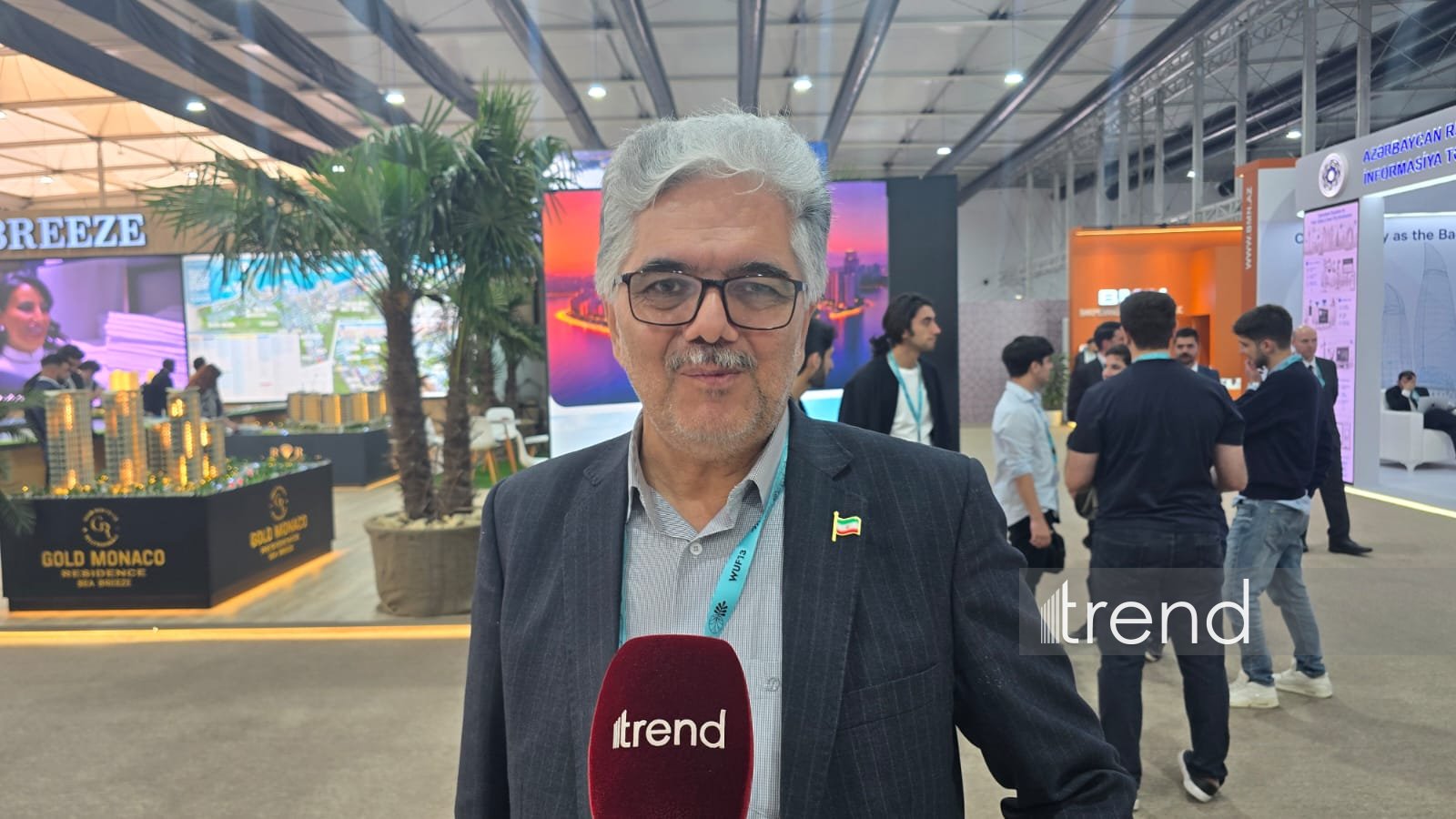

BAKU, Azerbaijan, May 19. Significant opportunities exist for expanding bilateral ties between Iran and Azerbaijan within the field of urban planning, Gholamreza Kazemian Shirvan, Deputy Minister of Roads and Urban Development of Iran, told Trend on the sidelines of the 13th session of the World Urban Forum (WUF13) in Baku.
The deputy minister spoke extensively about the prospects for urban planning cooperation between Azerbaijan and Iran.
Expressing appreciation to the Azerbaijani side for organizing the global forum, the deputy minister noted that such international platforms remain essential for fostering experience exchange among regional countries. "We thank the Government of Azerbaijan for organizing WUF13. It is gratifying that this conference takes place in a location close to our country," he said.
Gholamreza Kazemian Shirvan noted that historical and cultural links between Iran and Azerbaijan have naturally shaped similar approaches to architecture and municipal design. "Iran and Azerbaijan share numerous commonalities in urban planning and architecture, rooted in historical ties and cultural similarities. This creates a solid foundation for broader cooperation in urban development," he noted.
According to him, bilateral interaction can effectively cover the preparation of master plans, residential quarter designs, and the execution of diverse construction projects. "Extensive opportunities exist for cooperation in formulating urban development plans, executing construction projects, housing development, and other sectors. Iran possesses vast public and private sector experience in this field, which we stand ready to share with Azerbaijan. Iranian urban planning consulting, architectural, and construction firms hold deep expertise, and we remain eager to exchange these capabilities," he added.
He emphasized that Azerbaijan has also gained significant urban planning and architectural expertise in recent years, reinforcing a mutual interest in formal collaboration. "Azerbaijan possesses vital experience in urban planning and architecture, especially from recent years. This creates an excellent basis for cooperation among government agencies, the private sector, and non-governmental organizations," Kazemian noted.
The deputy minister added that while current interaction primarily bears a scientific and research-driven character, both sides plan to transform these relations into practical project implementation in the future.
He also touched upon the mutual study of urban planning projects implemented in the Karabakh region, alongside municipal development practices along the Caspian Sea coast. "Presently, cooperation remains largely research-oriented, but we aim to transition these ties to the project and execution level," he explained.
The deputy minister revealed that the two nations expect to sign a formal memorandum of understanding on urban planning and architectural cooperation in the near future. "Inshallah, a memorandum of cooperation will undergo signing between the Ministry of Roads and Urban Development of the Islamic Republic of Iran and the State Committee for Urban Planning and Architecture of Azerbaijan," he stated.
In conclusion, he emphasized that expanding urban planning cooperation between the two countries will contribute significantly to regional development and knowledge transfer.
The third day of the 13th session of the World Urban Forum (WUF13) is underway in Baku.
On the first day, a ministerial meeting dedicated to the New Urban Agenda, a roundtable of ministers, assemblies of women and civil society, business sessions, and discussions on urban well-being were held. A ceremony for raising the flags of the United Nations and Azerbaijan also took place within the framework of the forum.
The second day of the forum drew attention with the first-ever Leaders Summit. High-level discussions on the global housing crisis, urbanization policy, and urban resilience were held that day. At the same time, the Mexico City pavilion was inaugurated within the framework of WUF13. The pavilion was presented as an important platform for expanding cooperation with the Latin American region and preparing for WUF14.
WUF13, which has attracted more than 40,000 registered participants from 182 countries, will continue until May 22. Held under the theme “Housing the world: Safe and resilient cities and communities,” the forum brings together governments, international organizations, experts, and representatives of civil society to strengthen global cooperation in the field of sustainable urban development.



