


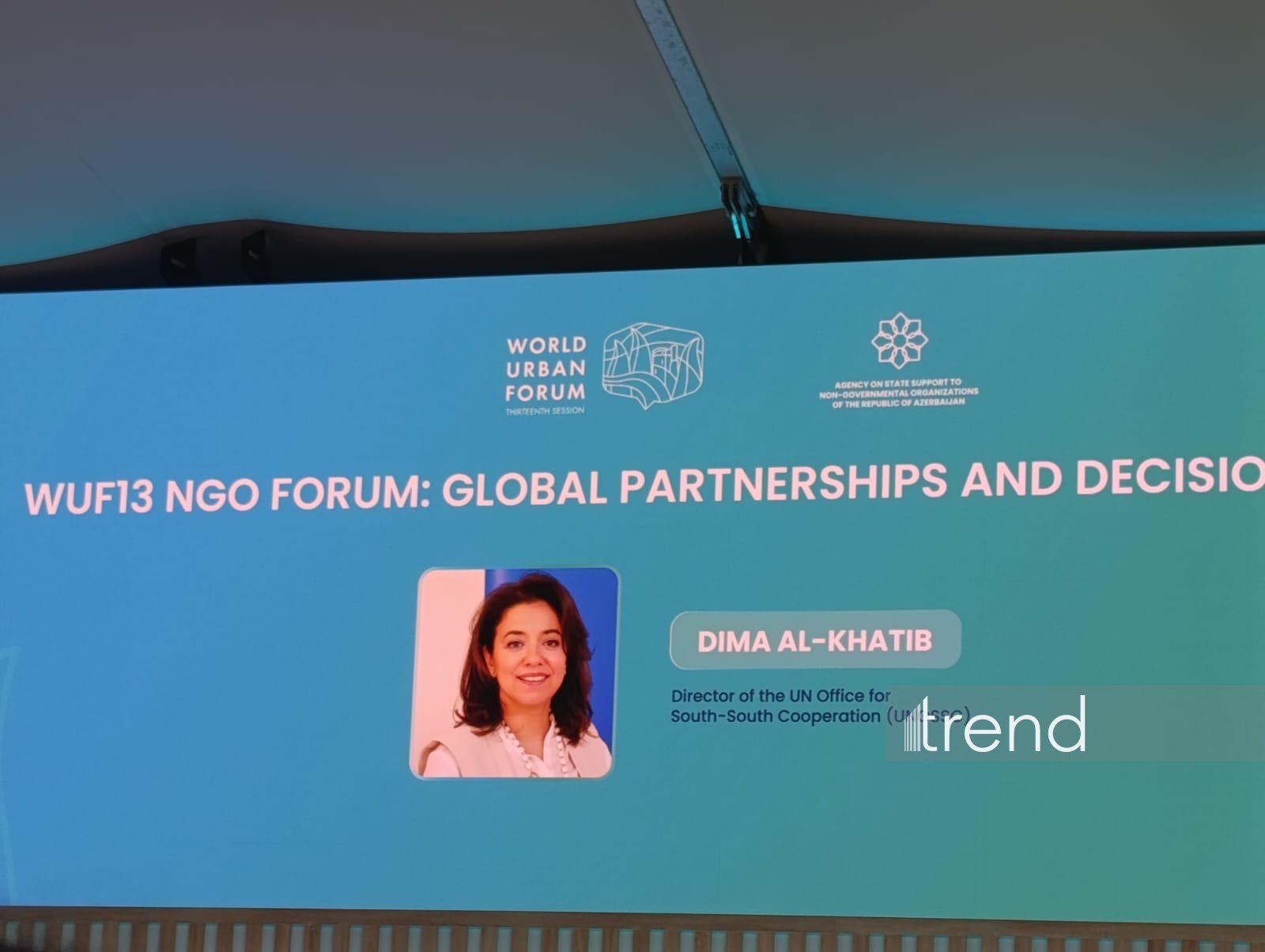
BAKU, Azerbaijan, May 19. Approximately 70% of the world's population will live in urban areas by 2050, and as urbanization accelerates, the importance of participatory governance increases further, Dima Al-Khatib, Director of the United Nations Office for South-South Cooperation (UNOSSC), said, Trend reports.
The director made the remarks during her speech at the event titled "WUF13 NGO Forum: Global Partnerships and Decision-Making" held within the framework of the 13th session of the World Urban Forum (WUF13) in Baku.
According to her, NGOs actively participate at an informal level in areas such as climate adaptation measures, disaster preparedness, and digital inclusivity, thereby contributing to the early identification of emerging needs and the formulation of inclusive urban policies.
"In this regard, NGOs often play the role of a trusted mediator between communities and institutions. They also uncover and bring to the agenda practical solutions that might otherwise be overlooked," Al-Khatib said.
"In cooperation with UNESCO and UN-Habitat, we pay special attention to heritage preservation, climate action, urban resilience, and recovery processes. At the same time, training sessions on disaster risk reduction get organized. To date, we have implemented training programs covering people across 168 countries and thousands of communities. We believe that NGOs should play an even more active role in this ecosystem. Resilient cities build themselves on inclusivity, local ownership, and mutual trust. Cities must become the primary driving force for change and innovation," she noted.
The third day of the 13th session of the World Urban Forum (WUF13) is underway in Baku.
On the first day, a ministerial meeting dedicated to the New Urban Agenda, a roundtable of ministers, assemblies of women and civil society, business sessions, and discussions on urban well-being were held. A ceremony for raising the flags of the United Nations and Azerbaijan also took place within the framework of the forum.
The second day of the forum drew attention with the first-ever Leaders Summit. High-level discussions on the global housing crisis, urbanization policy, and urban resilience were held that day. At the same time, the Mexico City pavilion was inaugurated within the framework of WUF13. The pavilion was presented as an important platform for expanding cooperation with the Latin American region and preparing for WUF14.
WUF13, which has attracted more than 40,000 registered participants from 182 countries, will continue until May 22. Held under the theme “Housing the world: Safe and resilient cities and communities,” the forum brings together governments, international organizations, experts, and representatives of civil society to strengthen global cooperation in the field of sustainable urban development.



