


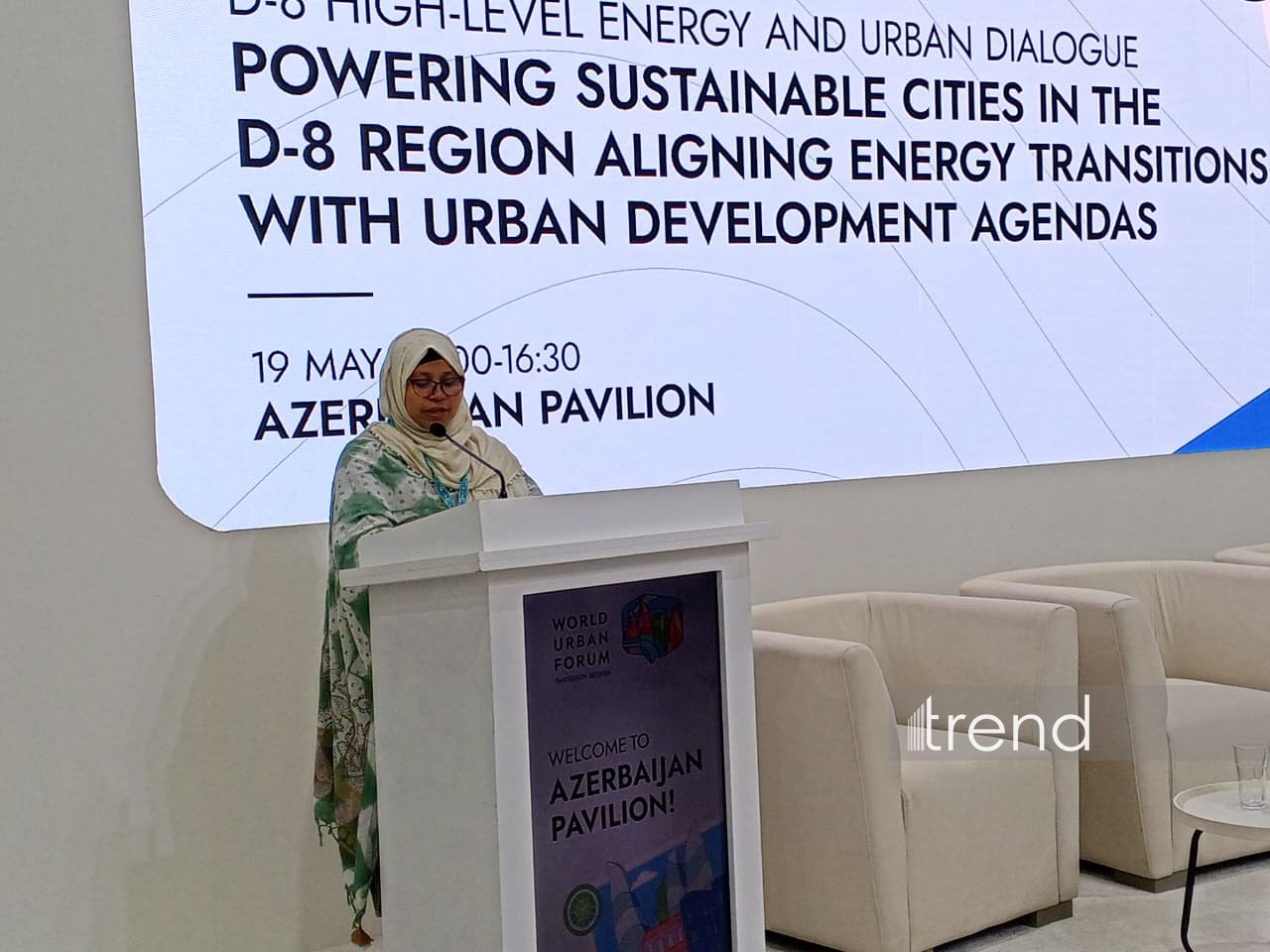

BAKU, Azerbaijan, May 19. Bangladesh presented its projects aimed at promoting sustainable urbanization and improving energy efficiency at the 13th World Urban Forum (WUF13). Ferdousi Begum, the Chairman of the National Housing Authority (NHA) under the Ministry of Housing and Public Works of Bangladesh, said, Trend reports.
He made the announcement at the panel session, High-Level Energy and Urban Dialogue of D-8 Countries, held as part of WUF13.
According to her, Bangladesh views sustainable urbanization not only as an environmental necessity but also as a key tool for inclusive economic growth, climate resilience, and energy security.
“Bangladesh, one of the countries undergoing one of the fastest urbanization processes in the world, attaches particular importance to the coordinated development of housing, infrastructure, and energy systems. Reducing carbon emissions and transitioning to an energy-efficient development model are among our top priorities,” she said.
Throughout the presentation, it was emphasized that Bangladesh is implementing projects to provide affordable, climate-resilient, and energy-efficient housing for low-income and vulnerable groups. “The Dhaka Urban Development Project integrates solar energy, digitalization, a green living environment, and employment support. The country is accelerating the development of renewable energy, green construction, energy-efficient transportation, and sustainable transport systems toward low-carbon urban development.”
Begum noted that Bangladesh has received international recognition for its achievements in decentralized solar energy and is currently increasing the number of rooftop solar panels as well as public facilities powered by solar energy.
“Sustainable urbanization and the energy transition must be people-centered, inclusive, and affordable, and cities must both reduce emissions and improve people’s well-being,” the Bangladeshi official added.
Meanwhile, the third day of the 13th session of the World Urban Forum (WUF13) is underway in Baku.
On the first day, a ministerial meeting dedicated to the New Urban Agenda, a roundtable of ministers, assemblies of women and civil society, business sessions, and discussions on urban well-being were held. A ceremony for raising the flags of the United Nations and Azerbaijan also took place within the framework of the forum.
The second day of the forum drew attention with the first-ever Leaders Summit. High-level discussions on the global housing crisis, urbanization policy, and urban resilience were held that day. At the same time, the Mexico City pavilion was inaugurated within the framework of WUF13. The pavilion was presented as an important platform for expanding cooperation with the Latin American region and preparing for WUF14.
WUF13, which has attracted more than 40,000 registered participants from 182 countries, will continue until May 22. Held under the theme “Housing the world: Safe and resilient cities and communities,” the forum brings together governments, international organizations, experts, and representatives of civil society to strengthen global cooperation in the field of sustainable urban development.



