


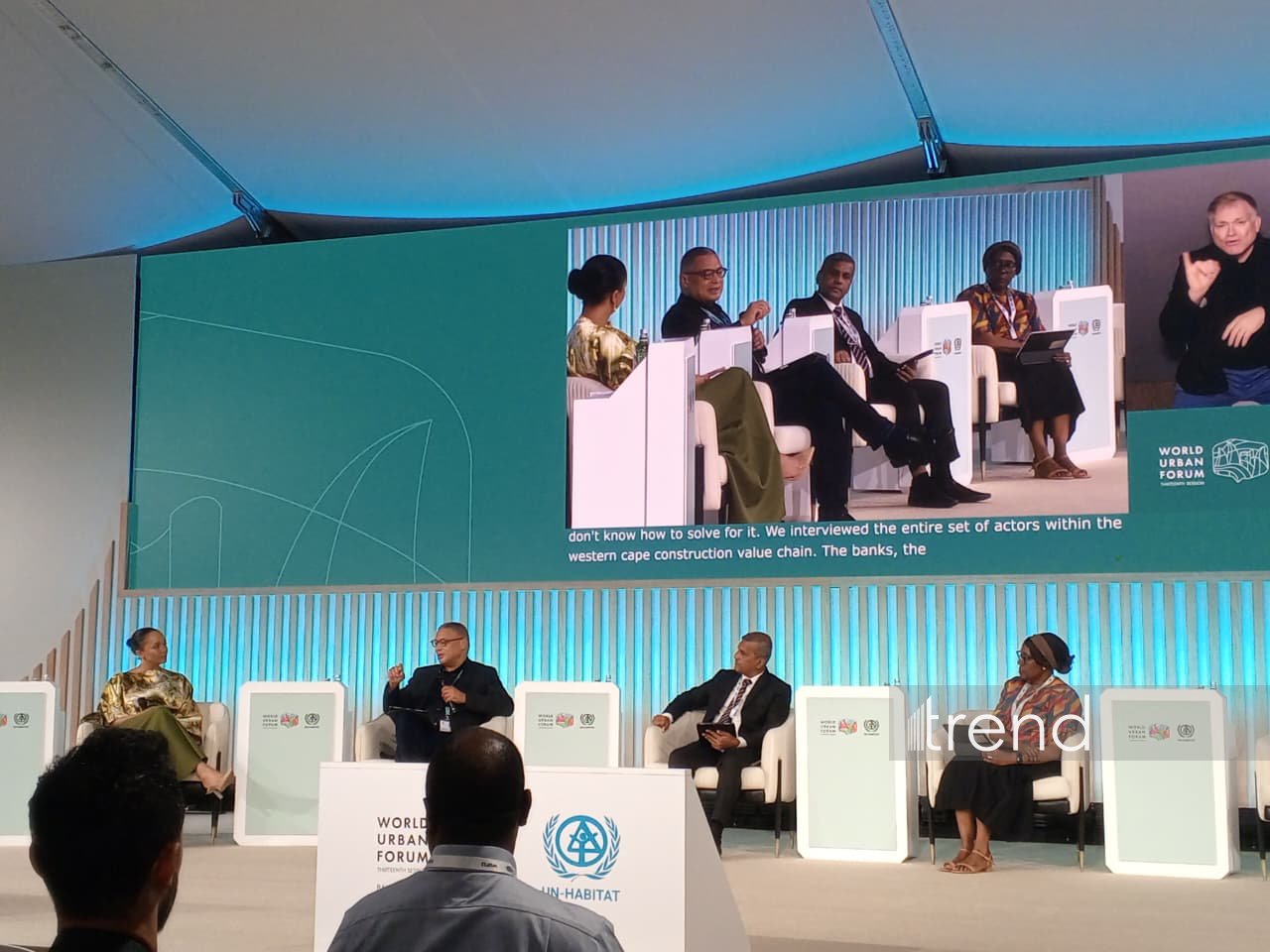
BAKU, Azerbaijan, May 20. Attempts to artificially "redesign" cities through the creation of new satellite agglomerations without addressing the structural problems of existing cities are a wrong approach to urban policy, Founder of the African Centre for Cities (ACC), Professor Edgar Pieterse said at the panel discussion titled "The Climate-Housing Nexus" within the framework of the 13th session of the World Forum of Cities (WUF13) in Baku, Trend reports.
"It's very difficult to consider urban development issues in the abstract, as they manifest themselves differently in different contexts," he noted.
According to him, research participants generally agree on the criteria for affordable, climate-resilient, and energy-efficient housing, but a significant gap remains between stated goals and practical implementation.
"We see that all participants agree on these principles, but in practice, there is an almost insurmountable gap between affordability and actual construction solutions," he added.
Pieterse emphasized that the construction sector involves numerous players—banks, developers, engineers, contractors, and others—but none is fully prepared to shoulder the risks of transforming construction models.
In this regard, he announced the need to implement more stringent regulatory and incentive mechanisms that will facilitate behavioral change among market participants.
The professor also addressed the issue of urbanization and the role of secondary cities, noting the differences between the European and African contexts and emphasizing that migration processes and the concentration of opportunities in large cities continue to intensify.
In his opinion, instead of attempting to artificially create new cities, it is necessary to focus on addressing the structural problems of existing urban spaces and increasing their sustainability and accessibility.
Today marks the fourth day of WUF13 in Baku.
The first day included a ministerial meeting dedicated to the New Urban Agenda, a ministerial roundtable, assemblies for women and civil society, business sessions, and discussions on urban prosperity. An official ceremony marking the raising of the UN and Azerbaijani flags also took place.
The second day stood out for the inaugural Leaders' Summit, featuring high-level discussions on the global housing crisis, urbanization policy, and urban resilience. Concurrently, the opening of the Mexico City pavilion took place, serving as a significant platform for expanding cooperation with the Latin American region and preparing for WUF14.
The third day of WUF13 featured a comprehensive program of events covering the global housing crisis, the formation of safe and inclusive cities, climate resilience, artificial intelligence and urban governance, green urbanization, social equity, and sustainable transport.
WUF13, which has attracted more than 40,000 registered participants from 182 countries, will continue until May 22. Held under the theme “Housing the world: Safe and resilient cities and communities,” the forum brings together governments, international organizations, experts, and representatives of civil society to strengthen global cooperation in the field of sustainable urban development.



