


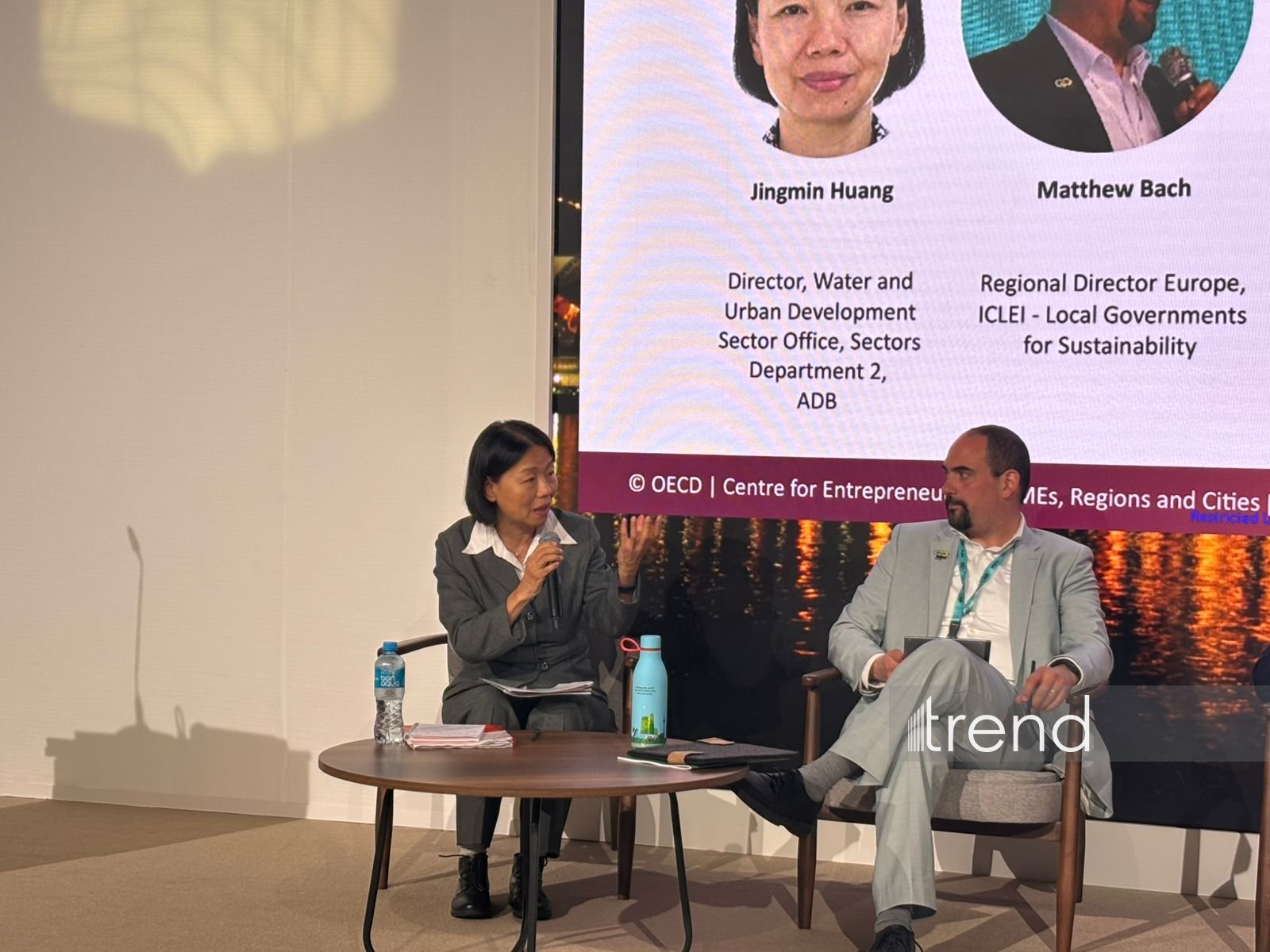

BAKU, Azerbaijan, May 20. The deployment of nature-positive approaches shifts from an option to a necessity for modern cities, particularly under conditions of rapid urbanization and escalating climate risks, said Jingmin Huang, Director of the Water and Urban Development Sector Office at the Asian Development Bank (ADB), Trend reports.
The official made the remarks during a session titled "Building Nature-Positive Cities Housing, Resilience, and Sustainable Urban Futures" held within the framework of the World Urban Forum (WUF13) in Baku.
According to her, the ADB actively supports investments in natural capital and the development of nature-positive policies. She recalled that two years ago in Baku, during the COP29 summit, the bank introduced its Environmental Action Plan for 2024–2030, titled "Toward a Nature-Positive Asia and the Pacific."
"This plan represents a roadmap to combat biodiversity loss, environmental pollution, and climate change across sectors such as urban development, water supply, transport, agriculture, and energy," Huang noted.
She emphasized that for Asian cities, nature-positive approaches are no longer optional: "In this regard, the ADB actively deploys nature-based solutions to enhance climate resilience, improve public health, and elevate the quality of the urban environment."
"One development track involves retrofitting existing urban territories by creating additional green spaces. Research demonstrates that such small green zones help reduce stress levels among residents while simultaneously supporting biodiversity, creating habitats for birds and wildlife," she said.
Huang identified the integration of "green" and "blue" infrastructure into urban planning as a second vital priority, highlighting the application of the "sponge city" concept popular in China. She stated that such solutions allow municipalities to manage floods more effectively compared to traditional, costly "grey" infrastructure.
At the same time, according to her, the deployment of nature-positive solutions faces a series of challenges, including land resource scarcity, the necessity of coordination between state structures, municipalities, and local communities, and financing complexities.
The ADB representative emphasized that nature-positive cities encompass far more than just planting trees and creating parks; they require a fundamentally different approach to urban planning that systematically integrates nature into the development of the urban environment.
Today marks the fourth day of WUF13 in Baku.
The first day included a ministerial meeting dedicated to the New Urban Agenda, a ministerial roundtable, assemblies for women and civil society, business sessions, and discussions on urban prosperity. An official ceremony marking the raising of the UN and Azerbaijani flags also took place.
The second day stood out for the inaugural Leaders' Summit, featuring high-level discussions on the global housing crisis, urbanization policy, and urban resilience. Concurrently, the opening of the Mexico City pavilion took place, serving as a significant platform for expanding cooperation with the Latin American region and preparing for WUF14.
The third day of WUF13 featured a comprehensive program of events covering the global housing crisis, the formation of safe and inclusive cities, climate resilience, artificial intelligence and urban governance, green urbanization, social equity, and sustainable transport.
WUF13, which has attracted more than 40,000 registered participants from 182 countries, will continue until May 22. Held under the theme “Housing the world: Safe and resilient cities and communities,” the forum brings together governments, international organizations, experts, and representatives of civil society to strengthen global cooperation in the field of sustainable urban development.



