


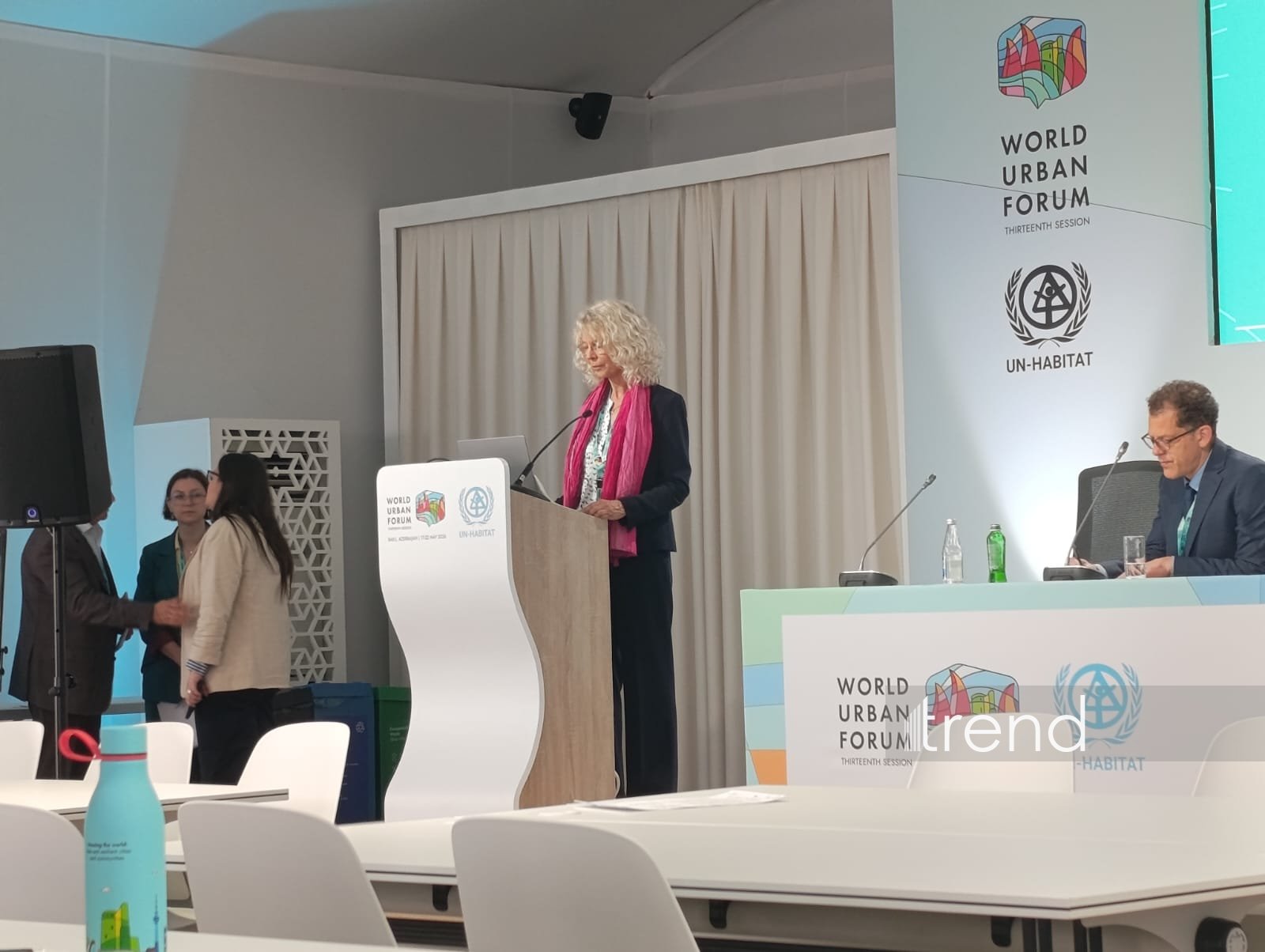

BAKU, Azerbaijan, May 20. Without institutional capacity, recovery efforts remain fragmented, said Evita Schmieg, a trade policy expert from Germany, Trend reports.
The expert made the remarks during a training session titled "Policies, papers, and bricks Capacity Building for Crisis Preparedness and Response" held within the framework of the 13th session of the World Urban Forum (WUF13) in Baku.
"Recovery does not solely concern physical infrastructure. It equally concerns institutions, management capabilities, and the capacity of municipalities to make decisions under pressure. This is precisely where capacity building becomes critically vital," she noted.
According to her, cities require trained local administrations, effective coordination mechanisms, and reliable planning systems. Without institutional capacity, recovery remains fragmented, reactive, and ultimately unsustainable.
Schmieg emphasized that the Ukrainian experience demonstrates the importance of practical and locally oriented approaches. Tools must function under real-world conditions: crisis coordination, geospatial data for recovery planning, high-quality information management, and cooperation among local authorities, civil society, and international partners emerge as key elements of resilience.
She also pointed out that crisis readiness and recovery remain impossible without a comprehensive approach. The housing sector, energy supply, local governance, digital infrastructure, and social cohesion must undergo evaluation as a unified system if cities aim to remain functional under the pressure of crises.
Germany, Schmieg concluded, remains firmly committed to supporting Ukraine and its municipalities as key actors in recovery and sustainable development.
Today marks the fourth day of WUF13 in Baku.
The first day included a ministerial meeting dedicated to the New Urban Agenda, a ministerial roundtable, assemblies for women and civil society, business sessions, and discussions on urban prosperity. An official ceremony marking the raising of the UN and Azerbaijani flags also took place.
The second day stood out for the inaugural Leaders' Summit, featuring high-level discussions on the global housing crisis, urbanization policy, and urban resilience. Concurrently, the opening of the Mexico City pavilion took place, serving as a significant platform for expanding cooperation with the Latin American region and preparing for WUF14.
The third day of WUF13 featured a comprehensive program of events covering the global housing crisis, the formation of safe and inclusive cities, climate resilience, artificial intelligence and urban governance, green urbanization, social equity, and sustainable transport.
WUF13, which has attracted more than 40,000 registered participants from 182 countries, will continue until May 22. Held under the theme “Housing the world: Safe and resilient cities and communities,” the forum brings together governments, international organizations, experts, and representatives of civil society to strengthen global cooperation in the field of sustainable urban development.



