


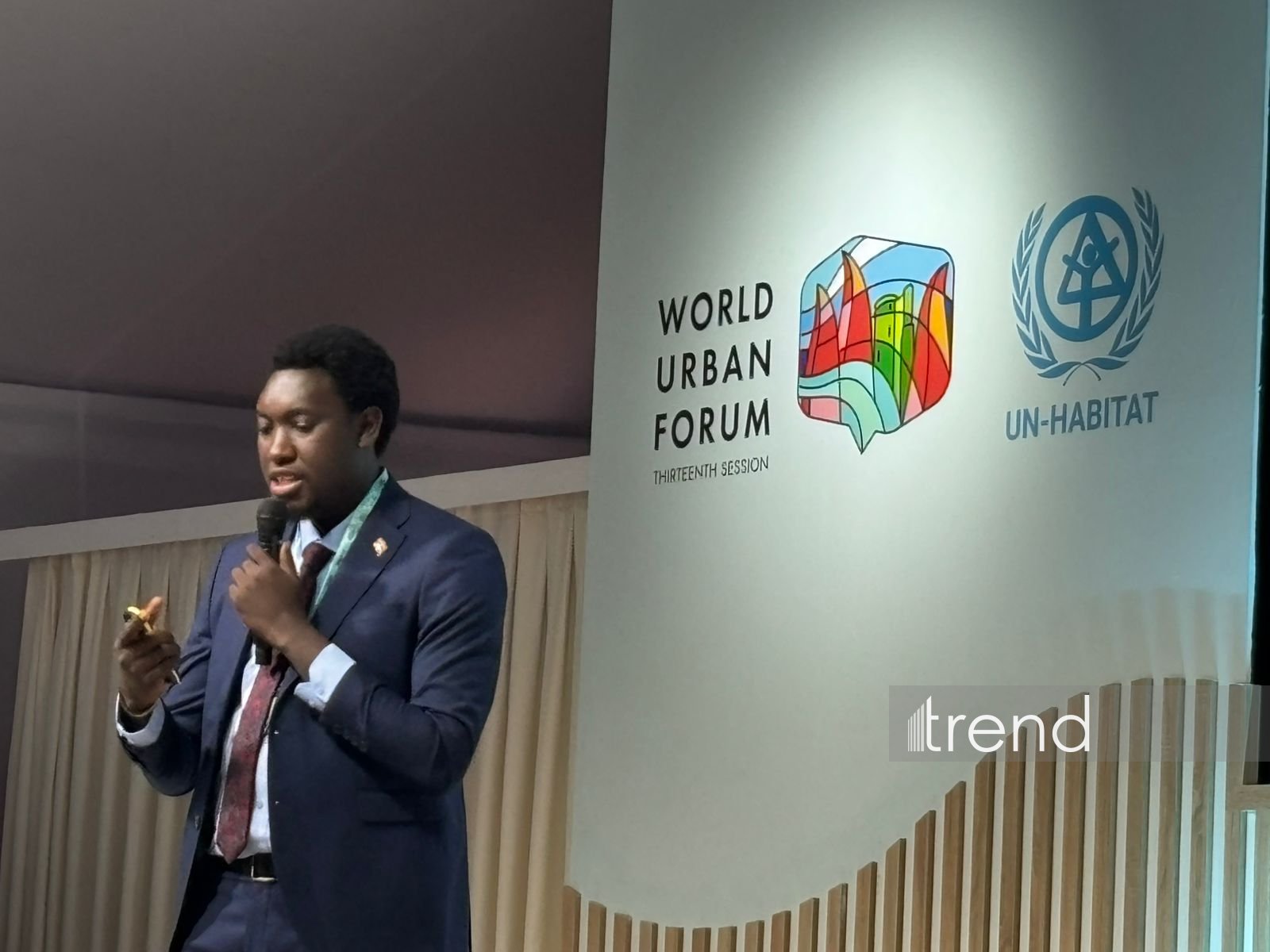

BAKU, Azerbaijan, May 20. Plastic waste must be perceived not merely as an environmental liability, but as a viable resource capable of driving innovation and generating new employment opportunities, Sinan Kitagenda Tiki, CEO and Co-founder of WastePlus, said, Trend reports.
He made the remarks during a session titled "Closing the Loop: Advancing Waste Management on the Path to a Circular Economy" held within the framework of the 13th session of the World Urban Forum (WUF13) in Baku.
During his address, Tiki shared that in Uganda, plastic waste was routinely repurposed by children to manufacture makeshift soccer balls. "For most people, it is just a plastic container. But for us in our childhood, it was a soccer ball," he noted. According to him, such formative experiences from an early age shaped an understanding of how waste materials can receive a second life and undergo repetitive reuse.
Tiki recounted that during his university years, he confronted a severe absence of an efficient waste management system. "I could not imagine that the university I felt so proud of would find itself in a worse state than my primary school. Waste lay everywhere, and organized collection points were completely nonexistent," he said.
This operational gap propelled him into environmental activism. Alongside fellow students, he organized initial sustainability initiatives and established a student group focused on ecology and waste management.
According to Tiki, years of hands-on experience led him to the conclusion that the waste crisis cannot undergo resolution solely through collection mechanisms. "We realized that waste holds inherent value. If plastic bottles continue to enter production, it follows that we must seek superior solutions for their cyclical reuse," he emphasized.
He noted that following his graduation, he began experimenting with various plastic recycling modalities and constructing innovative solutions based on recycled inputs. One such project culminated in manufacturing the first marine vessel constructed entirely from recycled plastic.
"This single project allowed for the creation of roughly 60 temporary jobs and successfully extracted over 10,000 plastic bottles from the natural environment," Tiki reported.
The expansion of the circular economy and the strategic backing of youth-led initiatives possess the capacity to play a pivotal role in resolving the global waste crisis and shaping sustainable municipal environments, the CEO concluded.
Today marks the fourth day of WUF13 in Baku.
The first day included a ministerial meeting dedicated to the New Urban Agenda, a ministerial roundtable, assemblies for women and civil society, business sessions, and discussions on urban prosperity. An official ceremony marking the raising of the UN and Azerbaijani flags also took place.
The second day stood out for the inaugural Leaders' Summit, featuring high-level discussions on the global housing crisis, urbanization policy, and urban resilience. Concurrently, the opening of the Mexico City pavilion took place, serving as a significant platform for expanding cooperation with the Latin American region and preparing for WUF14.
The third day of WUF13 featured a comprehensive program of events covering the global housing crisis, the formation of safe and inclusive cities, climate resilience, artificial intelligence and urban governance, green urbanization, social equity, and sustainable transport.
WUF13, which has attracted more than 40,000 registered participants from 182 countries, will continue until May 22. Held under the theme “Housing the world: Safe and resilient cities and communities,” the forum brings together governments, international organizations, experts, and representatives of civil society to strengthen global cooperation in the field of sustainable urban development.



