


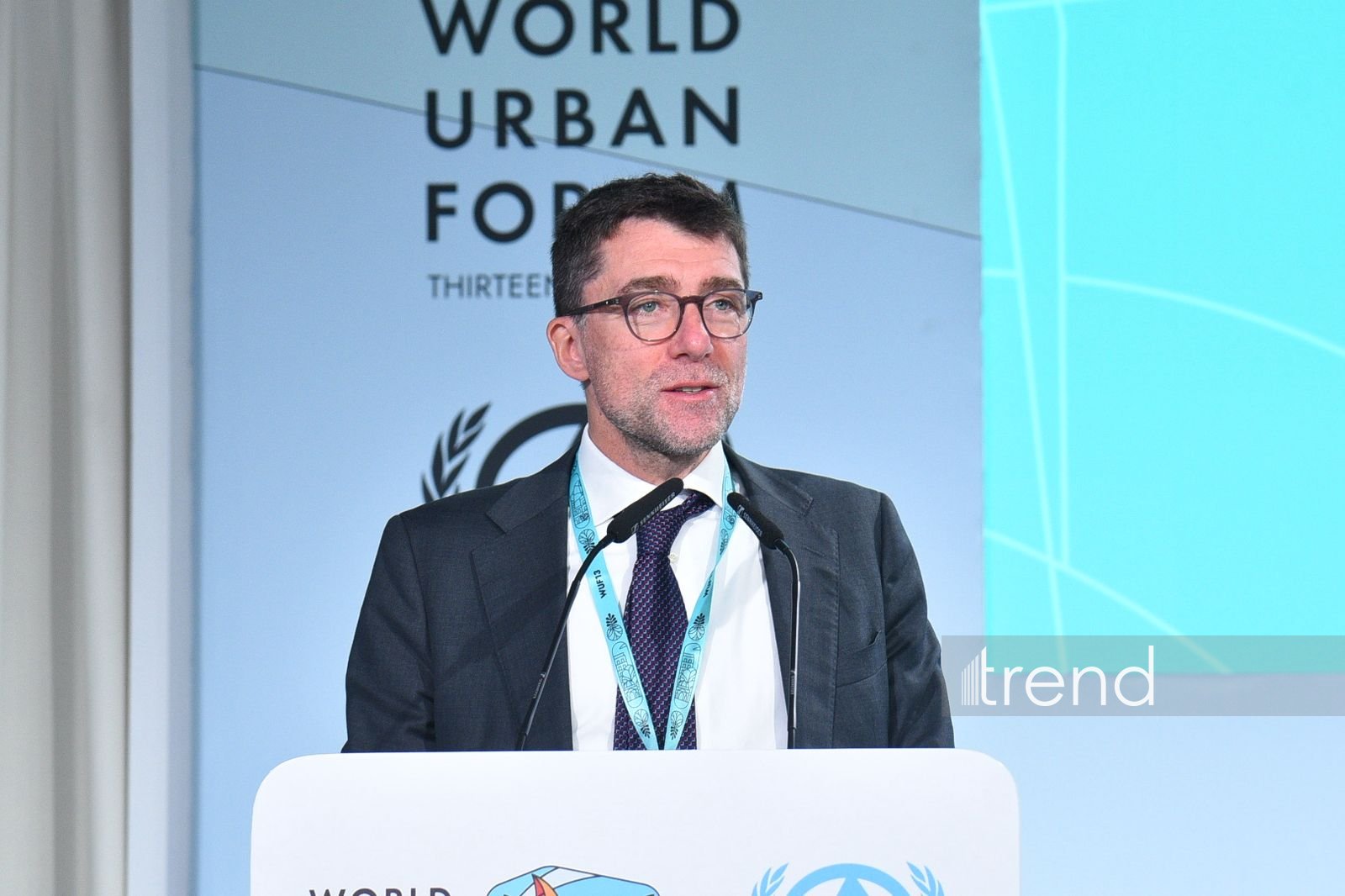

BAKU, Azerbaijan, May 20. There is a very clear link between buildings, industry, and the climate, Riccardo Savigliano, Head of the Energy Systems and Industrial Decarbonization Division at the United Nations Industrial Development Organization (UNIDO), said, Trend reports.
He made the remark during a session titled “Decarbonizing housing and buildings at the City-Industry-Climate Nexus” as part of WUF13.
“The product most consumed by humanity is, of course, water. We use water for everything—for life, sanitation, and production. The second most consumed product by humanity on a per capita basis is concrete. Thus, we cannot separate the development of our societies from the use of concrete,” he said.
Savillano noted that every month, a city roughly the size of New York is built somewhere in the world. And this trend will continue until 2050. Seventy percent of the infrastructure needed to accommodate the growing urban population has yet to be built.
"And we're not just talking about housing, but also about infrastructure for manufacturing, for transporting people, for providing services, for water distribution, water treatment, and so on. All of this infrastructure will, in one way or another, rely on the use of cement, concrete, and steel. But the main problem is that if the cement industry were a country, it would be the third-largest source of CO2 emissions. This is a huge challenge—both from an industrial perspective and, as mentioned earlier, from a development perspective. “That is why at UNIDO, together with other partners, we are really looking into this issue. And there is a very clear link between buildings, industry, and the climate,” he said.
Savigliano noted that buildings and housing lie at the intersection of industry, social development, and infrastructure. Therefore, decarbonizing this interplay has become a necessity.
Today, the fourth day of the WUF13 conference is taking place in Baku.
The first day included a ministerial meeting dedicated to the New Urban Agenda, a ministerial roundtable, assemblies for women and civil society, business sessions, and discussions on urban prosperity. An official ceremony marking the raising of the UN and Azerbaijani flags also took place.
The second day stood out for the inaugural Leaders' Summit, featuring high-level discussions on the global housing crisis, urbanization policy, and urban resilience. Concurrently, the opening of the Mexico City pavilion took place, serving as a significant platform for expanding cooperation with the Latin American region and preparing for WUF14.
The third day of WUF13 featured a comprehensive program of events covering the global housing crisis, the formation of safe and inclusive cities, climate resilience, artificial intelligence and urban governance, green urbanization, social equity, and sustainable transport.
WUF13, which has attracted more than 40,000 registered participants from 182 countries, will continue until May 22. Held under the theme “Housing the world: Safe and resilient cities and communities,” the forum brings together governments, international organizations, experts, and representatives of civil society to strengthen global cooperation in the field of sustainable urban development.



