


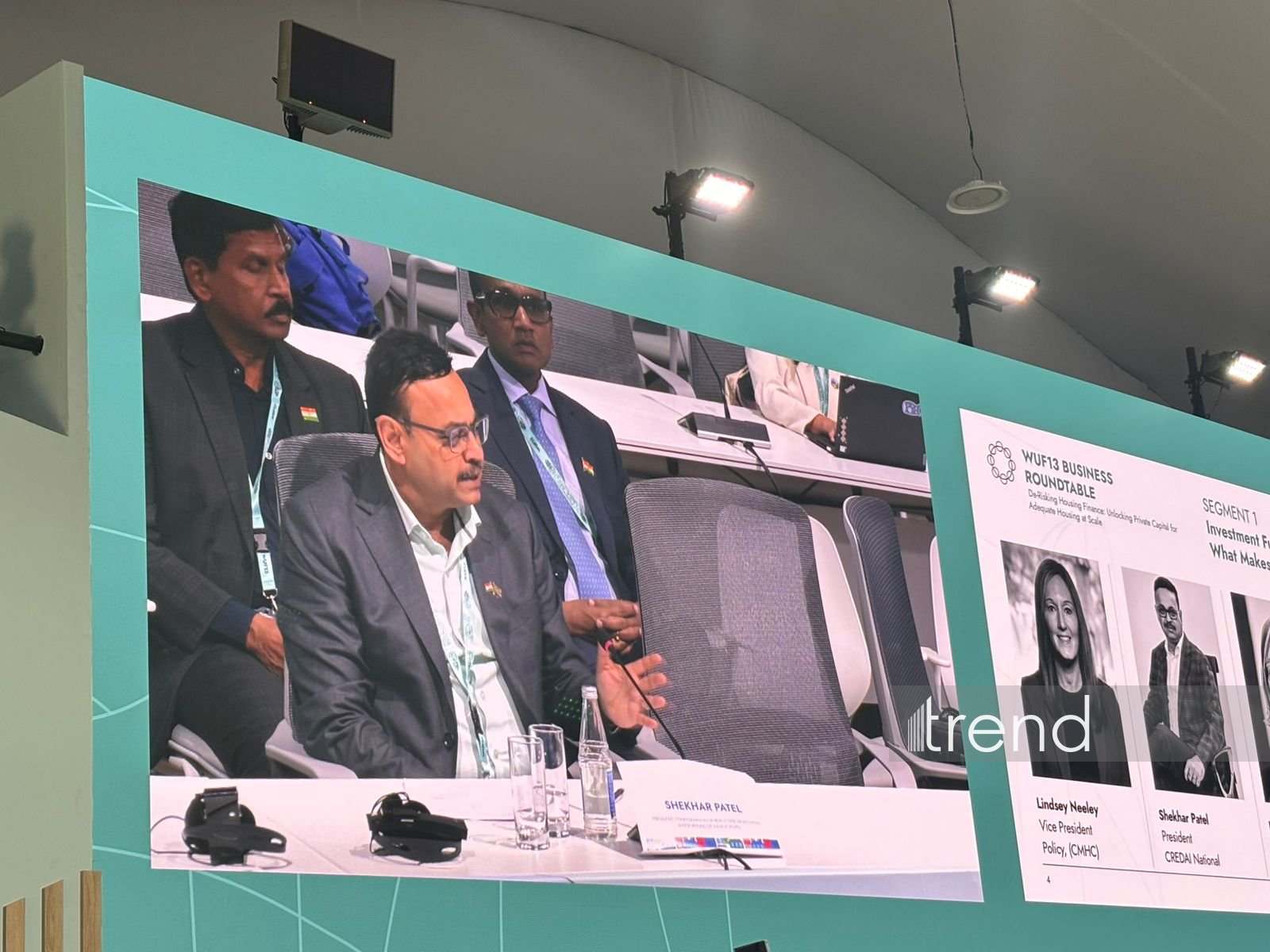

BAKU, Azerbaijan, May 20. A more flexible and modern model for defining affordable housing is needed, President of CREDAI National (Confederation of Real Estate Developers’ Associations of India), Shekhar Patel said, Trend reports.
He made the statement during a business roundtable on affordable housing financing held as part of the World Cities Forum in Baku.
Shekhar Patel stated that the key problem facing India’s affordable housing market is not a shortage of demand or supply, but rather an outdated regulatory definition of the “affordable housing” category.
Moreover, he noted that the current criteria, introduced about eight years ago, no longer reflect the current economic reality.
According to him, there remains steady demand in India for housing units ranging from 60 to 90 square meters in the middle and lower-middle-class segments; however, such properties do not always formally qualify as affordable housing due to the established price threshold of approximately 45 lakh rupees (about $42,000).
He emphasized that in recent years, construction costs have risen significantly due to inflation and increases in the cost of land, materials, and infrastructure, while housing prices have risen by an average of 8–10% annually.
“As a result, apartments that previously met the criteria for affordable housing now cost nearly twice as much, yet still do not qualify under the updated classification,” he said.
Patel also highlighted the tax burden in the real estate sector, noting that combined city, state, and federal taxes can reach 31–50% of a property’s value, which further limits housing affordability for buyers.
He called for a reevaluation of the approach to defining affordable housing, suggesting that the criteria should focus not only on price but also on square footage, urban characteristics, and a country’s level of economic development. In his view, the current classification system distorts statistics and reduces the effectiveness of government support programs.
“We have been discussing this with the government for the past few years and believe that a more flexible and modern model for defining affordable housing is necessary,” he noted.
Today, the fourth day of the WUF13 conference is taking place in Baku.
The first day included a ministerial meeting dedicated to the New Urban Agenda, a ministerial roundtable, assemblies for women and civil society, business sessions, and discussions on urban prosperity. An official ceremony marking the raising of the UN and Azerbaijani flags also took place.
The second day stood out for the inaugural Leaders' Summit, featuring high-level discussions on the global housing crisis, urbanization policy, and urban resilience. Concurrently, the opening of the Mexico City pavilion took place, serving as a significant platform for expanding cooperation with the Latin American region and preparing for WUF14.
The third day of WUF13 featured a comprehensive program of events covering the global housing crisis, the formation of safe and inclusive cities, climate resilience, artificial intelligence and urban governance, green urbanization, social equity, and sustainable transport.
WUF13, which has attracted more than 40,000 registered participants from 182 countries, will continue until May 22. Held under the theme “Housing the world: Safe and resilient cities and communities,” the forum brings together governments, international organizations, experts, and representatives of civil society to strengthen global cooperation in the field of sustainable urban development.



