


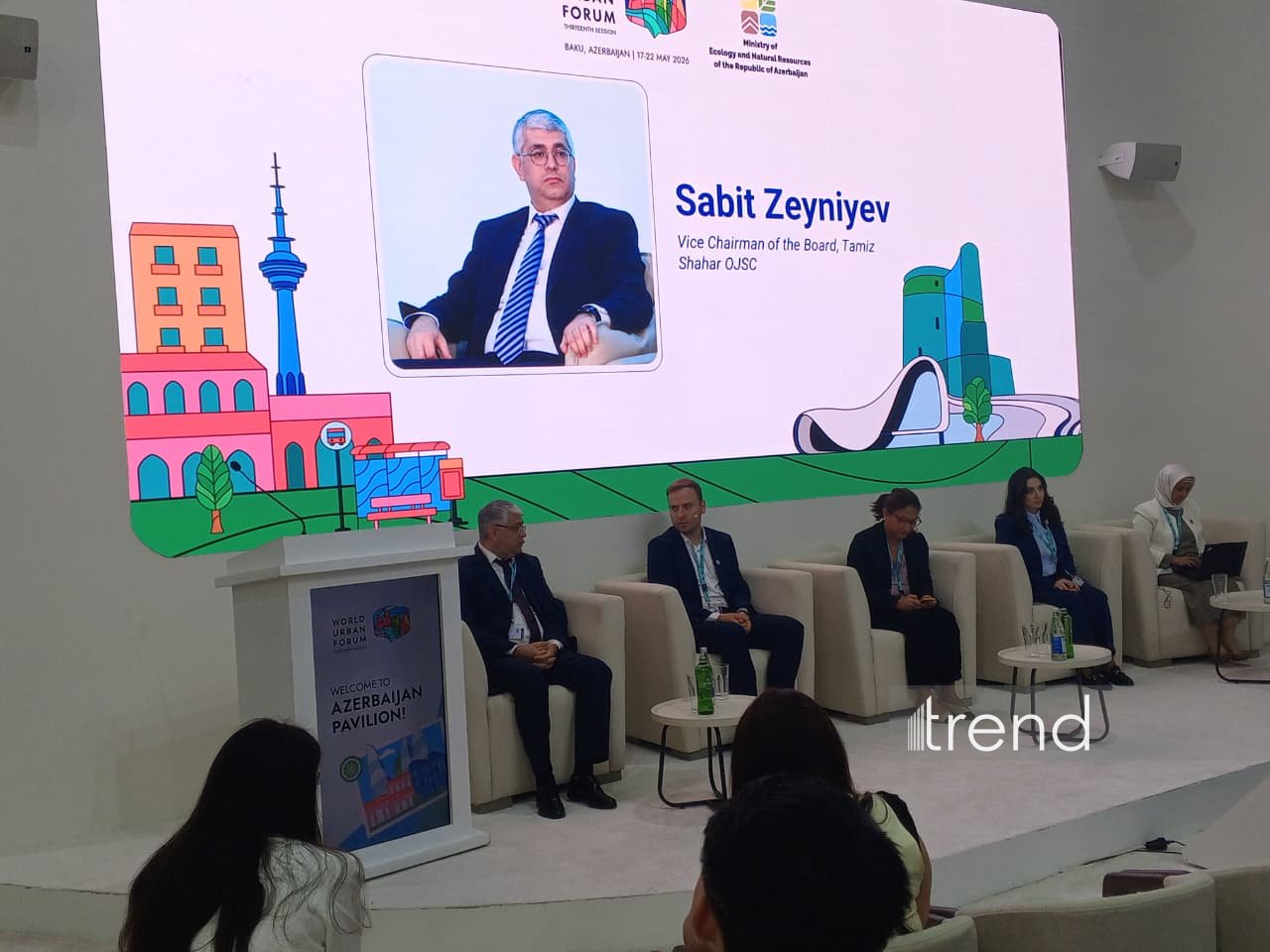
BAKU, Azerbaijan, May 20. In Azerbaijan, recyclable waste is sorted annually at a facility with a capacity of 100,000 tons, Sabit Zeyniyev, Deputy Chairman of the Executive Board of “Tamiz Shahar” JSC, said, Trend reports.
He made the announcement at the panel session “Tackling plastic pollution: promoting liveable cities and a circular economy” as part of WUF13 in Baku.
According to him, a materials recovery plant with an annual capacity of 100,000 tons was built in Balakhani, where recyclable waste is sorted and subsequently transferred to companies operating in the recycling sector.
He noted that the facility is operating at full capacity, but work continues to improve its efficiency and increase annual waste intake volumes. He also added that residents of the Balakhani industrial park are exempt from certain taxes for 10 years to stimulate the development of waste recycling.
Sabit Zeyniyev emphasized that an industrial park was also established to cover the entire waste management chain, where participants are eligible for government incentives.
“They are exempt from property taxes, land taxes, customs clearance fees, and income tax for a period of ten years,” he said.
According to him, household waste is collected by the park’s participants and transported to recycling facilities. Some of the waste is sent to a waste-to-energy plant to generate electricity, while the rest goes to a materials recovery facility, where, after sorting, the recyclable materials are transferred to residences in the Balakhani Industrial Park.
Today, the fourth day of the WUF13 conference is taking place in Baku.
The first day included a ministerial meeting dedicated to the New Urban Agenda, a ministerial roundtable, assemblies for women and civil society, business sessions, and discussions on urban prosperity. An official ceremony marking the raising of the UN and Azerbaijani flags also took place.
The second day stood out for the inaugural Leaders' Summit, featuring high-level discussions on the global housing crisis, urbanization policy, and urban resilience. Concurrently, the opening of the Mexico City pavilion took place, serving as a significant platform for expanding cooperation with the Latin American region and preparing for WUF14.
The third day of WUF13 featured a comprehensive program of events covering the global housing crisis, the formation of safe and inclusive cities, climate resilience, artificial intelligence and urban governance, green urbanization, social equity, and sustainable transport.
WUF13, which has attracted more than 40,000 registered participants from 182 countries, will continue until May 22. Held under the theme “Housing the world: Safe and resilient cities and communities,” the forum brings together governments, international organizations, experts, and representatives of civil society to strengthen global cooperation in the field of sustainable urban development.



