


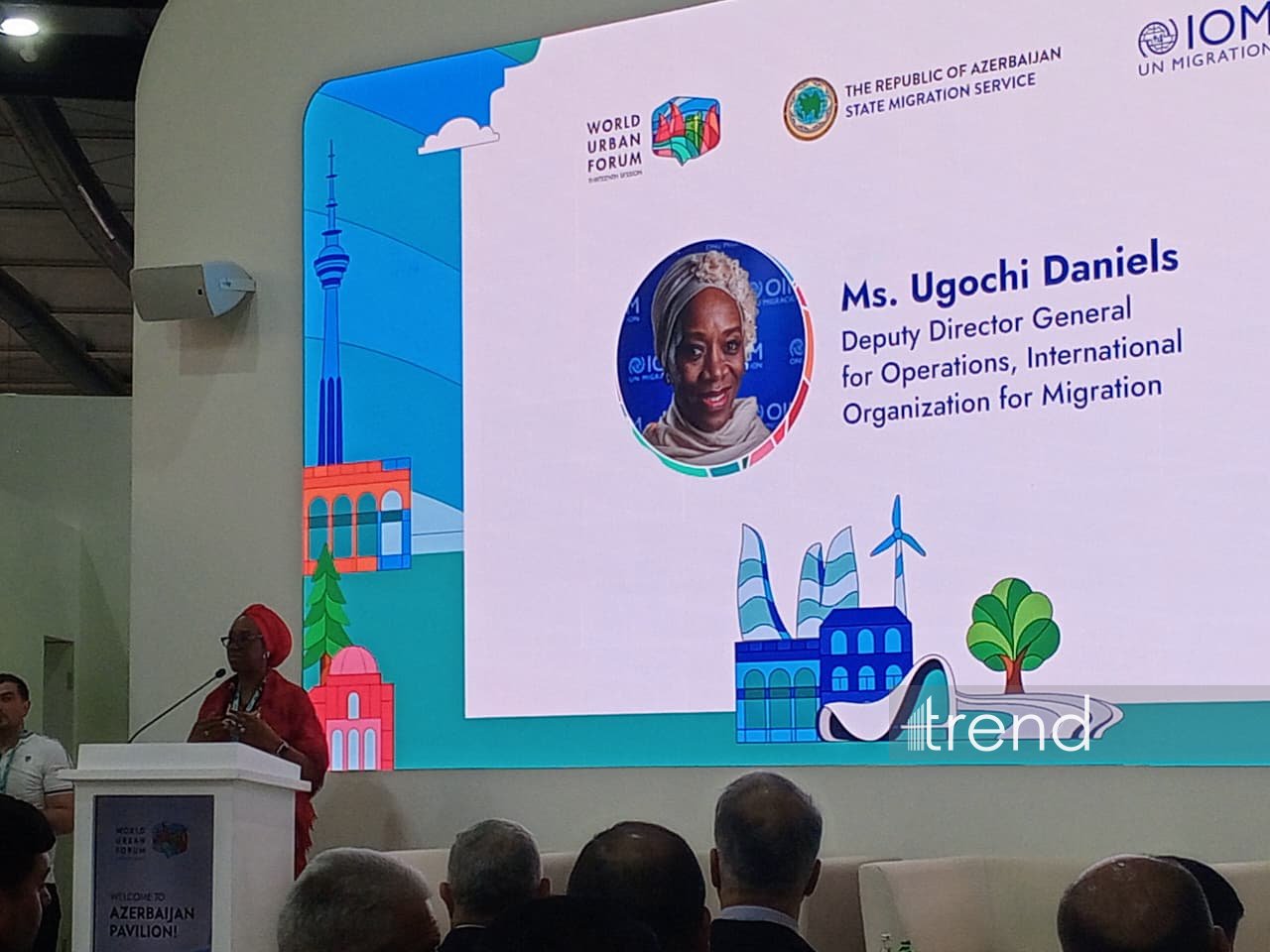

BAKU, Azerbaijan, May 20. Migration and urbanization can no longer undergo management in isolation from one another, as these processes remain deeply interconnected, said Ugochi Daniels, Deputy Director General of the International Organization for Migration (IOM), Trend reports.
She made the remark during a panel discussion titled "Migration and Cities: A Framework for Safe, Innovative and Sustainable Governance" held within the framework of the 13th session of the World Urban Forum (WUF13) in Baku.
She noted that the current discussions serve as a direct continuation of the global dialogue conducted two weeks prior at the International Migration Review Forum in New York.
"Today, migration takes on an increasingly urban character. This process shapes itself against the backdrop of climate change, conflicts, demographic shifts, and ongoing inequalities," she pointed out.
Daniels stated that according to the IOM's World Migration Report 2026, roughly 304 million international migrants currently live worldwide. "This constitutes approximately 3.7% of the global population. However, their economic and social contributions stand far larger than their numbers alone suggest," she emphasized.
She noted that over 55% of the global population currently resides in cities, with this metric expected to reach 68% in the future. "This is precisely why, as the IOM, our cooperation with the State Migration Service in Azerbaijan carries special significance for us. Cities turn into the front lines of migration management," the Deputy Director General added.
Daniels concluded that migrants predominantly settle in urban areas where jobs, services, and opportunities concentrate. "Yet, concurrently, pressure amplifies across cities regarding housing, infrastructure, public services, and social cohesion," she noted.
Today marks the fourth day of WUF13 in Baku.
The first day included a ministerial meeting dedicated to the New Urban Agenda, a ministerial roundtable, assemblies for women and civil society, business sessions, and discussions on urban prosperity. An official ceremony marking the raising of the UN and Azerbaijani flags also took place.
The second day stood out for the inaugural Leaders' Summit, featuring high-level discussions on the global housing crisis, urbanization policy, and urban resilience. Concurrently, the opening of the Mexico City pavilion took place, serving as a significant platform for expanding cooperation with the Latin American region and preparing for WUF14.
The third day of WUF13 featured a comprehensive program of events covering the global housing crisis, the formation of safe and inclusive cities, climate resilience, artificial intelligence and urban governance, green urbanization, social equity, and sustainable transport.
WUF13, which has attracted more than 40,000 registered participants from 182 countries, will continue until May 22. Held under the theme “Housing the world: Safe and resilient cities and communities,” the forum brings together governments, international organizations, experts, and representatives of civil society to strengthen global cooperation in the field of sustainable urban development.



