


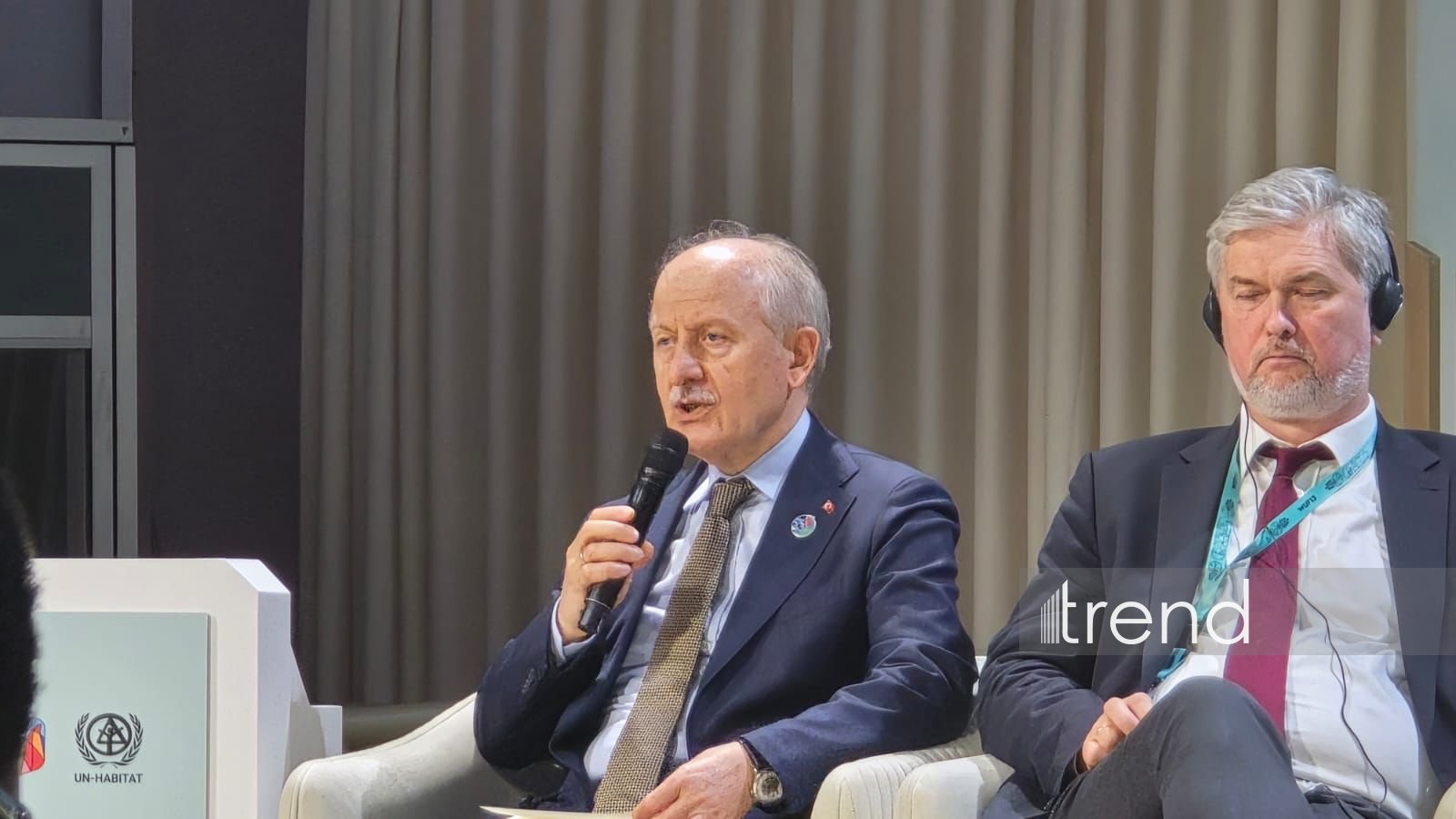

BAKU, Azerbaijan, May 20. Türkiye plans to increase its waste recycling rate to 60% by 2035 and scale it up further to 70% by 2053, said Hasan Suver, Deputy Minister of Environment, Urbanization and Climate Change of Türkiye, Trend reports.
He made the remark during a session titled "Closing the Loop: Advancing Waste Management on the Path to a Circular Economy" held within the framework of the 13th session of the World Urban Forum (WUF13) in Baku.
According to him, unmanaged waste, particularly within vulnerable urban areas, generates severe environmental liabilities along with significant climatic and social risks. "The uncontrolled accumulation of waste drives methane emission growth, contaminates water and soil resources, and amplifies the risk of flash floods and environmental disasters due to clogged municipal drainage networks," Suver pointed out.
The deputy minister noted that Türkiye approaches waste management not merely as a disposal utility, but as a core pillar of climate policy, public health, social inclusion, and sustainable development paradigms.
He emphasized that the country's state policy anchors itself to the principles of the waste hierarchy and the circular economy. "Our foundational priority centers on waste prevention, alongside separate sorting, reuse, recycling, and reintroducing secondary materials back into the economic stream under our comprehensive 'Zero Waste' blueprint," he stressed.
Initiated by the ministry in 2017, the "Zero Waste" project has evolved into a global ecological movement, Suver noted, with waste management systems now successfully deployed across thousands of public and commercial structures. To popularize this approach, encourage sustainable production and consumption patterns, and raise ecological awareness, Türkiye executes joint operational programs alongside various institutions and civil organizations.
"Roughly 28 million individuals have completed waste management training modules. Türkiye's waste recycling rate expanded from 13% in 2017 to 34.92% in 2023, hit 36.08% in 2024, and reached 37.53% as of 2025. According to ministry data, from the project's launch through the end of 2025, the country processed approximately 90 million tons of recyclable materials, including paper, plastic, glass, metal, and organic waste," he reported.
Suver added that these recycling mechanisms successfully returned 365 billion Turkish Liras back into the national economy, generated significant savings in electricity, water, and oil consumption, and substantially lowered municipal reliance on landfills.
Today marks the fourth day of WUF13 in Baku.
The first day included a ministerial meeting dedicated to the New Urban Agenda, a ministerial roundtable, assemblies for women and civil society, business sessions, and discussions on urban prosperity. An official ceremony marking the raising of the UN and Azerbaijani flags also took place.
The second day stood out for the inaugural Leaders' Summit, featuring high-level discussions on the global housing crisis, urbanization policy, and urban resilience. Concurrently, the opening of the Mexico City pavilion took place, serving as a significant platform for expanding cooperation with the Latin American region and preparing for WUF14.
The third day of WUF13 featured a comprehensive program of events covering the global housing crisis, the formation of safe and inclusive cities, climate resilience, artificial intelligence and urban governance, green urbanization, social equity, and sustainable transport.
WUF13, which has attracted more than 40,000 registered participants from 182 countries, will continue until May 22. Held under the theme “Housing the world: Safe and resilient cities and communities,” the forum brings together governments, international organizations, experts, and representatives of civil society to strengthen global cooperation in the field of sustainable urban development.



