


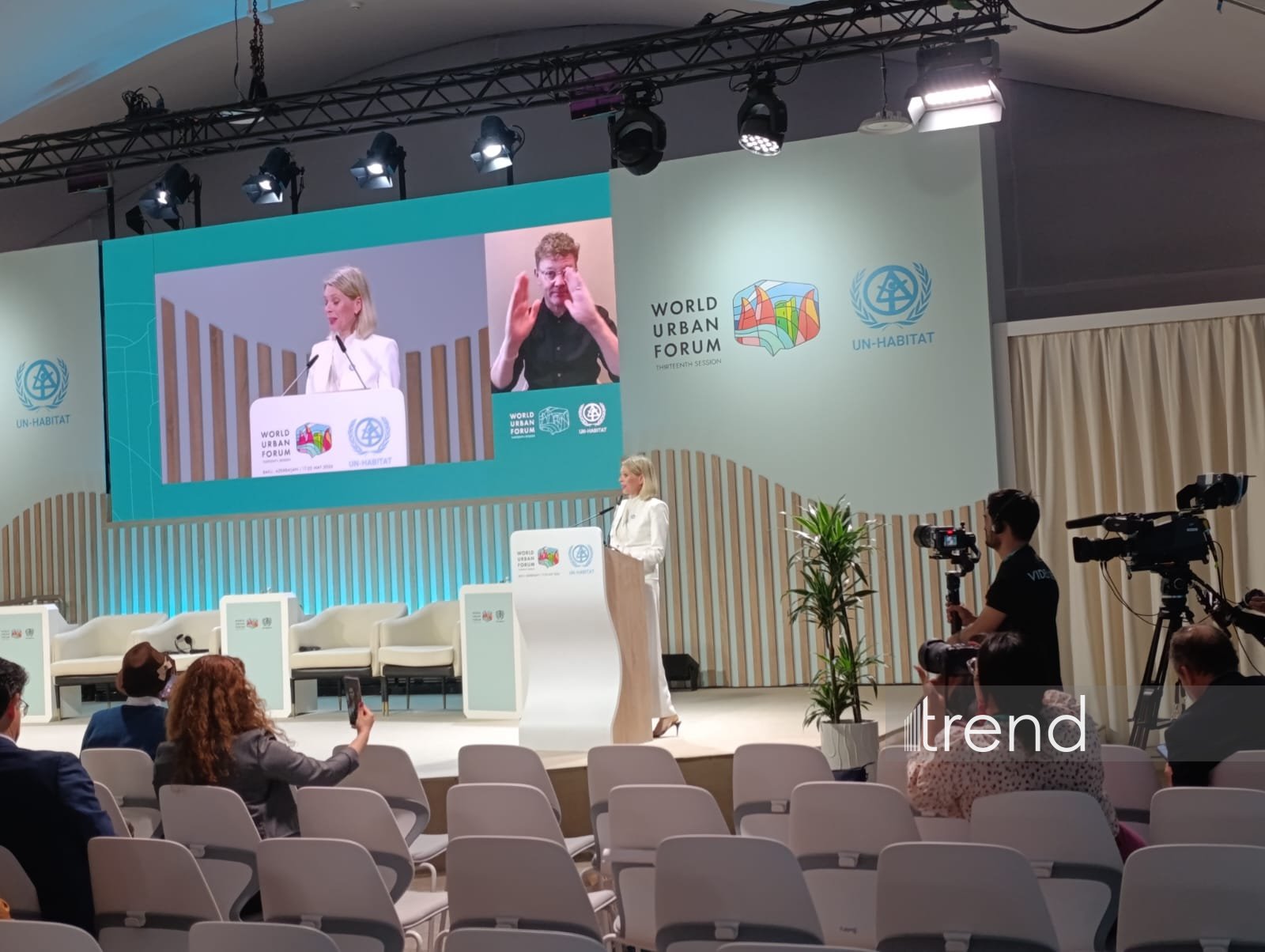

BAKU, Azerbaijan, May 20. Allocating investments toward land restoration generates substantial economic, social, and environmental returns, said Xenya Scanlon, Chief of Communications, External Relations and Partnerships at the United Nations Convention to Combat Desertification (UNCCD), Trend reports.
She made the remarks during a session titled "Stories from the Climate Frontlines" held within the framework of the 13th session of the World Urban Forum (WUF13) in Baku.
"We remain only as resilient to climate change as our land proves to be. When we invest in land restoration and drought resilience, we receive returns manifested as economic, social, health, and environmental advantages. Furthermore, as we restore the land, we concurrently restore hope for our communities, economies, and society as a whole," she pointed out.
Scanlon noted that droughts constitute a universal challenge, with their frequency intensifying by one-third since the year 2000.
"Experts continuously signal to us that our future shapes up to be even hotter, drier, and undeniably more urbanized. Therefore, how do we navigate this emerging reality? It is both astonishing and alarming to observe the Amazon basin featured on the global drought 'hotspots' index published by our convention last year. We are witness to the fact that the Amazon region in Brazil increasingly suffers from the compounding impacts of drought and wildfires," she concluded.
Today marks the fourth day of WUF13 in Baku.
The first day included a ministerial meeting dedicated to the New Urban Agenda, a ministerial roundtable, assemblies for women and civil society, business sessions, and discussions on urban prosperity. An official ceremony marking the raising of the UN and Azerbaijani flags also took place.
The second day stood out for the inaugural Leaders' Summit, featuring high-level discussions on the global housing crisis, urbanization policy, and urban resilience. Concurrently, the opening of the Mexico City pavilion took place, serving as a significant platform for expanding cooperation with the Latin American region and preparing for WUF14.
The third day of WUF13 featured a comprehensive program of events covering the global housing crisis, the formation of safe and inclusive cities, climate resilience, artificial intelligence and urban governance, green urbanization, social equity, and sustainable transport.
WUF13, which has attracted more than 40,000 registered participants from 182 countries, will continue until May 22. Held under the theme “Housing the world: Safe and resilient cities and communities,” the forum brings together governments, international organizations, experts, and representatives of civil society to strengthen global cooperation in the field of sustainable urban development.



