


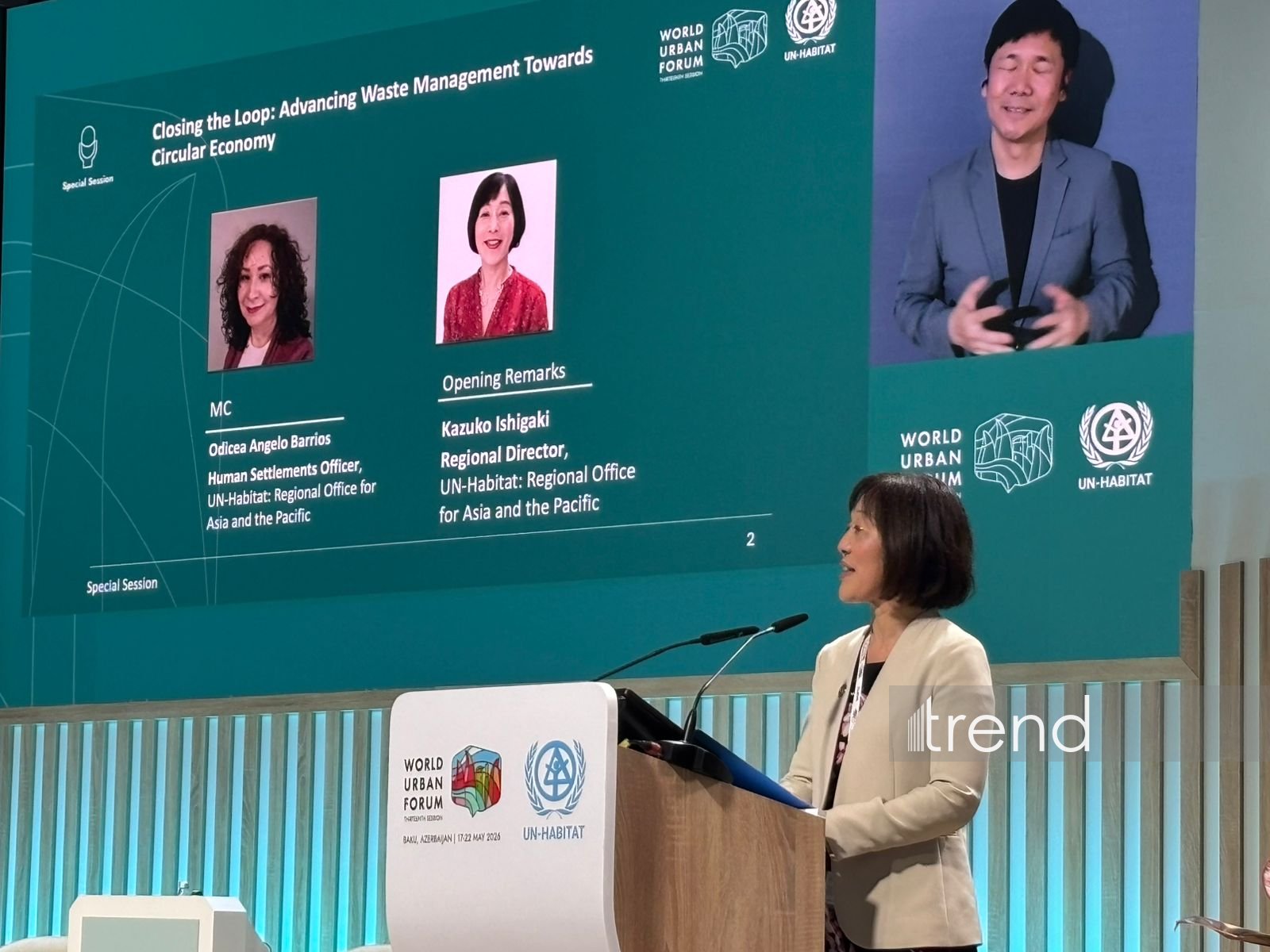
BAKU, Azerbaijan, May 20. Traditional approaches to waste management are no longer enough, and the world must adopt more integrated, innovative solutions based on circular economy principles, said Kazuko Ishigaki, Regional Director of UN-Habitat’s Asia and Pacific office, made the remarks at the session “Closing the Loop: Advancing Waste Management Towards a Circular Economy,” held during the 13th World Urban Forum (WUF13) in Baku, Trend reports.
Ishigaki said efforts are intensifying worldwide to move beyond conventional waste management and toward more comprehensive approaches, including developing circular systems, rethinking production processes and supply chains, and factoring in climate impacts.
“We must ensure that no community, especially those in vulnerable situations, is left behind,” she emphasized.
She highlighted that municipal solid waste is among the fastest-growing environmental problems in the Asia-Pacific region, with a significant portion ending up in the ocean and worsening marine plastic pollution.
“Solid waste management is an urgent task to protect human health and the entire ecosystem,” Ishigaki said, noting that many countries and cities are seeking support to create effective waste management systems.
However, she stressed that addressing the root causes of waste generation is just as important as improving disposal methods. “We must reduce, reuse, and recycle waste, creating new production systems and shaping new lifestyles,” she said.
Ishigaki underscored that the circular economy represents a fundamental shift in development approaches and that sessions like WUF13 provide a vital platform for sharing experiences among international organizations, governments, academics, the private sector, and entrepreneurs.
By the way, today marks the fourth day of WUF13 in Baku.
The first day included a ministerial meeting dedicated to the New Urban Agenda, a ministerial roundtable, assemblies for women and civil society, business sessions, and discussions on urban prosperity. An official ceremony marking the raising of the UN and Azerbaijani flags also took place.
The second day stood out for the inaugural Leaders' Summit, featuring high-level discussions on the global housing crisis, urbanization policy, and urban resilience. Concurrently, the opening of the Mexico City pavilion took place, serving as a significant platform for expanding cooperation with the Latin American region and preparing for WUF14.
The third day of WUF13 featured a comprehensive program of events covering the global housing crisis, the formation of safe and inclusive cities, climate resilience, artificial intelligence and urban governance, green urbanization, social equity, and sustainable transport.
WUF13, which has attracted more than 40,000 registered participants from 182 countries, will continue until May 22. Held under the theme “Housing the world: Safe and resilient cities and communities,” the forum brings together governments, international organizations, experts, and representatives of civil society to strengthen global cooperation in the field of sustainable urban development.



