


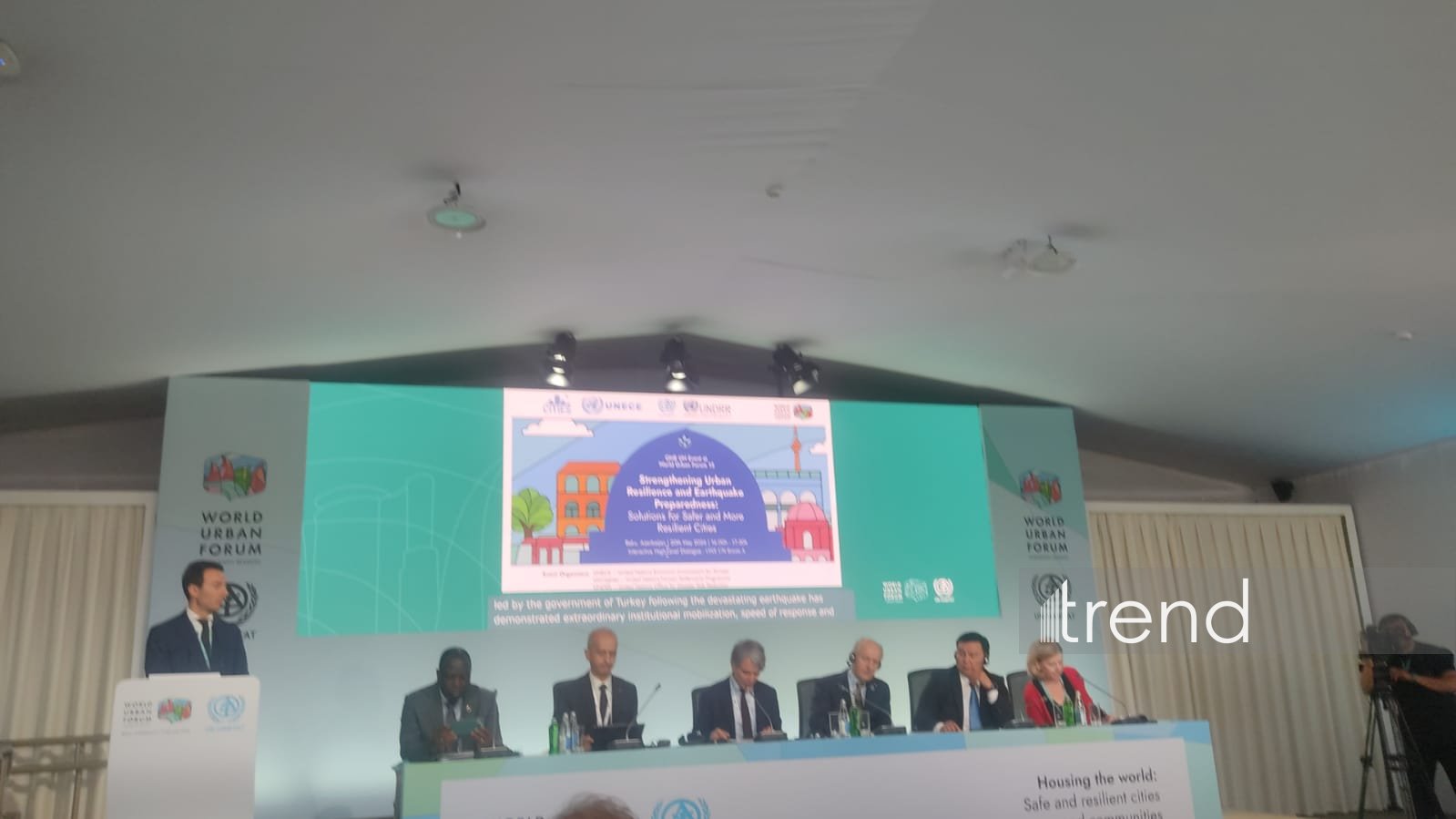

BAKU, Azerbaijan, May 20. Most cities around the world are unprepared for interconnected risks and multiple hazards, warned Dmitri Mariyasin, Deputy Executive Secretary of the UN Economic Commission for Europe (UNECE), at the 13th World Urban Forum (WUF13), Trend reports.
Making remarks during the conference “Strengthening Urban Earthquake Preparedness: UN Solutions for Safer and More Resilient Cities”, Mariyasin said, “Risks never come alone”.
He explained that urban risks are multifaceted and interconnected, ranging from human-made disasters and natural hazards to the consequences of conflicts and sudden climate-related events. “Sometimes it’s even difficult to classify these events correctly,” he added.
Mariyasin emphasized that earthquakes pose some of the most destructive risks for urban areas. “Earthquakes expose structural weaknesses in cities. They reveal where housing, infrastructure, and land management systems fail. They test governance mechanisms. And, of course, they result in significant human, social, and economic losses. Recovering from these losses is extremely difficult,” he said.
He pointed to recent disasters in the UNECE region and elsewhere as evidence of the urgency. “Unfortunately, investments in resilience must be made before a crisis occurs. Once a crisis hits, it’s often too late. The devastating earthquake in Turkey a few years ago provided us with crucial and highly relevant lessons,” Mariyasin added.
Today marks the fourth day of WUF13 in Baku.
The first day included a ministerial meeting dedicated to the New Urban Agenda, a ministerial roundtable, assemblies for women and civil society, business sessions, and discussions on urban prosperity. An official ceremony marking the raising of the UN and Azerbaijani flags also took place.
The second day stood out for the inaugural Leaders' Summit, featuring high-level discussions on the global housing crisis, urbanization policy, and urban resilience. Concurrently, the opening of the Mexico City pavilion took place, serving as a significant platform for expanding cooperation with the Latin American region and preparing for WUF14.
The third day of WUF13 featured a comprehensive program of events covering the global housing crisis, the formation of safe and inclusive cities, climate resilience, artificial intelligence and urban governance, green urbanization, social equity, and sustainable transport.
WUF13, which has attracted more than 40,000 registered participants from 182 countries, will continue until May 22. Held under the theme “Housing the world: Safe and resilient cities and communities,” the forum brings together governments, international organizations, experts, and representatives of civil society to strengthen global cooperation in the field of sustainable urban development.



