


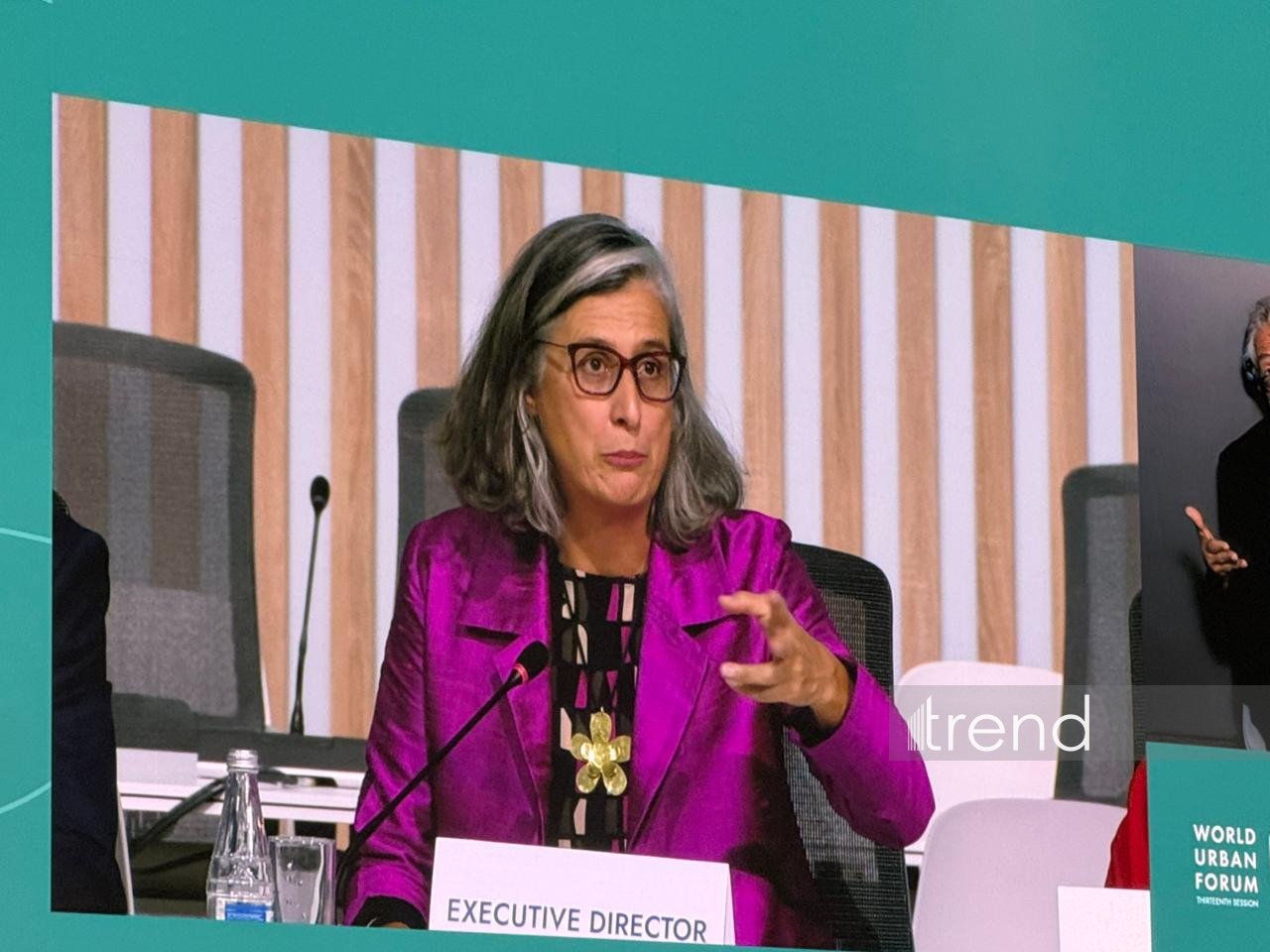

BAKU, Azerbaijan, May 20. Current urban master plans often fail to address future housing needs or how housing will be distributed across city territories, Anaclaudia Rossbach, Executive Director of UN-Habitat, made the remarks during a parliamentary roundtable on “How Can National Legislation Translate Global Housing Commitments into Real Results?” at the 13th World Urban Forum (WUF13), Trend reports.
Rossbach said that existing financial flows to cities often fail to serve all citizens and, in some cases, exacerbate social inequality and spatial segregation.
“Existing subsidies are sometimes inconsistent with local plans. City master plans do not account for future housing needs or their placement within territories. As a result, subsidies are directed to city outskirts, uncontrolled urban sprawl occurs, and socially unsustainable urbanization develops. Low-income residents are forced to live far from city centers, spending more time and money on transportation and losing access to opportunities. Children are also deprived of opportunities. This creates additional infrastructure costs and places further burdens on the environment,” she said.
Rossbach emphasized the need for a comprehensive approach: “Legislation and regulations that properly guide urban development and housing policy at national, regional, and local levels are essential to ensure balanced development and meet real needs. Even with political will in the executive branch, results will be limited if parliaments are not actively involved in the process, and vice versa.”
She noted that at the conclusion of WUF13, the “Baku Call to Action,” the final document of the ministerial meeting under Azerbaijani chairmanship, and the “World Cities Report” will be presented.
Today marks the fourth day of WUF13 in Baku.
The first day included a ministerial meeting dedicated to the New Urban Agenda, a ministerial roundtable, assemblies for women and civil society, business sessions, and discussions on urban prosperity. An official ceremony marking the raising of the UN and Azerbaijani flags also took place.
The second day stood out for the inaugural Leaders' Summit, featuring high-level discussions on the global housing crisis, urbanization policy, and urban resilience. Concurrently, the opening of the Mexico City pavilion took place, serving as a significant platform for expanding cooperation with the Latin American region and preparing for WUF14.
The third day of WUF13 featured a comprehensive program of events covering the global housing crisis, the formation of safe and inclusive cities, climate resilience, artificial intelligence and urban governance, green urbanization, social equity, and sustainable transport.
WUF13, which has attracted more than 40,000 registered participants from 182 countries, will continue until May 22. Held under the theme “Housing the world: Safe and resilient cities and communities,” the forum brings together governments, international organizations, experts, and representatives of civil society to strengthen global cooperation in the field of sustainable urban development.



