


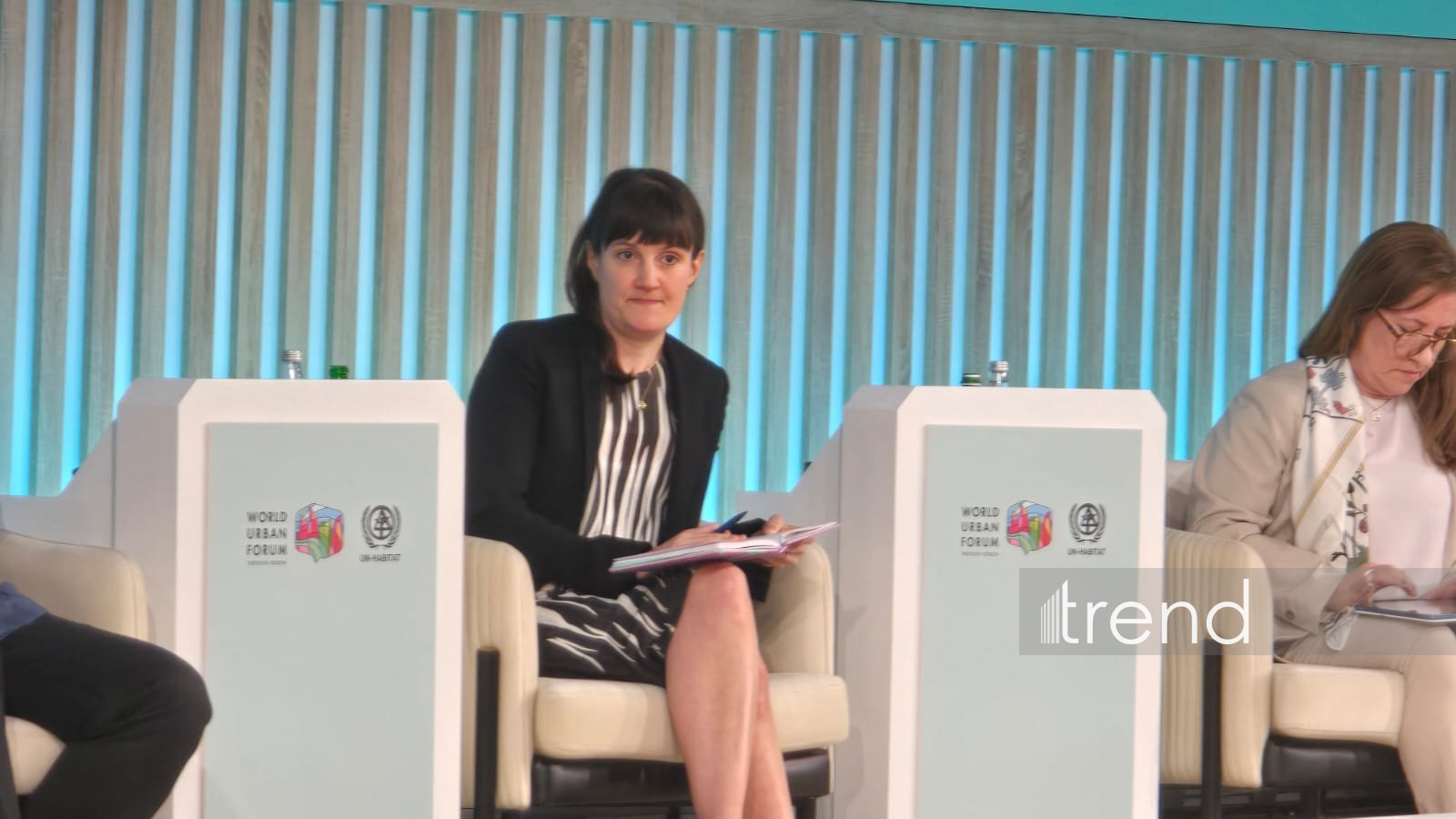
BAKU, Azerbaijan, May 21. Forcing displaced populations within densely populated metropolitan zones to remain confined to tent camps or public facilities for extended durations generates severe socio-economic crises, Lucy Earle, Director of Research and Strategic Impact at the International Institute for Environment and Development (IIED), said, Trend reports.
She made the remarks during a session titled "Housing at the Centre of Crisis Recovery and Reconstruction" held within the framework of the 13th session of the World Urban Forum (WUF13) in Baku.
Lucy Earle noted that in these emergency scenarios, individuals are routinely forced to live in transient shelters for years at a time—a structural breakdown observed with acute severity across vulnerable metropolitan hubs such as Port-au-Prince, Haiti.
Furthermore, Earle emphasized that during humanitarian crises, the prevailing operational assumption among aid agencies remains that "displaced populations will eventually return home." In reality, however, the vast majority of displaced families choose to remain permanently inside the cities where they have sought refuge, progressively anchored their lives and built livelihoods there.
According to her, as long as this institutional mindset fails to shift, categorizing internally displaced persons (IDPs) as mere "temporary residents" severely hinders their systematic integration into civic urban life and negatively distorts municipal utility and service planning.
The IIED director identified the humanitarian sector's systemic failure to accurately account for local land tenure and property rights as a major operational bottleneck.
"We must comprehensively evaluate the localized context and specific land rights structures of each unique city. Unfortunately, rehabilitation solutions are too often engineered exclusively for individuals possessing formal title deeds and certified property documentation. Consequently, the most highly vulnerable segments of the population—namely renters and informal settlement dwellers—are entirely excluded from these institutional recovery frameworks," Earle stated.
Furthermore, she pointed out that the flawed spatial planning of large-scale residential zones erected for displaced communities triggers profound negative long-term consequences.
"Housing developments positioned far away from employment hubs and vital municipal infrastructure lines frequently sit underutilized, rapidly devolving into 'ghost towns.' This occurs because specific refugee encampments are strategically isolated from broader economic centers, structurally preventing them from naturally evolving into viable, self-sustaining cities," she explained.
According to her, the conceptual idea of organically transitioning temporary refugee camps into functional municipalities is not always feasible. "If trapped populations lack freedom of movement and direct access to viable economic activities for their basic livelihoods, that geographic space simply cannot transition into a resilient city," Earle noted.
She concluded that future international paradigms must firmly shift their focus away from segregating displaced populations on peripheral metropolitan margins, prioritizing instead their immediate and comprehensive integration directly into existing municipal fabrics, cities, and townships.
Today marks the fifth day of WUF13 in Baku.
The first day included a ministerial meeting dedicated to the New Urban Agenda, a ministerial roundtable, assemblies for women and civil society, business sessions, and discussions on urban prosperity. An official ceremony marking the raising of the UN and Azerbaijani flags also took place.
The second day stood out for the inaugural Leaders' Summit, featuring high-level discussions on the global housing crisis, urbanization policy, and urban resilience. Concurrently, the opening of the Mexico City pavilion took place, serving as a significant platform for expanding cooperation with the Latin American region and preparing for WUF14.
The third day of WUF13 featured a comprehensive program of events covering the global housing crisis, the formation of safe and inclusive cities, climate resilience, artificial intelligence and urban governance, green urbanization, social equity, and sustainable transport.
One of the highlights of the third day was the signing of a sister-city memorandum between the Azerbaijani city of Shusha and the Turkish city of Trabzon.
The fourth day of WUF13 featured a broad program of events dedicated to urbanization, climate change, inclusive urban development, housing policy, and sustainable governance.
One of the important events of the UN Special Program for the Economies of Central Asia (SPECA) Cities Forum, held on the fourth day, was the announcement of Almaty’s official accession to the “Declaration of Intent on the Establishment of the SPECA Smart Climate-Resilient Cities Forum.”
Also, for the first time in WUF history and at Azerbaijan’s initiative, the “WUF13 NGO Forum: Global Partnership and Decision-Making” was held.
WUF13, which has attracted more than 40,000 registered participants from 182 countries, will continue until May 22. Held under the theme “Housing the world: Safe and resilient cities and communities,” the forum brings together governments, international organizations, experts, and representatives of civil society to strengthen global cooperation in the field of sustainable urban development.



