


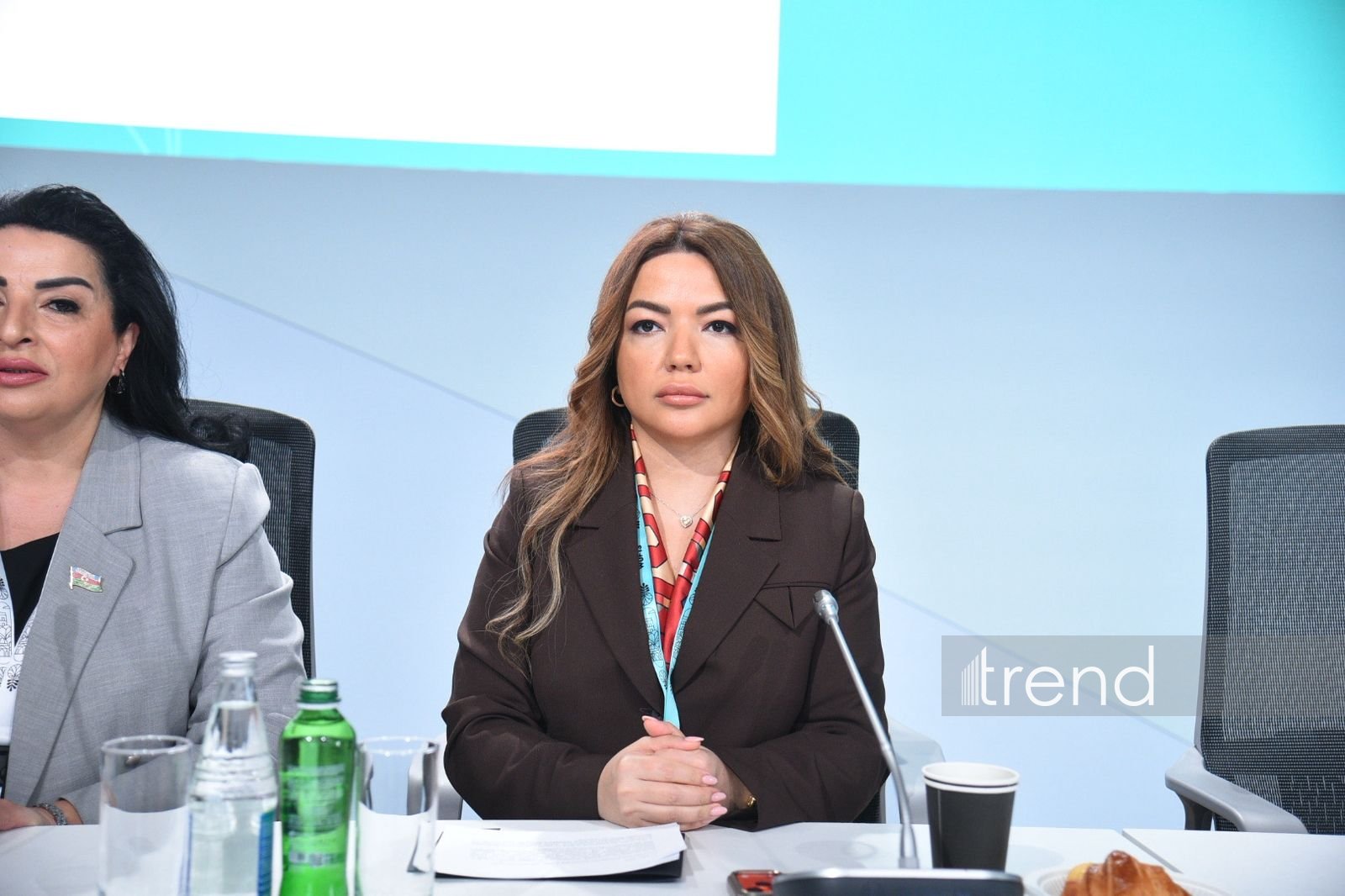
BAKU, Azerbaijan, May 21. The active deployment of green energy zones and smart village frameworks across the liberated territories highlights Azerbaijan's systematic approach to sustainable development and the global climate agenda, Aigun Aliyeva, Chairperson of the Board of the Agency for State Support to NGOs of Azerbaijan, said, Trend reports.
The official made the remark during a panel discussion titled "Developing Azerbaijan’s First National Sustainability Standard: The Sustainable Practices Standard (SPS)" held within the framework of the 13th session of the World Urban Forum (WUF13) in Baku.
According to her, embedding green growth metrics directly into the "Azerbaijan 2030: National Priorities for Socio-Economic Development" strategic framework, coupled with the legacy of hosting the COP29 climate summit, firmly anchors the country’s consistent policy trajectory in this sector.
Aliyeva noted that the United Nations Sustainable Development Goals (SDGs)—specifically Goal 11 targeting sustainable cities and communities—clearly demonstrate that long-term development remains structurally impossible without synchronized urban and regional policies rooted in environmental sustainability principles.
She emphasized that current WUF13 dialogues place extensive focus on multi-level institutional coordination, public participation, municipal resilience, and the scaling of "green cities."
According to Aliyeva, international practice indicates that environmental governance standards operate effectively as robust institutional models. Consequently, ESG (Environmental, Social, and Governance) principles undergo deeper integration into executive decision-making pipelines across both public and private sectors.
She concurrently highlighted that the Sustainable Practices Standard (SPS)—pioneered and presented by the "Ecosphere" Social-Economic Development Center—seeks to merge global sustainability metrics with localized implementation mechanisms, embedding resilience directly into daily management workflows.
"The primary operational advantage of the SPS framework lies in its design: it functions not merely as an abstract theoretical concept, but as a fully measurable and applicable managerial toolkit," she pointed out.
Aliyeva underscored the critical role that civil society organizations fulfill in driving environmental education, climate adaptation workflows, green city initiatives, municipal waste management optimization, ecotourism, and youth mobilization.
She concluded by noting that the Agency for State Support to NGOs of Azerbaijan systematically fosters an efficient, multilateral model of sustainable development. This is achieved by utilizing transparent grant allocation mechanisms to fortify institutional collaboration between state bodies and civil society networks.
"Sustainable development represents far more than a standard environmental policy; it constitutes a progressive management culture and a structural model of collective responsibility," Aliyeva stated.
Today marks the fifth day of WUF13 in Baku.
The first day included a ministerial meeting dedicated to the New Urban Agenda, a ministerial roundtable, assemblies for women and civil society, business sessions, and discussions on urban prosperity. An official ceremony marking the raising of the UN and Azerbaijani flags also took place.
The second day stood out for the inaugural Leaders' Summit, featuring high-level discussions on the global housing crisis, urbanization policy, and urban resilience. Concurrently, the opening of the Mexico City pavilion took place, serving as a significant platform for expanding cooperation with the Latin American region and preparing for WUF14.
The third day of WUF13 featured a comprehensive program of events covering the global housing crisis, the formation of safe and inclusive cities, climate resilience, artificial intelligence and urban governance, green urbanization, social equity, and sustainable transport.
One of the highlights of the third day was the signing of a sister-city memorandum between the Azerbaijani city of Shusha and the Turkish city of Trabzon.
The fourth day of WUF13 featured a broad program of events dedicated to urbanization, climate change, inclusive urban development, housing policy, and sustainable governance.
One of the important events of the UN Special Program for the Economies of Central Asia (SPECA) Cities Forum, held on the fourth day, was the announcement of Almaty’s official accession to the “Declaration of Intent on the Establishment of the SPECA Smart Climate-Resilient Cities Forum.”
Also, for the first time in WUF history and at Azerbaijan’s initiative, the “WUF13 NGO Forum: Global Partnership and Decision-Making” was held.
WUF13, which has attracted more than 40,000 registered participants from 182 countries, will continue until May 22. Held under the theme “Housing the world: Safe and resilient cities and communities,” the forum brings together governments, international organizations, experts, and representatives of civil society to strengthen global cooperation in the field of sustainable urban development.



