


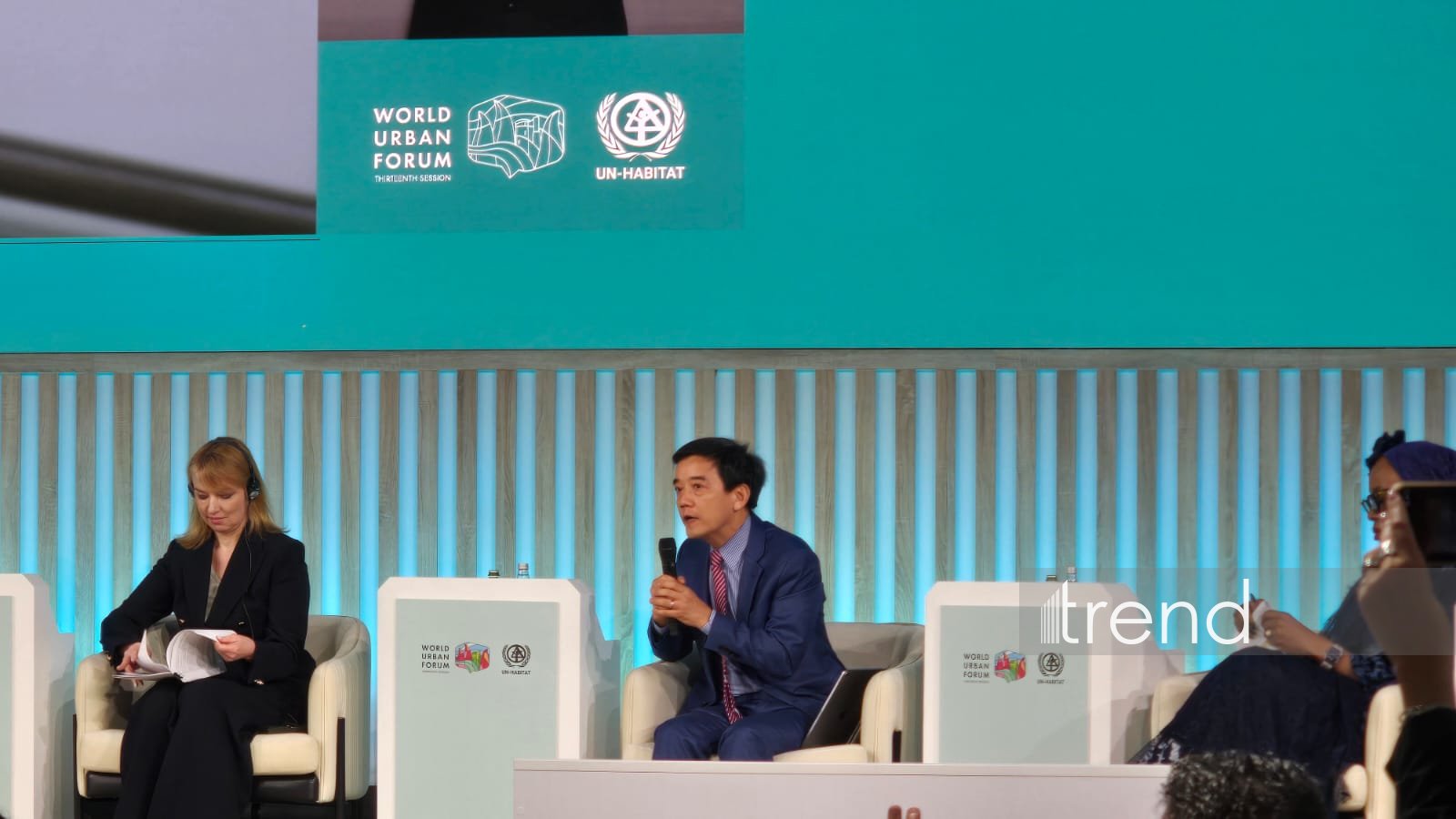

BAKU, Azerbaijan, May 21. The implementation of digital systems and the involvement of local communities in the recovery process following an earthquake or natural disaster play a crucial role in accelerating housing provision and are gaining momentum in the aftermath, Ming Zhang, the World Bank Group's Global Director for Cities, Subnational Finance, Tourism, and Disaster Management said, Trend reports.
Addressing the event on "Housing at the Centre of Crisis Recovery and Reconstruction" held as part of WUF13, Ming Zhang noted that thanks to digital systems implemented in Ukraine, affected homeowners can submit applications, and thanks to a transparent prioritization mechanism, the process yields faster results.
M. Zhang noted that the “owner-managed” model of post-disaster recovery has been successfully implemented in many countries and is particularly effective in areas with low population density.
According to him, in cities with high population density and high-rise buildings, centralized contractor systems take more time, and the recovery process can be prolonged.
The Global Director added that the existence of disaster preparedness mechanisms in countries such as Turkey and Chile allows for a more effective recovery process. “If contracting and planning mechanisms are developed in advance, then in the event of a natural disaster, there will be no need to create procedures from scratch, and work can begin more quickly,” he emphasized.
Zhang also noted the importance of the role of local authorities:
“Municipalities play a key role in supporting families, rebuilding infrastructure, and coordinating efforts at the community level.”
He added that community-level recovery committees also serve as an important mechanism for providing housing support in the aftermath of natural disasters and contribute to a more inclusive and effective implementation of this process.
Today marks the fifth day of WUF13 in Baku.
The first day included a ministerial meeting dedicated to the New Urban Agenda, a ministerial roundtable, assemblies for women and civil society, business sessions, and discussions on urban prosperity. An official ceremony marking the raising of the UN and Azerbaijani flags also took place.
The second day stood out for the inaugural Leaders' Summit, featuring high-level discussions on the global housing crisis, urbanization policy, and urban resilience. Concurrently, the opening of the Mexico City pavilion took place, serving as a significant platform for expanding cooperation with the Latin American region and preparing for WUF14.
The third day of WUF13 featured a comprehensive program of events covering the global housing crisis, the formation of safe and inclusive cities, climate resilience, artificial intelligence and urban governance, green urbanization, social equity, and sustainable transport.
One of the highlights of the third day was the signing of a sister-city memorandum between the Azerbaijani city of Shusha and the Turkish city of Trabzon.
The fourth day of WUF13 featured a broad program of events dedicated to urbanization, climate change, inclusive urban development, housing policy, and sustainable governance.
One of the important events of the UN Special Program for the Economies of Central Asia (SPECA) Cities Forum, held on the fourth day, was the announcement of Almaty’s official accession to the “Declaration of Intent on the Establishment of the SPECA Smart Climate-Resilient Cities Forum.”
Also, for the first time in WUF history and at Azerbaijan’s initiative, the “WUF13 NGO Forum: Global Partnership and Decision-Making” was held.
WUF13, which has attracted more than 40,000 registered participants from 182 countries, will continue until May 22. Held under the theme “Housing the world: Safe and resilient cities and communities,” the forum brings together governments, international organizations, experts, and representatives of civil society to strengthen global cooperation in the field of sustainable urban development.



