


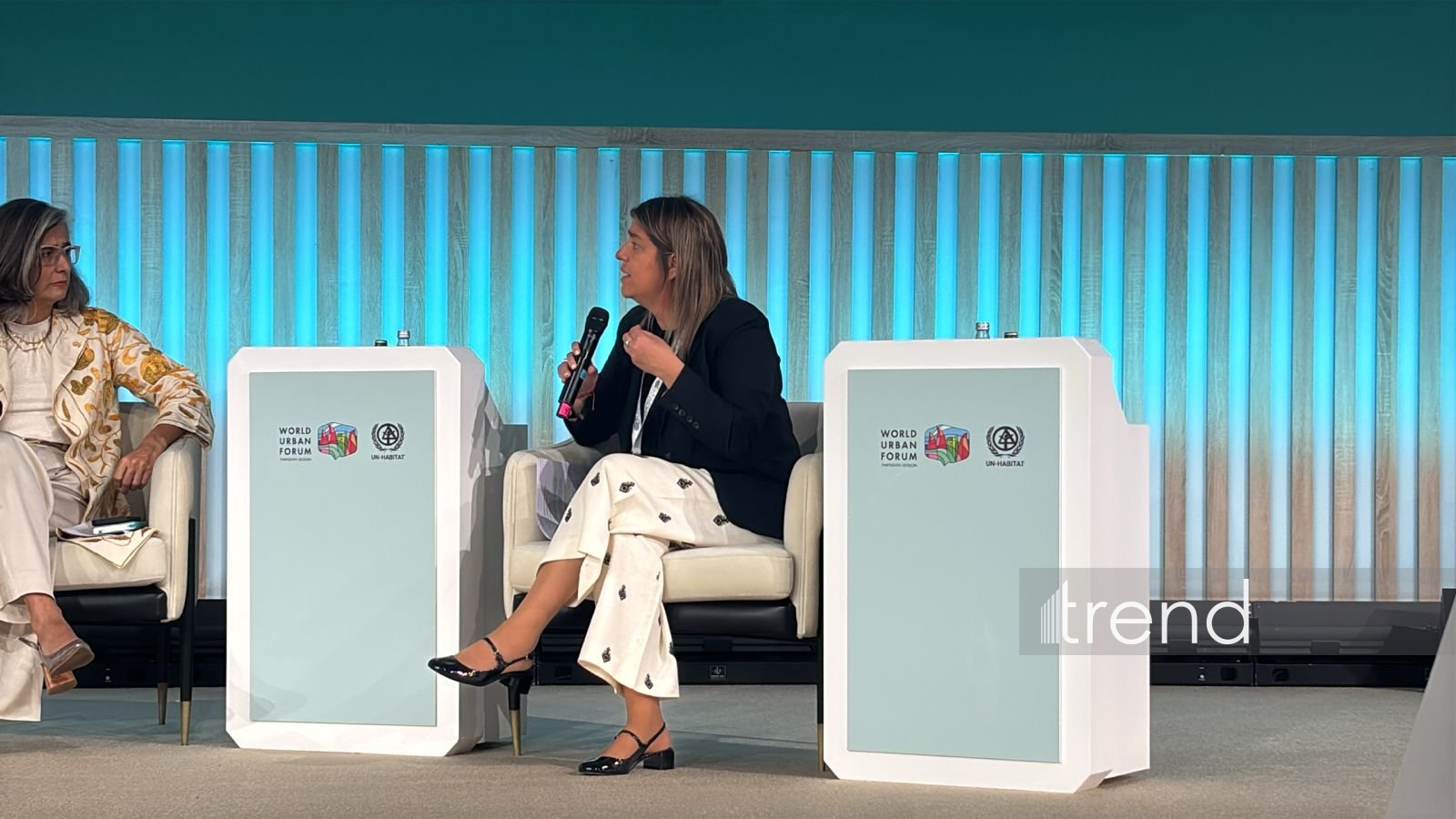
BAKU, Azerbaijan, May 21. Housing policy must rely on a long-term strategic approach and maintain absolute institutional continuity regardless of changes in government administration, Tamara Paceyro, Minister of Housing and Territorial Planning of Uruguay, said, Trend reports.
She made the remarks during a session titled "A New Deal for Housing Finance" held within the framework of the 13th session of the World Urban Forum (WUF13) in Baku.
According to her, constant fluctuations in real estate and zoning regulations actively hinder the efficiency of the sector. "We cannot alter the rules of the game every five years, because doing so fundamentally destabilizes the system and prevents it from functioning in the structural manner we all desire," the minister pointed out.
The official emphasized that national housing frameworks require classification as sovereign state strategies that exist beyond short-term political cycles. "Establishing a unified state housing policy remains of paramount importance. We must secure broad legislative and social pacts that remain fully operational irrespective of changing political administrations to guarantee the baseline continuity and resilience of our housing initiatives," Paceyro Marin noted.
The minister concurrently directed attention toward the pressing necessity of deploying innovations across the housing ecosystem. According to her, structural upgrades are urgently required within construction technologies, financial underwriting mechanisms, and public administrative workflows. "We cannot continue operating along the exact same methodologies used 20 or 30 years ago, because the global landscape has evolved, and the socio-economic needs and realities of families have shifted. The state and its public policies must rapidly adapt to these modern parameters," she stated.
In conclusion, Paceyro extended her appreciation to the forum organizers for the platform to present Uruguay's domestic models and expressed readiness to deepen multilateral cooperation regarding housing finance architecture and urban planning tracks.
Today marks the fifth day of WUF13 in Baku.
The first day included a ministerial meeting dedicated to the New Urban Agenda, a ministerial roundtable, assemblies for women and civil society, business sessions, and discussions on urban prosperity. An official ceremony marking the raising of the UN and Azerbaijani flags also took place.
The second day stood out for the inaugural Leaders' Summit, featuring high-level discussions on the global housing crisis, urbanization policy, and urban resilience. Concurrently, the opening of the Mexico City pavilion took place, serving as a significant platform for expanding cooperation with the Latin American region and preparing for WUF14.
The third day of WUF13 featured a comprehensive program of events covering the global housing crisis, the formation of safe and inclusive cities, climate resilience, artificial intelligence and urban governance, green urbanization, social equity, and sustainable transport.
One of the highlights of the third day was the signing of a sister-city memorandum between the Azerbaijani city of Shusha and the Turkish city of Trabzon.
The fourth day of WUF13 featured a broad program of events dedicated to urbanization, climate change, inclusive urban development, housing policy, and sustainable governance.
One of the important events of the UN Special Program for the Economies of Central Asia (SPECA) Cities Forum, held on the fourth day, was the announcement of Almaty’s official accession to the “Declaration of Intent on the Establishment of the SPECA Smart Climate-Resilient Cities Forum.”
Also, for the first time in WUF history and at Azerbaijan’s initiative, the “WUF13 NGO Forum: Global Partnership and Decision-Making” was held.
WUF13, which has attracted more than 40,000 registered participants from 182 countries, will continue until May 22. Held under the theme “Housing the world: Safe and resilient cities and communities,” the forum brings together governments, international organizations, experts, and representatives of civil society to strengthen global cooperation in the field of sustainable urban development.



