


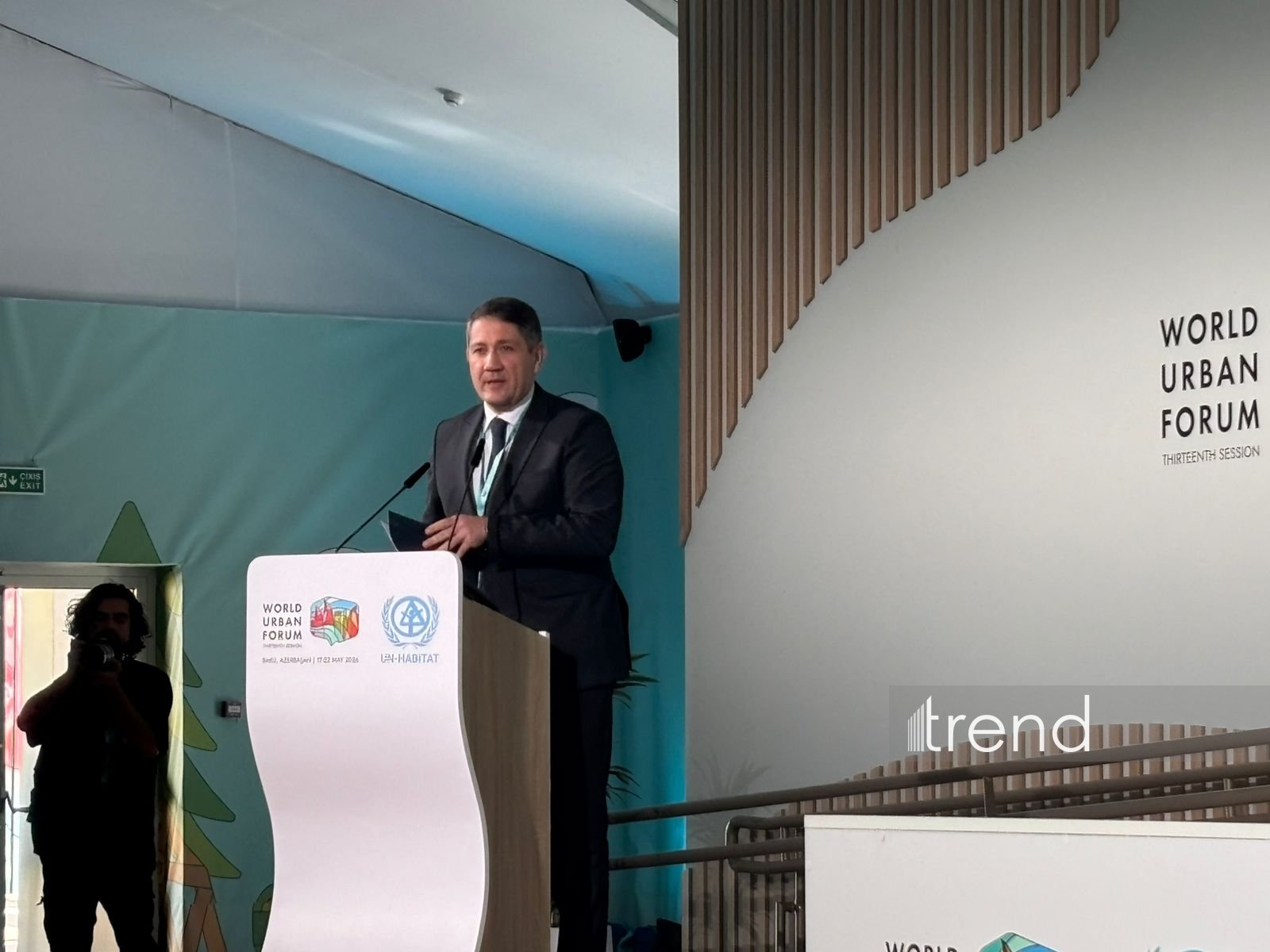

BAKU, Azerbaijan, May 21. Modern housing finance frameworks have evolved significantly beyond basic structural construction, operating as highly strategic instruments to drive human capital development, secure social stability, and catalyze macroeconomic growth, Azerbaijan's Deputy Minister of Finance Anar Karimov said, Trend reports.
He made the remark during a high-level session titled "A New Deal for Housing Finance" held within the framework of the 13th session of the World Urban Forum (WUF13) in Baku.
According to him, a progressive housing policy must simultaneously guarantee affordability, social inclusion, environmental sustainability, and long-term financial viability. He pointed out that structural housing finance directly shapes the future fabric of society, dictating aggregate social well-being and expanding wealth-building opportunities for young families.
Karimov reported that Azerbaijan has successfully engineered a resilient housing finance matrix that seamlessly balances direct social safety nets with the strict macroprudential sustainability of the broader financial system. He highlighted that the state-backed Mortgage and Credit Guarantee Fund has supported more than 58,000 residential mortgage loans and executed approximately 9,000 rent-to-own agreements, pushing the fund’s total assets under management past the $2 billion threshold.
According to the deputy minister, this financing model strategically blends targeted state budget support with diversified capital market instruments, including the regular issuance of corporate and sovereign bonds on the domestic market. He added that subsidized concessionary mortgage programs systematically cover highly vulnerable population segments, including refugees, internally displaced persons (IDPs), military personnel, and public-school educators.
Karimov emphasized that the Ministry of Finance directs substantial attention toward the comprehensive digitalization of all housing finance workflows. This architectural transition incorporates fully automated, end-to-end electronic loan application pipelines and real-time data processing synchronized across integrated e-government platforms.
He concurrently detailed the operational activities of the State Agency for Housing Development (MIDA), which actively executes large-scale residential projects to provide subsidized housing stock to eligible citizens. Furthermore, the deputy minister highlighted the monumental "Great Return" state program, noting that Azerbaijan has channeled over $10 billion since 2022 into the physical reconstruction and economic rehabilitation of its liberated territories.
The residential housing sector exerts a powerful multiplier effect across the broader national economy, directly stimulating industrial production, accelerating local employment loops, and driving municipal infrastructure and modern urban expansion, Karimov explained.
In conclusion, Karimov outlined Azerbaijan's accelerating deployment of green financial architecture, including the development of a national green taxonomy, the issuance of green bonds, the integration of distributed renewable energy sources into residential grids, the digitization of land cadastres, and the enforcement of ecological construction standards. Housing finance represents far more than a simple metric of square meters; it constitutes the foundational core of human potential development and resilient, sustainable urbanism, he concluded.
Today marks the fifth day of WUF13 in Baku.
The first day included a ministerial meeting dedicated to the New Urban Agenda, a ministerial roundtable, assemblies for women and civil society, business sessions, and discussions on urban prosperity. An official ceremony marking the raising of the UN and Azerbaijani flags also took place.
The second day stood out for the inaugural Leaders' Summit, featuring high-level discussions on the global housing crisis, urbanization policy, and urban resilience. Concurrently, the opening of the Mexico City pavilion took place, serving as a significant platform for expanding cooperation with the Latin American region and preparing for WUF14.
The third day of WUF13 featured a comprehensive program of events covering the global housing crisis, the formation of safe and inclusive cities, climate resilience, artificial intelligence and urban governance, green urbanization, social equity, and sustainable transport.
One of the highlights of the third day was the signing of a sister-city memorandum between the Azerbaijani city of Shusha and the Turkish city of Trabzon.
The fourth day of WUF13 featured a broad program of events dedicated to urbanization, climate change, inclusive urban development, housing policy, and sustainable governance.
One of the important events of the UN Special Program for the Economies of Central Asia (SPECA) Cities Forum, held on the fourth day, was the announcement of Almaty’s official accession to the “Declaration of Intent on the Establishment of the SPECA Smart Climate-Resilient Cities Forum.”
Also, for the first time in WUF history and at Azerbaijan’s initiative, the “WUF13 NGO Forum: Global Partnership and Decision-Making” was held.
WUF13, which has attracted more than 40,000 registered participants from 182 countries, will continue until May 22. Held under the theme “Housing the world: Safe and resilient cities and communities,” the forum brings together governments, international organizations, experts, and representatives of civil society to strengthen global cooperation in the field of sustainable urban development.



