


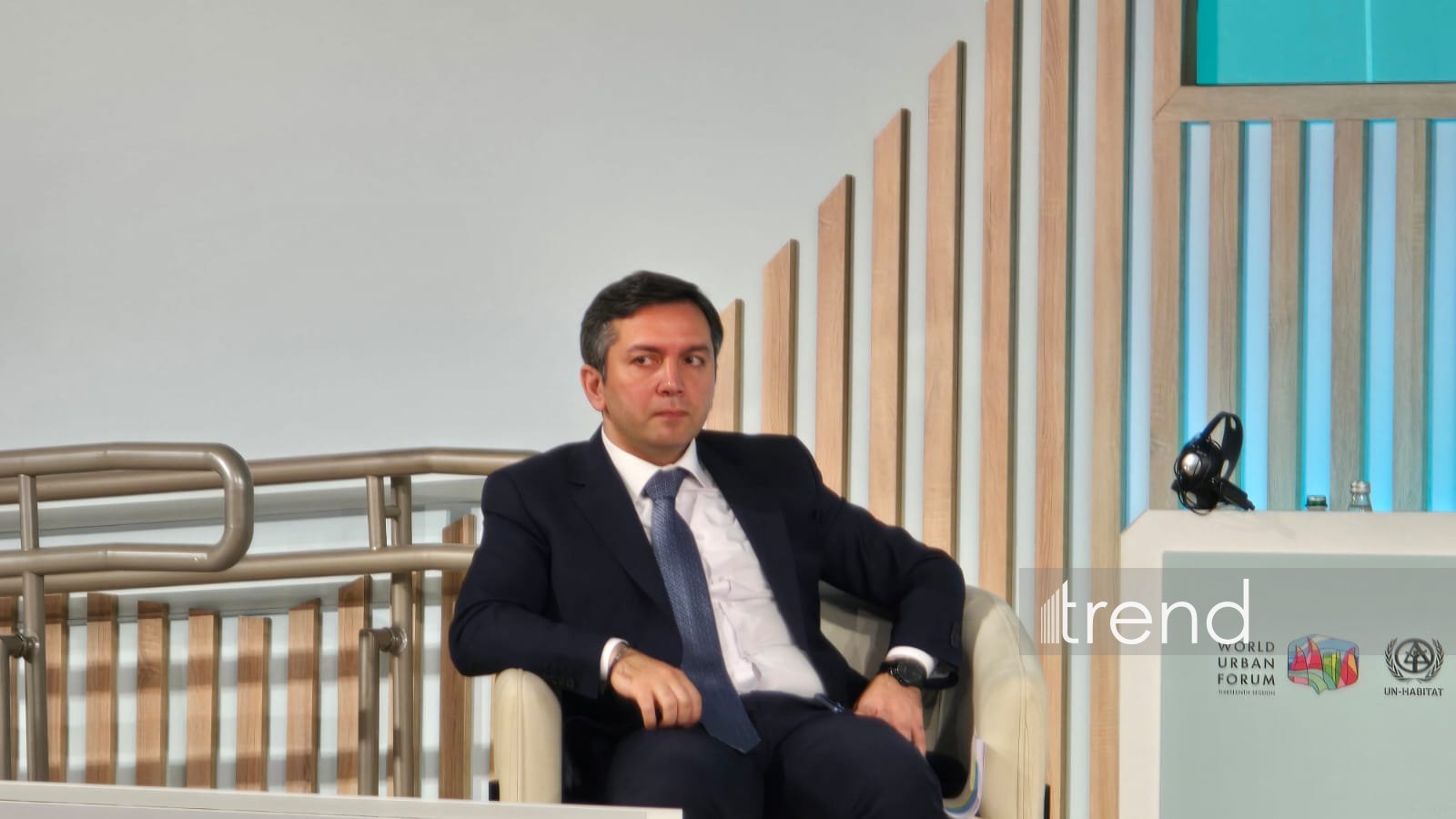
BAKU, Azerbaijan, May 21. Following the resolution of the conflict, Azerbaijan has directed approximately $15 billion toward its comprehensive regional reconstruction program, allocating roughly 25% of its national state budget annually to these strategic tasks, Yalchin Rafiyev, Deputy Minister of Foreign Affairs of Azerbaijan, said, Trend reports.
He made the remark during a session titled "Housing at the Centre of Crisis Recovery and Reconstruction" held within the framework of the 13th session of the World Urban Forum (WUF13) in Baku.
According to him, the severe concentration of landmines and unexploded ordnance (UXO) across conflict-affected zones continues to act as a major structural barrier preventing the initiation of recovery and physical rehabilitation workflows in multiple countries.
The deputy minister noted that for Azerbaijan, mine contamination remains one of the most pressing national challenges, rendering the establishment of a completely secure physical environment a mandatory prerequisite before any core rebuilding processes can commence.
Rafiyev emphasized that an estimated 1.5 million landmines across the liberated territories require systematic clearing to guarantee public safety, a massive operational bottleneck without which large-scale residential and infrastructure development remains impossible to execute.
"We can possess highly favorable financial portfolios and optimal political conditions, but as long as these territories remain heavily contaminated by landmines, executing the broader recovery and reconstruction trajectory to its full extent remains structurally impossible," he pointed out.
According to him, Azerbaijan is successfully pioneering a global model for post-conflict rehabilitation by systematically implementing the international "Building Back Better" paradigm.
"Regional reconstruction must extend far beyond simply restoring past infrastructure configurations; it must target the cultivation of deeply resilient, climate-adaptive ecosystems that fully comply with modern smart urban planning standards," the deputy minister concluded.
Today marks the fifth day of WUF13 in Baku.
The first day included a ministerial meeting dedicated to the New Urban Agenda, a ministerial roundtable, assemblies for women and civil society, business sessions, and discussions on urban prosperity. An official ceremony marking the raising of the UN and Azerbaijani flags also took place.
The second day stood out for the inaugural Leaders' Summit, featuring high-level discussions on the global housing crisis, urbanization policy, and urban resilience. Concurrently, the opening of the Mexico City pavilion took place, serving as a significant platform for expanding cooperation with the Latin American region and preparing for WUF14.
The third day of WUF13 featured a comprehensive program of events covering the global housing crisis, the formation of safe and inclusive cities, climate resilience, artificial intelligence and urban governance, green urbanization, social equity, and sustainable transport.
One of the highlights of the third day was the signing of a sister-city memorandum between the Azerbaijani city of Shusha and the Turkish city of Trabzon.
The fourth day of WUF13 featured a broad program of events dedicated to urbanization, climate change, inclusive urban development, housing policy, and sustainable governance.
One of the important events of the UN Special Programme for the Economies of Central Asia (SPECA) Cities Forum, held on the fourth day, was the announcement of Almaty’s official accession to the “Declaration of Intent on the Establishment of the SPECA Smart Climate-Resilient Cities Forum.”
Also, for the first time in WUF history and at Azerbaijan’s initiative, the “WUF13 NGO Forum: Global Partnership and Decision-Making” was held.
WUF13, which has attracted more than 40,000 registered participants from 182 countries, will continue until May 22. Held under the theme “Housing the world: Safe and resilient cities and communities,” the forum brings together governments, international organizations, experts, and representatives of civil society to strengthen global cooperation in the field of sustainable urban development.



