


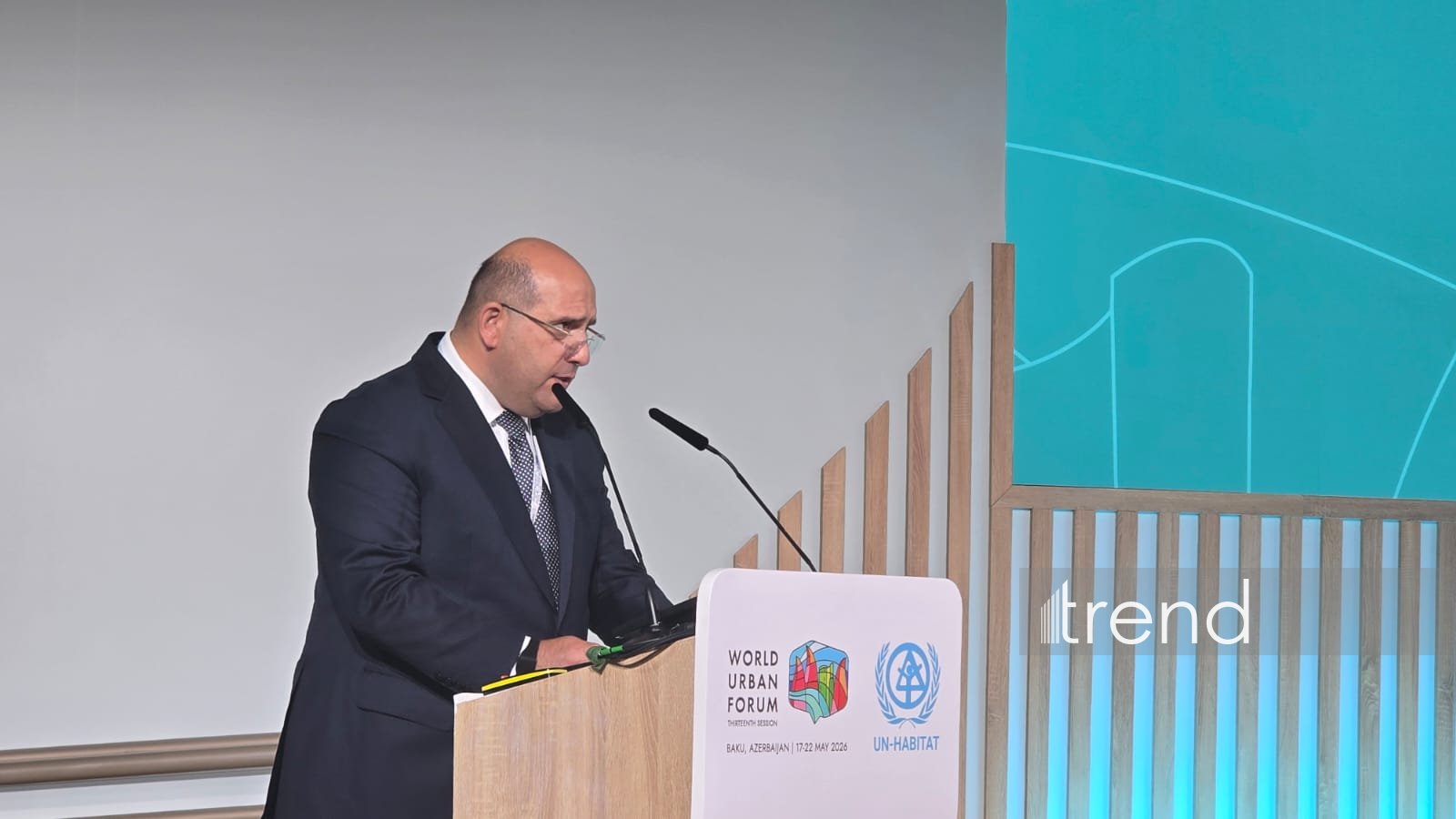

BAKU, Azerbaijan, May 21. Providing housing is one of the top priorities of post-crisis recovery and reconstruction efforts, Special Representative of the President of the Republic of Azerbaijan in the Aghdam, Fuzuli, and Khojavend regions, Emin Huseynov said, Trend reports.
He made the statement on session themed “Housing at the Centre of Crisis Recovery and Reconstruction,” held as part of WUF13.
Huseynov noted that this topic is of particular importance for Azerbaijan:
“For nearly thirty years, internally displaced persons have lived in the hope that one day they will return to their homes and communities. Cities and villages in the liberated territories have been completely destroyed. In some regions, the scale of destruction was so great that it resulted in a devastated urban environment and a collapsed housing system.”
According to him, reconstruction is not limited to rebuilding structures:
“For nearly thirty years, internally displaced persons have lived in the hope that one day they will return to their homes and communities. Towns and villages in the liberated territories have been completely destroyed. In some regions, the scale of the destruction was so great that it resulted in a devastated urban environment and a collapsed housing system.”
According to him, reconstruction is not limited to rebuilding structures:
“The reconstruction process begins when people can once again envision their future in their homeland, when they regain a sense of belonging. Today, Azerbaijan is implementing one of the largest reconstruction and return programs in the region.”
The Special Representative emphasized that significant financial resources have already been allocated for reconstruction and rehabilitation:
“In the Aghdam, Fuzuli, and Khojavend regions, which I represent, towns and villages are being rebuilt according to a long-term strategy based on the principles of sustainability, inclusivity, and resilience. Our approach is based on one key principle—housing must come first. Because housing gives people dignity, stability, and confidence in the future,” he added.
Huseynov said that when families return to safe homes, schools reopen, the local economy recovers, social ties are restored, and communities look to the future with greater confidence. According to him, a significant number of former internally displaced persons have already returned to restored settlements, and more people are expected to return in the coming years: “New residential neighborhoods, schools, medical facilities, and other public services are being established. All of this is an integral part of large-scale efforts aimed at restoring normal life.”
The Special Representative added that the reconstruction process must not repeat the mistakes of the past:
“We need to build better, smarter, and more sustainable urban systems. That is why Azerbaijan is integrating modern approaches to urban planning, green energy solutions, digital governance, and elements of sustainable infrastructure into the reconstruction process” .
He noted that, as part of the “Smart City” and “Smart Village” concepts, technologically advanced and sustainable living spaces are being created in the Aghdam, Fuzuli, and Khojavend regions: “The villages of Bashkend and Tugh are leading examples in this regard. The implemented projects combine renewable energy solutions, high-speed fiber-optic internet infrastructure based on GPON technology, modern social facilities, and environmentally responsible approaches to urban planning.”
According to him, hybrid energy systems based on solar power and the national grid, as well as two-way electricity meters, are being introduced in Azerbaijan for the first time.
“In addition, safer and more energy-efficient centralized heating systems are being installed to replace hundreds of individual boiler rooms. Residents can adjust their heating themselves and pay only for what they actually use. This significantly reduces energy losses and carbon dioxide emissions,” Huseynov emphasized.
Today marks the fifth day of WUF13 in Baku.
The first day included a ministerial meeting dedicated to the New Urban Agenda, a ministerial roundtable, assemblies for women and civil society, business sessions, and discussions on urban prosperity. An official ceremony marking the raising of the UN and Azerbaijani flags also took place.
The second day stood out for the inaugural Leaders' Summit, featuring high-level discussions on the global housing crisis, urbanization policy, and urban resilience. Concurrently, the opening of the Mexico City pavilion took place, serving as a significant platform for expanding cooperation with the Latin American region and preparing for WUF14.
The third day of WUF13 featured a comprehensive program of events covering the global housing crisis, the formation of safe and inclusive cities, climate resilience, artificial intelligence and urban governance, green urbanization, social equity, and sustainable transport.
One of the highlights of the third day was the signing of a sister-city memorandum between the Azerbaijani city of Shusha and the Turkish city of Trabzon.
The fourth day of WUF13 featured a broad program of events dedicated to urbanization, climate change, inclusive urban development, housing policy, and sustainable governance.
One of the important events of the UN Special Program for the Economies of Central Asia (SPECA) Cities Forum, held on the fourth day, was the announcement of Almaty’s official accession to the “Declaration of Intent on the Establishment of the SPECA Smart Climate-Resilient Cities Forum.”
Also, for the first time in WUF history and at Azerbaijan’s initiative, the “WUF13 NGO Forum: Global Partnership and Decision-Making” was held.
WUF13, which has attracted more than 40,000 registered participants from 182 countries, will continue until May 22. Held under the theme “Housing the world: Safe and resilient cities and communities,” the forum brings together governments, international organizations, experts, and representatives of civil society to strengthen global cooperation in the field of sustainable urban development.



