


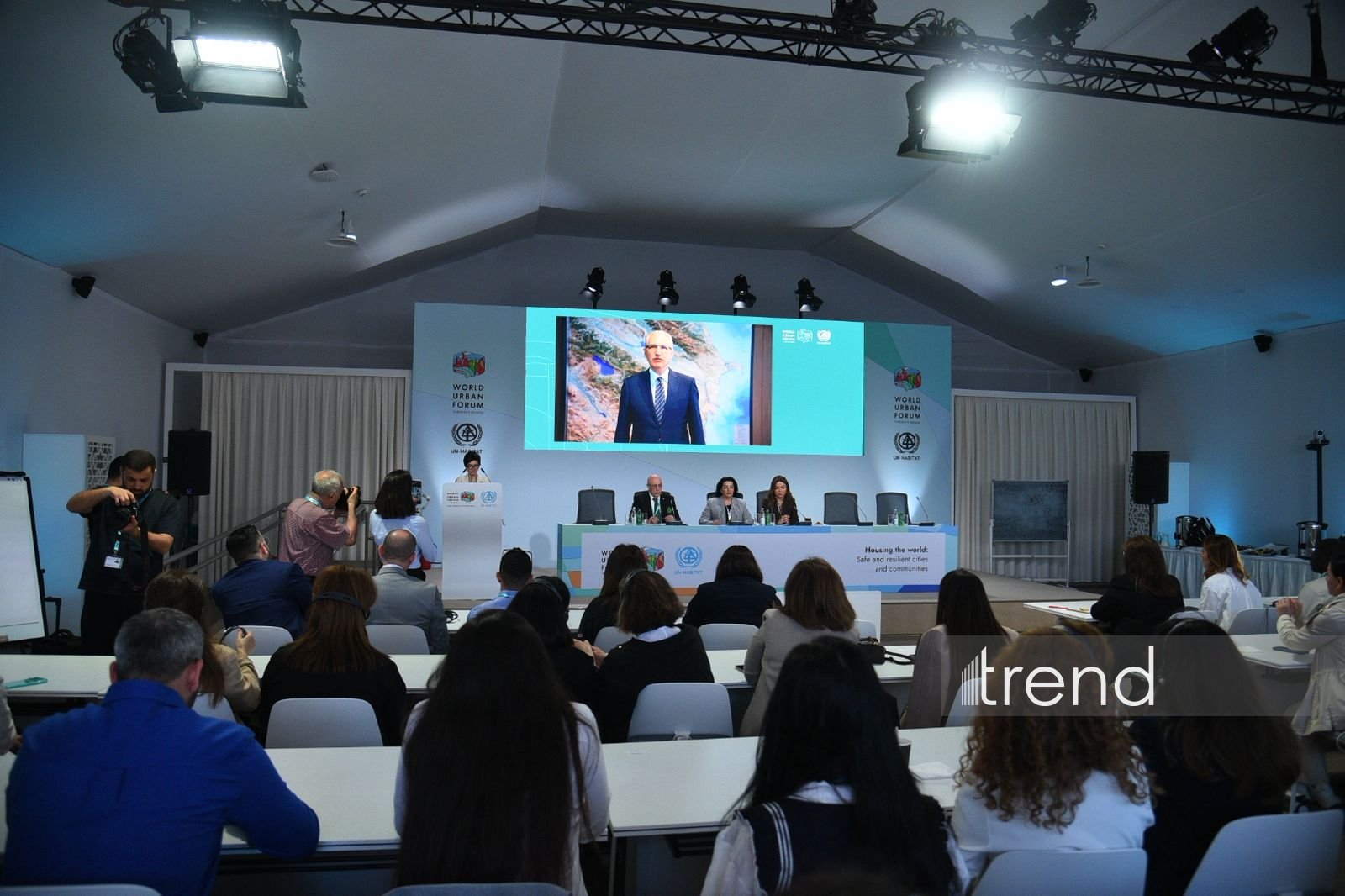
BAKU, Azerbaijan, May 21. The development of Azerbaijan's inaugural national sustainability standard represents a highly critical milestone in translating high-level climate strategies into actionable operations, Mukhtar Babayev, Representative of the President of the Republic of Azerbaijan on Climate Issues, said, Trend reports.
Babayev made the remark in a video address delivered during a panel discussion titled "Developing Azerbaijan’s First National Sustainability Standard: The Sustainable Practices Standard (SPS)" held within the framework of the 13th session of the World Urban Forum (WUF13) in Baku.
Furthermore, Babayev noted that Azerbaijan attaches particular strategic importance to sustainable urban development, environmental accountability, and climate resilience paradigms.
He emphasized that drafting the country's first national sustainability standard reflects a clear institutional understanding that sustainable development must look beyond abstract strategies and political declarations. Instead, he noted, these principles must undergo deep integration into spatial planning, infrastructure project management, and everyday institutional workflows.
"Today, rapidly expanding cities sit directly at the epicenter of both climate vulnerabilities and climate solutions," the presidential envoy pointed out.
According to Babayev, the implementation of sustainable practices helps transform sustainable development from a conceptual theory into measurable, localized actions. Furthermore, he noted that this standardized regulatory architecture drives corporate and public accountability, strengthens institutional capacity, and maximizes resource-use efficiency across both public and private sectors.
In addition, the presidential representative stated that hosting the COP29 climate summit in Baku permanently reinforced Azerbaijan's long-term commitment to practical climate actions and multilateral international cooperation.
"The high-level negotiations and agreements achieved within the framework of COP29 systematically underscored the growing global necessity of deploying practical mitigation measures, scaling climate finance mechanisms, and executing a deeper integration of sustainability frameworks into state policy", Babayev concluded.
Today marks the fifth day of WUF13 in Baku.
The first day included a ministerial meeting dedicated to the New Urban Agenda, a ministerial roundtable, assemblies for women and civil society, business sessions, and discussions on urban prosperity. An official ceremony marking the raising of the UN and Azerbaijani flags also took place.
The second day stood out for the inaugural Leaders' Summit, featuring high-level discussions on the global housing crisis, urbanization policy, and urban resilience. Concurrently, the opening of the Mexico City pavilion took place, serving as a significant platform for expanding cooperation with the Latin American region and preparing for WUF14.
The third day of WUF13 featured a comprehensive program of events covering the global housing crisis, the formation of safe and inclusive cities, climate resilience, artificial intelligence and urban governance, green urbanization, social equity, and sustainable transport.
One of the highlights of the third day was the signing of a sister-city memorandum between the Azerbaijani city of Shusha and the Turkish city of Trabzon.
The fourth day of WUF13 featured a broad program of events dedicated to urbanization, climate change, inclusive urban development, housing policy, and sustainable governance.
One of the important events of the UN Special Program for the Economies of Central Asia (SPECA) Cities Forum, held on the fourth day, was the announcement of Almaty’s official accession to the “Declaration of Intent on the Establishment of the SPECA Smart Climate-Resilient Cities Forum.”
Also, for the first time in WUF history and at Azerbaijan’s initiative, the “WUF13 NGO Forum: Global Partnership and Decision-Making” was held.
WUF13, which has attracted more than 40,000 registered participants from 182 countries, will continue until May 22. Held under the theme “Housing the world: Safe and resilient cities and communities,” the forum brings together governments, international organizations, experts, and representatives of civil society to strengthen global cooperation in the field of sustainable urban development.



