


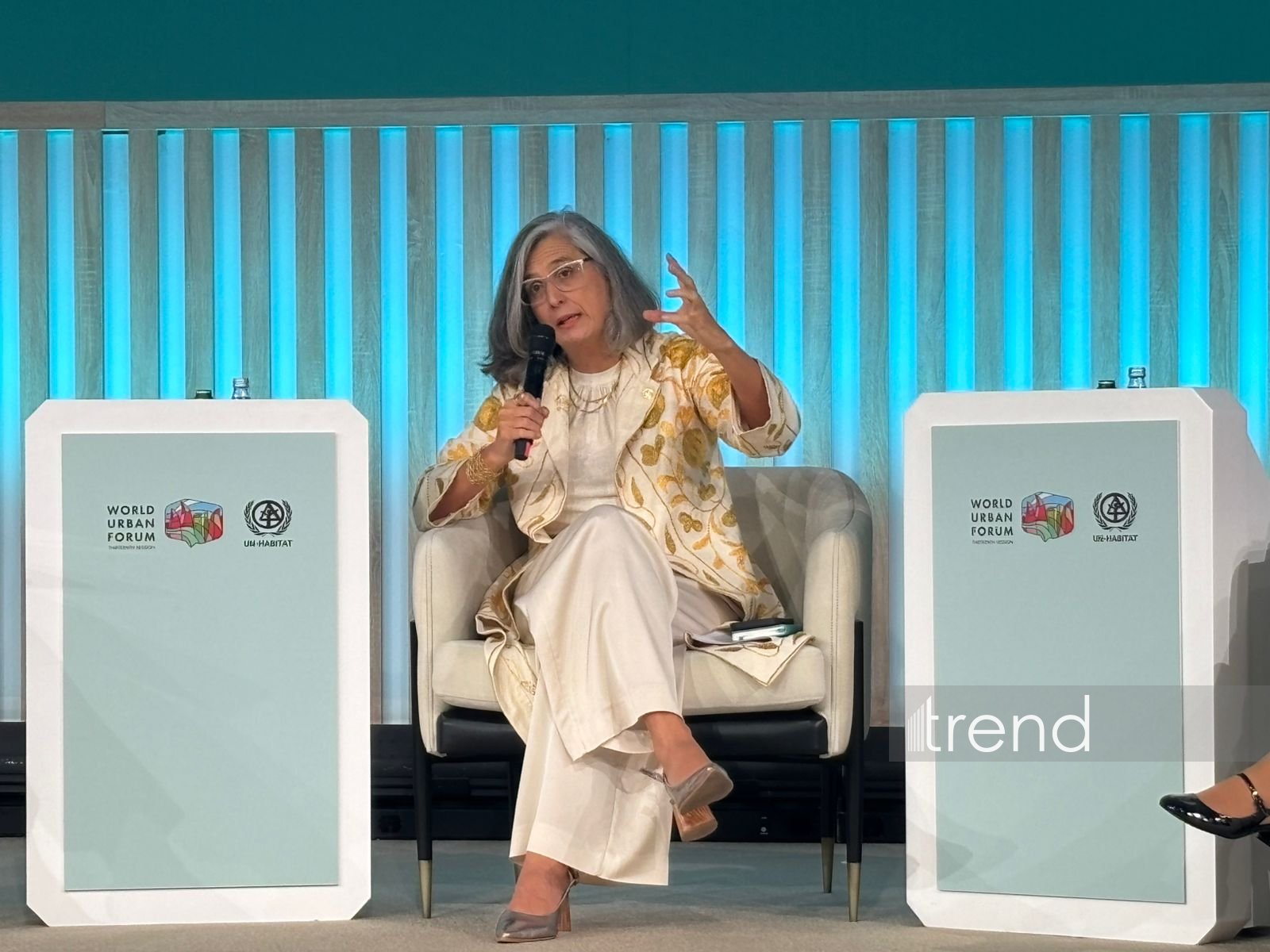

BAKU, Azerbaijan, May 21. No nation has successfully resolved its housing challenges over the long-term relying exclusively on international capital, rendering the establishment of sustainable domestic financial mechanisms absolutely critical, Anacláudia Rossbach, Executive Director of the United Nations Human Settlements Program (UN-Habitat), said, Trend reports.
She made the remarks during a session titled "A New Deal for Housing Finance" held within the framework of the 13th session of the World Urban Forum (WUF13) in Baku.
According to her, one of the core procedural challenges centers on defining exactly what type of housing qualifies for funding and determining the strategic modalities through which governments intend to mitigate the global housing crisis.
"We must reach a consensus with society regarding how the housing crisis undergoes resolution: whether the focus points toward the eradication of informal settlements, the construction of entirely new housing stock, and what specific standards this housing must fulfill," Rossbach pointed out.
She noted that foundational approaches to urban development exert a direct, measurable influence on overall real estate valuation.
"It remains vital to evaluate whether we generate uncontrolled urban sprawl or adhere strictly to the principles of the New Urban Agenda, balanced development density, and more compact municipal layouts. These structural choices reflect directly upon aggregate infrastructure costs," the UN-Habitat Executive Director emphasized.
Land, she noted, persists as the most capital-intensive component within the housing supply chain, particularly across central metropolitan districts. Rossbach underscored the necessity of engineering efficient spatial planning instruments and land policies capable of reserving specific land parcels for construction, repurposing underutilized zones, and executing urban renovation initiatives.
"If a state retains public land assets in its portfolio, half of the operational challenge is effectively solved, given that the land input enters the development equation at zero cost," she said.
The head of UN-Habitat further stressed that successful historical precedents of solving large-scale housing deficits across diverse geographies anchored themselves primarily to domestic funding streams. She cited China, European nations, Uruguay, Brazil, Colombia, Mexico, Chile, and India as prime operational examples.
"These countries successfully deployed domestic financing mechanisms, such as state-backed savings accounts, cooperative accumulations, and worker-retention funds combined with targeted tax frameworks," Rossbach noted.
According to her, international financing can serve as a viable catalyst or seed capital, but long-term sustainability materializes only through constructing resilient national housing finance frameworks.
"We can certainly leverage initial external financing to trigger the process, but the ultimate goal must center on building sustainable national systems for housing finance," the UN-Habitat chief concluded.
Today marks the fifth day of WUF13 in Baku.
The first day included a ministerial meeting dedicated to the New Urban Agenda, a ministerial roundtable, assemblies for women and civil society, business sessions, and discussions on urban prosperity. An official ceremony marking the raising of the UN and Azerbaijani flags also took place.
The second day stood out for the inaugural Leaders' Summit, featuring high-level discussions on the global housing crisis, urbanization policy, and urban resilience. Concurrently, the opening of the Mexico City pavilion took place, serving as a significant platform for expanding cooperation with the Latin American region and preparing for WUF14.
The third day of WUF13 featured a comprehensive program of events covering the global housing crisis, the formation of safe and inclusive cities, climate resilience, artificial intelligence and urban governance, green urbanization, social equity, and sustainable transport.
One of the highlights of the third day was the signing of a sister-city memorandum between the Azerbaijani city of Shusha and the Turkish city of Trabzon.
The fourth day of WUF13 featured a broad program of events dedicated to urbanization, climate change, inclusive urban development, housing policy, and sustainable governance.
One of the important events of the UN Special Programme for the Economies of Central Asia (SPECA) Cities Forum, held on the fourth day, was the announcement of Almaty’s official accession to the “Declaration of Intent on the Establishment of the SPECA Smart Climate-Resilient Cities Forum.”
Also, for the first time in WUF history and at Azerbaijan’s initiative, the “WUF13 NGO Forum: Global Partnership and Decision-Making” was held.
WUF13, which has attracted more than 40,000 registered participants from 182 countries, will continue until May 22. Held under the theme “Housing the world: Safe and resilient cities and communities,” the forum brings together governments, international organizations, experts, and representatives of civil society to strengthen global cooperation in the field of sustainable urban development.



