


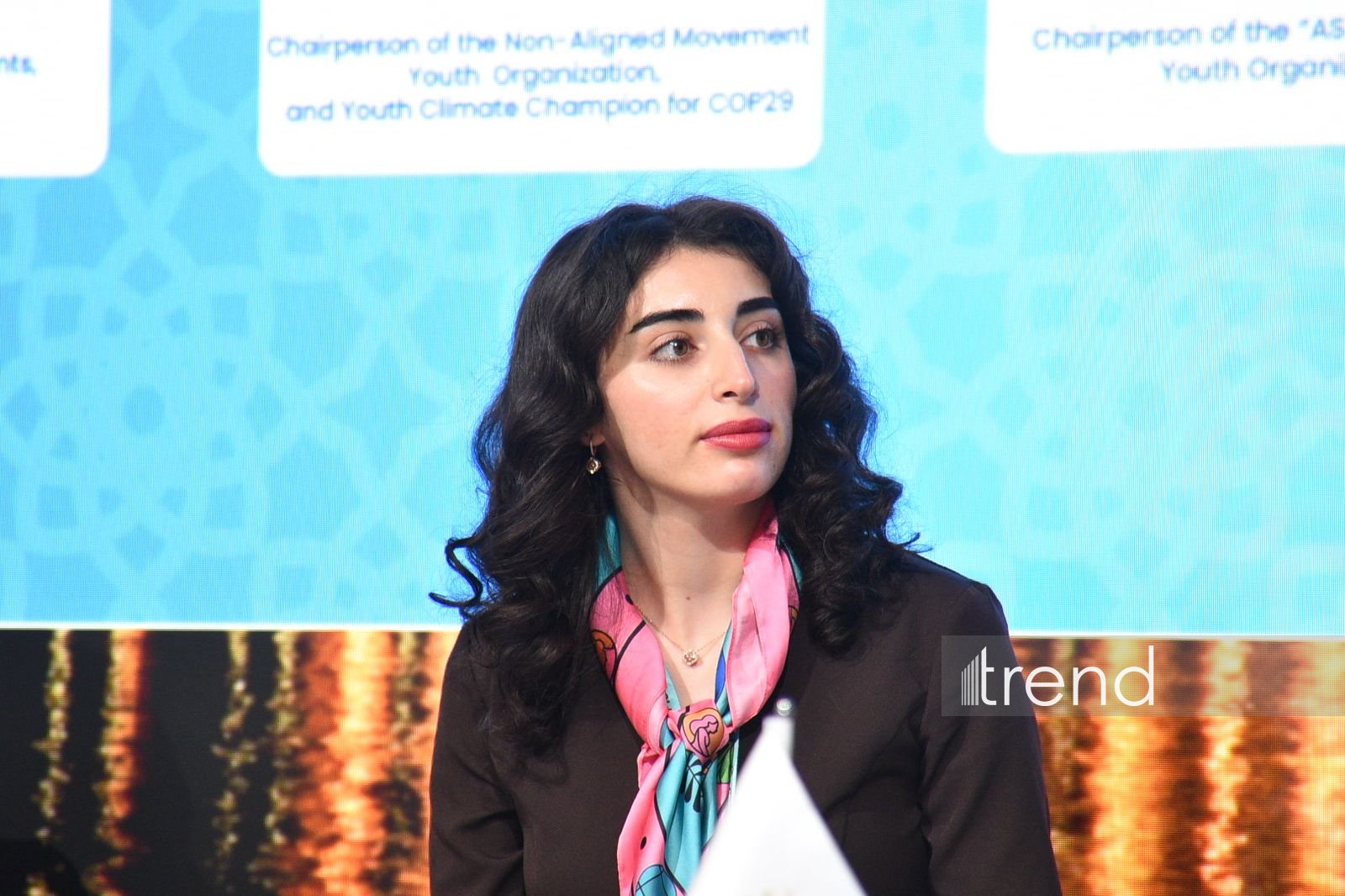

BAKU, Azerbaijan, May 21. Young people must be involved in urban planning from the very beginning, Chief Adviser at UN-Habitat Maleyka Taghizada said, Trend reports.
She made the announcement during an event on “Youth and Civil Society Leadership in Advancing Sustainable and Inclusive Cities” as part of WUF13.
According to her, cities are often designed without the participation of residents themselves, so communities, especially youth and civil society—must be involved in this process from the very beginning as co-authors of urban solutions, not merely as recipients of ready-made initiatives.
"One of the most effective ways to strengthen this cooperation is to make participation real, not just symbolic. What often happens now is this: people are invited and motivated with phrases like ‘you are leaders, you are the future of our cities,’ but in the end, they simply come, listen, leave the auditorium, and that’s where it ends. We need a well-established system in which young people truly feel that they are actively involved in decision-making. We need to create long-term mechanisms where youth organizations, NGOs, civil society, and academic circles can jointly identify problems, seek solutions, and determine who should participate in these processes,” she said.
Taghizada noted that in Azerbaijan, as part of the Azerbaijan Urban Campaign, this approach has been implemented since last October.
"And I can say that it is truly working well. From the very beginning, we invited not only government agencies working with youth — not just the Ministry of Youth and Sports or the Youth Fund — but also youth clubs, NGOs, civil society organizations, and international organizations that work closely with youth. Thanks to this, the views of all parties are heard in the discussions," she said.
Today marks the fifth day of WUF13 in Baku.
The first day included a ministerial meeting dedicated to the New Urban Agenda, a ministerial roundtable, assemblies for women and civil society, business sessions, and discussions on urban prosperity. An official ceremony marking the raising of the UN and Azerbaijani flags also took place.
The second day stood out for the inaugural Leaders' Summit, featuring high-level discussions on the global housing crisis, urbanization policy, and urban resilience. Concurrently, the opening of the Mexico City pavilion took place, serving as a significant platform for expanding cooperation with the Latin American region and preparing for WUF14.
The third day of WUF13 featured a comprehensive program of events covering the global housing crisis, the formation of safe and inclusive cities, climate resilience, artificial intelligence and urban governance, green urbanization, social equity, and sustainable transport.
One of the highlights of the third day was the signing of a sister-city memorandum between the Azerbaijani city of Shusha and the Turkish city of Trabzon.
The fourth day of WUF13 featured a broad program of events dedicated to urbanization, climate change, inclusive urban development, housing policy, and sustainable governance.
One of the important events of the UN Special Program for the Economies of Central Asia (SPECA) Cities Forum, held on the fourth day, was the announcement of Almaty’s official accession to the “Declaration of Intent on the Establishment of the SPECA Smart Climate-Resilient Cities Forum.”
Also, for the first time in WUF history and at Azerbaijan’s initiative, the “WUF13 NGO Forum: Global Partnership and Decision-Making” was held.
WUF13, which has attracted more than 40,000 registered participants from 182 countries, will continue until May 22. Held under the theme “Housing the world: Safe and resilient cities and communities,” the forum brings together governments, international organizations, experts, and representatives of civil society to strengthen global cooperation in the field of sustainable urban development.



