


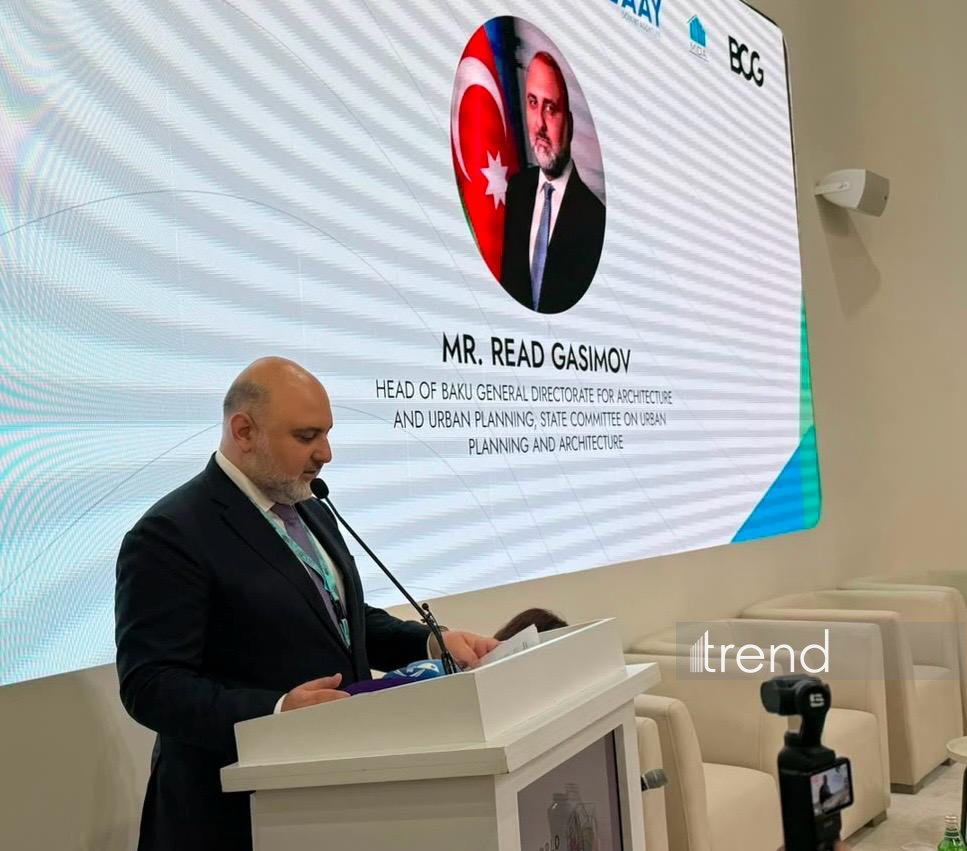
BAKU, Azerbaijan, May 21. The Baku City Master Plan 2040 functions as a highly systematic, long-term strategic planning framework engineered to consistently guide the structural transformation and spatial evolution of the capital, Riad Gasimov, Head of the Baku Main Department for Architecture and Urban Planning, said, Trend reports.
He made the remark during a specialized event dedicated to the capital’s master plan, held within the framework of the 13th session of the World Urban Forum (WUF13) in Baku.
According to him, the comprehensive planning document moves past evaluating Baku as a merely expanding metropolis, envisioning it instead as a significantly greener, more inclusive, highly resilient, and macroeconomically competitive global city.
Gasimov reported that a primary tier of the regulatory document targets the substantial elevation of the baseline quality of life for all metropolitan residents.
"The ultimate success of a modern city cannot undergo measurement simply through the height of its commercial skyscrapers or the sheer scale of its concrete infrastructure pipelines. True urban success remains strictly defined by how comfortable, safe, healthy, and accessible daily civic life is for the population," the department head pointed out.
"Consequently, the Master Plan directs targeted capital and structural attention toward the aggressive expansion of public parks, optimized open municipal spaces, pedestrian-friendly transit environments, foundational social infrastructure, and localized urban services. Scaling the Central Park network, engineering entirely new coastal public waterfront zones, developing recreational belts, executing targeted urban renewal initiatives, and modernizing neighborhood-level utility fabrics collectively serve to anchor a far more livable metropolitan model for Baku," Gasimov explained.
The planning chief concurrently emphasized that another non-negotiable directive within the strategic blueprint focuses on the rigorous preservation of Baku’s historical and cultural architecture.
"Baku's unique architectural legacy and rich cultural identity must remain completely protected throughout every phase of metropolitan expansion. Our core executive objective relies on maintaining a flawless, calculated equilibrium between modern smart urbanism workflows and the strict conservation of our historical urban fabric," Gasimov concluded.
Today marks the fifth day of WUF13 in Baku.
The first day included a ministerial meeting dedicated to the New Urban Agenda, a ministerial roundtable, assemblies for women and civil society, business sessions, and discussions on urban prosperity. An official ceremony marking the raising of the UN and Azerbaijani flags also took place.
The second day stood out for the inaugural Leaders' Summit, featuring high-level discussions on the global housing crisis, urbanization policy, and urban resilience. Concurrently, the opening of the Mexico City pavilion took place, serving as a significant platform for expanding cooperation with the Latin American region and preparing for WUF14.
The third day of WUF13 featured a comprehensive program of events covering the global housing crisis, the formation of safe and inclusive cities, climate resilience, artificial intelligence and urban governance, green urbanization, social equity, and sustainable transport.
One of the highlights of the third day was the signing of a sister-city memorandum between the Azerbaijani city of Shusha and the Turkish city of Trabzon.
The fourth day of WUF13 featured a broad program of events dedicated to urbanization, climate change, inclusive urban development, housing policy, and sustainable governance.
One of the important events of the UN Special Programme for the Economies of Central Asia (SPECA) Cities Forum, held on the fourth day, was the announcement of Almaty’s official accession to the “Declaration of Intent on the Establishment of the SPECA Smart Climate-Resilient Cities Forum.”
Also, for the first time in WUF history and at Azerbaijan’s initiative, the “WUF13 NGO Forum: Global Partnership and Decision-Making” was held.
WUF13, which has attracted more than 40,000 registered participants from 182 countries, will continue until May 22. Held under the theme “Housing the world: Safe and resilient cities and communities,” the forum brings together governments, international organizations, experts, and representatives of civil society to strengthen global cooperation in the field of sustainable urban development.



