


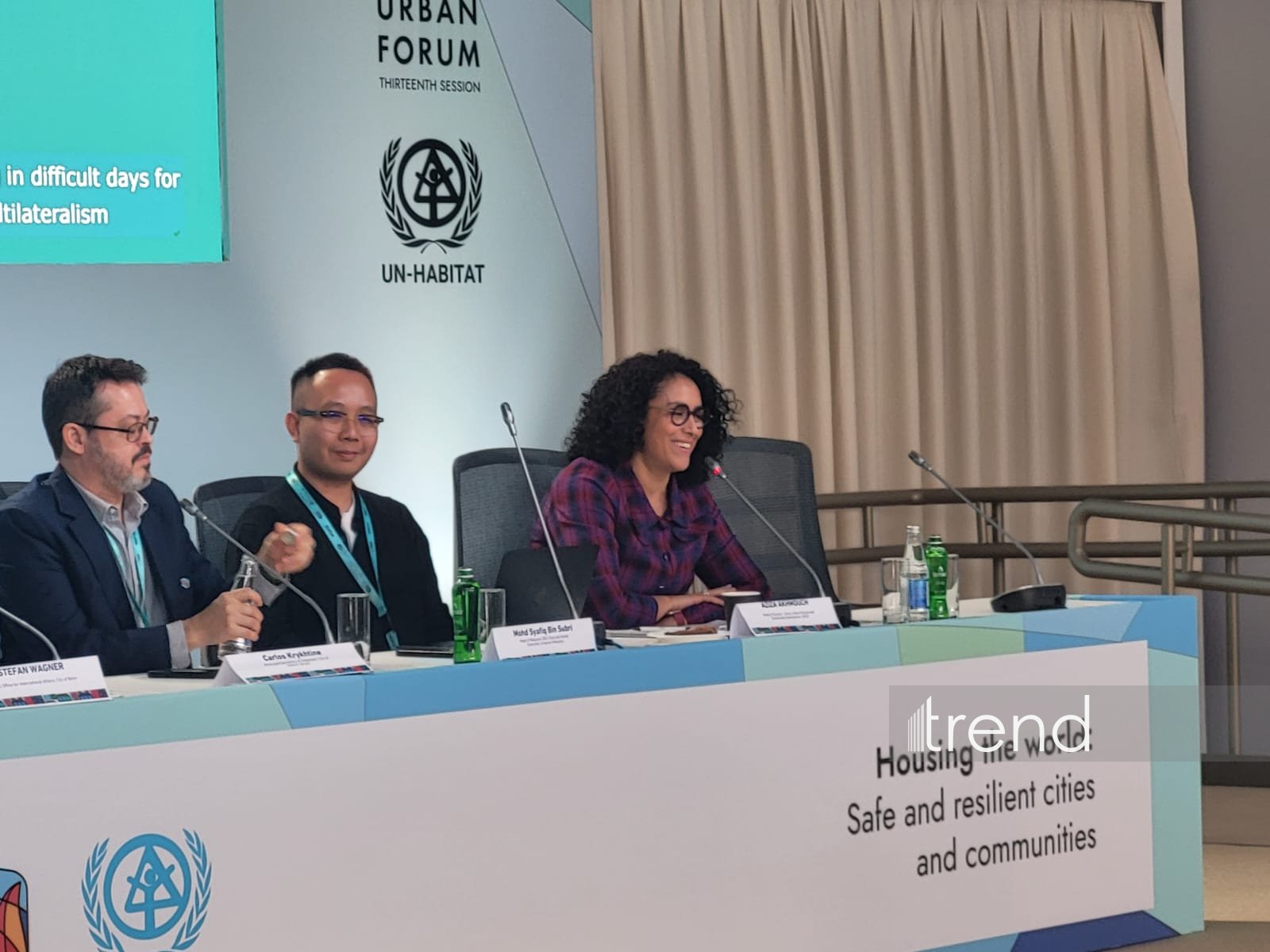

BAKU, Azerbaijan, May 21. Housing policy should be viewed as a key element of sustainable urban development and social resilience, Aziza Akhmush, head of division at the Organization for Economic Cooperation and Development (OECD), made the remarks during an event titled “Does the Housing Construction of the Future Meet Today’s Sustainable Development Goals? How Localization Strategies Help Us Get Back on Track,” held within the framework of WUF13, Trend reports.
According to her, the OECD has been working with member states for nearly two decades to improve housing policy and promote the localization of the Sustainable Development Goals (SDGs).
Akhmush stressed that the effective implementation of housing policy requires a so-called “territorial approach,” under which decisions are made based on local characteristics, population needs, and the involvement of regional and municipal authorities.
“Cities today not only implement decisions but also shape the market. Through urban zoning, land policy, and infrastructure planning, they determine housing affordability and the level of social inclusion,” she said.
The OECD representative noted that housing issues are directly linked to the economy, environment, healthcare, education, and social stability. According to her, fewer than 20% of cities currently meet SDG 11 targets related to sustainable cities and communities, while housing costs have risen significantly in many countries.
Akhmush said the issue is not only the quantity of housing being built, but also its quality, affordability, and suitability for the population’s needs.
“It is not enough to simply build more housing. It is important to understand what is being built, where it is being built, and for whom,” she stressed.
She cited examples from France and Sweden, where housing modernization programs and the integration of transport and social infrastructure have helped improve quality of life and reduce emissions.
According to Akhmush, climate risks and demographic changes are becoming increasingly important under current conditions.
She noted that around 40% of energy-related CO2 emissions are linked to buildings, with the figure reaching as high as 70% in some megacities.
“It is impossible to achieve climate neutrality without developing a low-carbon housing sector,” the OECD representative said.
Akhmush also highlighted the need to adapt urban policy to aging populations, changing household structures, and population growth or decline in different cities.
In conclusion, she emphasized the importance of national urban strategies developed jointly with local authorities, international organizations, and the private sector.
In the mean time, today marks the fifth day of WUF13 in Baku.
The first day included a ministerial meeting dedicated to the New Urban Agenda, a ministerial roundtable, assemblies for women and civil society, business sessions, and discussions on urban prosperity. An official ceremony marking the raising of the UN and Azerbaijani flags also took place.
The second day stood out for the inaugural Leaders' Summit, featuring high-level discussions on the global housing crisis, urbanization policy, and urban resilience. Concurrently, the opening of the Mexico City pavilion took place, serving as a significant platform for expanding cooperation with the Latin American region and preparing for WUF14.
The third day of WUF13 featured a comprehensive program of events covering the global housing crisis, the formation of safe and inclusive cities, climate resilience, artificial intelligence and urban governance, green urbanization, social equity, and sustainable transport.
One of the highlights of the third day was the signing of a sister-city memorandum between the Azerbaijani city of Shusha and the Turkish city of Trabzon.
The fourth day of WUF13 featured a broad program of events dedicated to urbanization, climate change, inclusive urban development, housing policy, and sustainable governance.
One of the important events of the UN Special Programme for the Economies of Central Asia (SPECA) Cities Forum, held on the fourth day, was the announcement of Almaty’s official accession to the “Declaration of Intent on the Establishment of the SPECA Smart Climate-Resilient Cities Forum.”
Also, for the first time in WUF history and at Azerbaijan’s initiative, the “WUF13 NGO Forum: Global Partnership and Decision-Making” was held.
WUF13, which has attracted more than 40,000 registered participants from 182 countries, will continue until May 22. Held under the theme “Housing the world: Safe and resilient cities and communities,” the forum brings together governments, international organizations, experts, and representatives of civil society to strengthen global cooperation in the field of sustainable urban development.



