


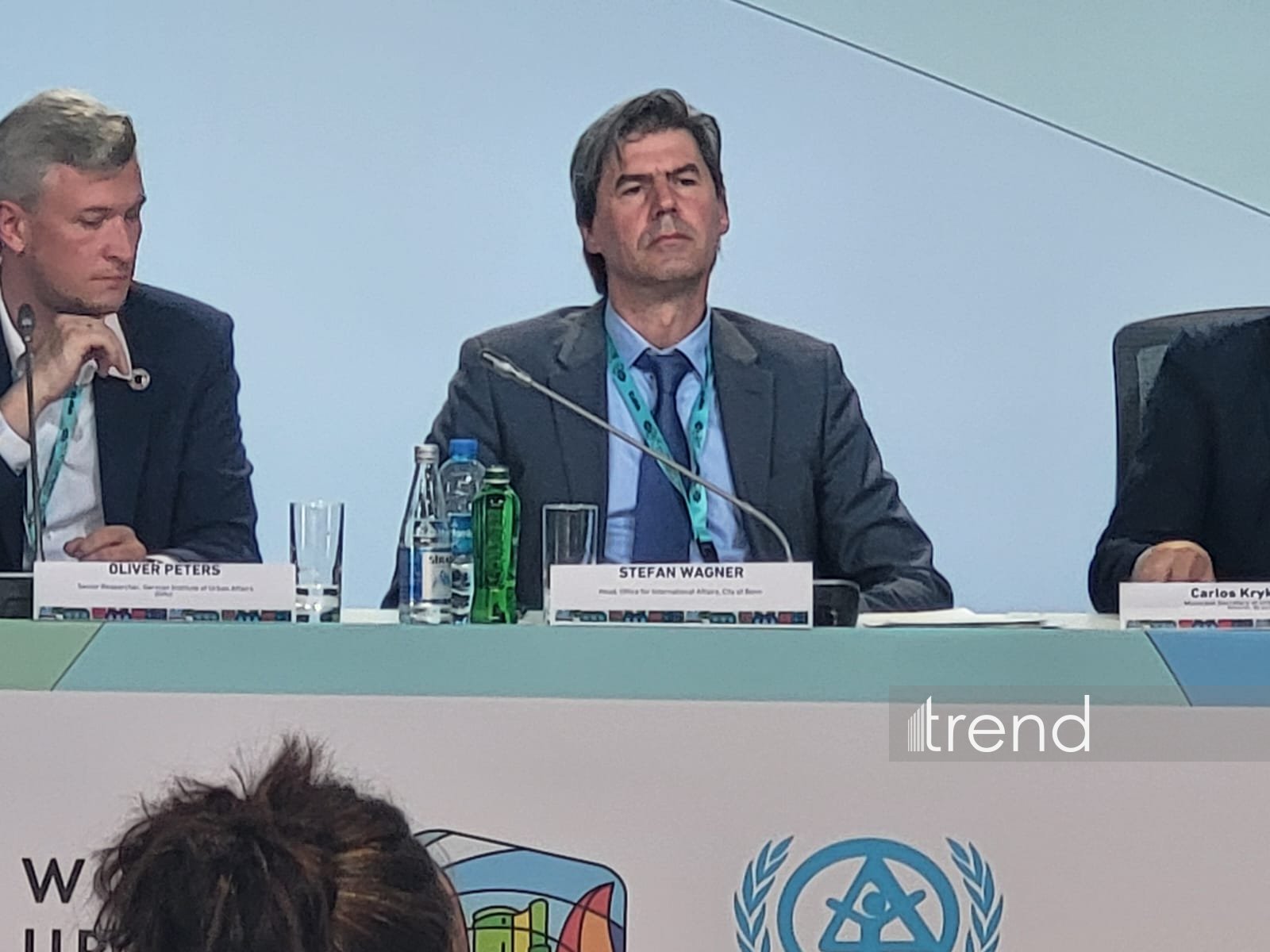

BAKU, Azerbaijan, May 21. Housing policy plays an indispensable role in securing the United Nations Sustainable Development Goals (SDGs), while rapid population growth and a widening affordable housing deficit present an increasingly severe challenge for modern municipalities, said Stefan Wagner, representative of the city of Bonn (Germany), Trend reports.
He made the remarks on Thursday during a specialized session titled "Does Future Housing Align with Today's SDGs? How Localization Strategies Help Us Get Back on Track," held within the framework of the 13th session of the World Urban Forum (WUF13) in Baku.
According to him, the population of Bonn has expanded by nearly 16 percent over the past three decades, dramatically intensifying commercial pressures on the local real estate market, particularly for highly vulnerable socioeconomic demographics, including students, elderly citizens, single parents, and persons with disabilities.
Wagner noted that a substantial segment of urban residents already allocates more than one-third of their aggregate household income strictly toward housing costs, while the volume of citizens unable to afford baseline rents continues to climb. He emphasized that housing accessibility has crystallized into one of the central social pillars of contemporary metropolitan policymaking, not only within Germany but across the vast majority of European cities.
The Bonn representative concurrently directed sharp analytical focus toward the intersecting macroeconomic and environmental dimensions of the crisis. He pointed out that highly constrained urban land parcels, surging construction material prices, and a marked decline in the volume of new affordable housing project pipelines collectively complicate conditions across the real estate sector. Furthermore, Wagner reported that the building and residential housing sector accounts for approximately 35 percent of Germany's total carbon dioxide ($CO_2$) emissions, rendering immediate, aggressive interventions to curb energy consumption non-negotiable. This baseline requires scaling distributed renewable energy grids and executing far more rational spatial zoning models across municipal land banks.
He reported that the municipality of Bonn is actively pioneering advanced methodologies for the localization of the Sustainable Development Goals (SDG localization). Specifically, the municipality formally ratified its comprehensive Municipal Sustainable Development Strategy in 2019, followed by the integration of a dedicated, independent tracking module focusing entirely on housing frameworks and resilient neighborhoods within its 2020 and 2022 Voluntary Local Review (VLR) reporting metrics. Concurrently, Wagner announced that the city is currently engineering an interactive, data-driven digital dashboard populated with real-time indicators mapping localized rental indices, the aggregate volume of social housing units, per-capita residential square footage allocations, and proximity to foundational public services.
Today marks the fifth day of WUF13 in Baku.
The first day included a ministerial meeting dedicated to the New Urban Agenda, a ministerial roundtable, assemblies for women and civil society, business sessions, and discussions on urban prosperity. An official ceremony marking the raising of the UN and Azerbaijani flags also took place.
The second day stood out for the inaugural Leaders' Summit, featuring high-level discussions on the global housing crisis, urbanization policy, and urban resilience. Concurrently, the opening of the Mexico City pavilion took place, serving as a significant platform for expanding cooperation with the Latin American region and preparing for WUF14.
The third day of WUF13 featured a comprehensive program of events covering the global housing crisis, the formation of safe and inclusive cities, climate resilience, artificial intelligence and urban governance, green urbanization, social equity, and sustainable transport.
One of the highlights of the third day was the signing of a sister-city memorandum between the Azerbaijani city of Shusha and the Turkish city of Trabzon.
The fourth day of WUF13 featured a broad program of events dedicated to urbanization, climate change, inclusive urban development, housing policy, and sustainable governance.
One of the important events of the UN Special Programme for the Economies of Central Asia (SPECA) Cities Forum, held on the fourth day, was the announcement of Almaty’s official accession to the “Declaration of Intent on the Establishment of the SPECA Smart Climate-Resilient Cities Forum.”
Also, for the first time in WUF history and at Azerbaijan’s initiative, the “WUF13 NGO Forum: Global Partnership and Decision-Making” was held.
WUF13, which has attracted more than 40,000 registered participants from 182 countries, will continue until May 22. Held under the theme “Housing the world: Safe and resilient cities and communities,” the forum brings together governments, international organizations, experts, and representatives of civil society to strengthen global cooperation in the field of sustainable urban development.



