


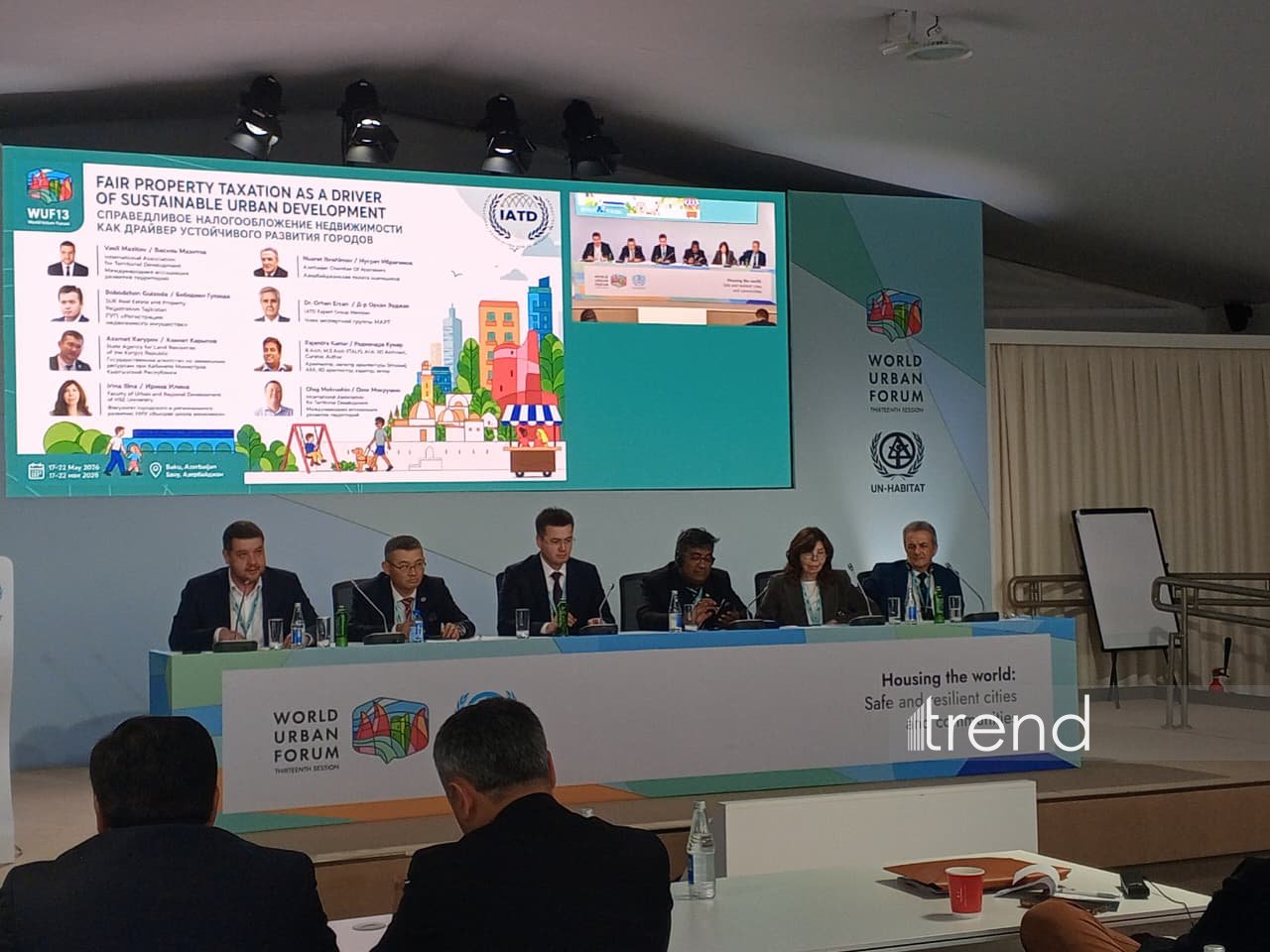
BAKU, Azerbaijan, May 21. Establishing an equitable property tax architecture operates far beyond a simple fiscal revenue tool, serving fundamentally as a structural mechanism to redistribute urban value across society, said Nusret Ibrahimov, Chairman of the Azerbaijan Chamber of Appraisers, Trend reports.
He made the remarks during a panel discussion titled "Fair Property Taxation as a Driver of Sustainable Urban Development," held within the framework of the World Urban Forum (WUF13) in Baku.
According to him, modern international public finance trends demonstrate that channeling a calculated portion of the added value generated within metropolitan zones directly back into the rehabilitation of the municipal environment forms a primary financial pillar of sustainable urbanization.
Ibrahimov noted that the capital appreciation of land parcels and real estate assets occurs not merely through private owner investment, but heavily due to state-backed capital expenditures, public transit grid expansions, utility services, protected green infrastructure zones, and efficient spatial city planning.
"From this structural perspective, property taxes function as a precise instrument to claw back a percentage of this publicly created urban value into the public coffers. It is precisely this methodology that stands out as a baseline component of resilient municipal financing models globally," he pointed out.
The chairman of the Appraisers Chamber concurrently highlighted that within highly developed economies, real estate taxation yields approximately 19% of all local municipal budget revenues, playing a vital role in underwriting daily urban public utilities and services. By contrast, he cited data from the World Bank indicating that developing markets have yet to fully optimize the latent structural potential of property-based tax portfolios.
"In Azerbaijan, the current real estate taxation matrix operates primarily on baseline parameters consisting of an asset's physical surface area and geographical location. While this administrative layout guarantees operational simplicity, it often fails to accurately mirror true real-time market valuations, which naturally introduces structural elements of socioeconomic inequality," Ibrahimov explained.
The chamber head emphasized that following the 44-day war, Azerbaijan is aggressively pioneering advanced "Smart City" and "Smart Village" master-planned ecosystems across the liberated territories, particularly as the nation marks 2026 as the official "Year of Urban Planning and Architecture," he concluded.
Today marks the fifth day of WUF13 in Baku.
The first day included a ministerial meeting dedicated to the New Urban Agenda, a ministerial roundtable, assemblies for women and civil society, business sessions, and discussions on urban prosperity. An official ceremony marking the raising of the UN and Azerbaijani flags also took place.
The second day stood out for the inaugural Leaders' Summit, featuring high-level discussions on the global housing crisis, urbanization policy, and urban resilience. Concurrently, the opening of the Mexico City pavilion took place, serving as a significant platform for expanding cooperation with the Latin American region and preparing for WUF14.
The third day of WUF13 featured a comprehensive program of events covering the global housing crisis, the formation of safe and inclusive cities, climate resilience, artificial intelligence and urban governance, green urbanization, social equity, and sustainable transport.
One of the highlights of the third day was the signing of a sister-city memorandum between the Azerbaijani city of Shusha and the Turkish city of Trabzon.
The fourth day of WUF13 featured a broad program of events dedicated to urbanization, climate change, inclusive urban development, housing policy, and sustainable governance.
One of the important events of the UN Special Programme for the Economies of Central Asia (SPECA) Cities Forum, held on the fourth day, was the announcement of Almaty’s official accession to the “Declaration of Intent on the Establishment of the SPECA Smart Climate-Resilient Cities Forum.”
Also, for the first time in WUF history and at Azerbaijan’s initiative, the “WUF13 NGO Forum: Global Partnership and Decision-Making” was held.
WUF13, which has attracted more than 40,000 registered participants from 182 countries, will continue until May 22. Held under the theme “Housing the world: Safe and resilient cities and communities,” the forum brings together governments, international organizations, experts, and representatives of civil society to strengthen global cooperation in the field of sustainable urban development.



